Before You Buy an AI Detector, Read This
AI detectors can be useful. They can also be wrong. Before trusting a score, it helps to understand what these tools actually do—and what they don’t.
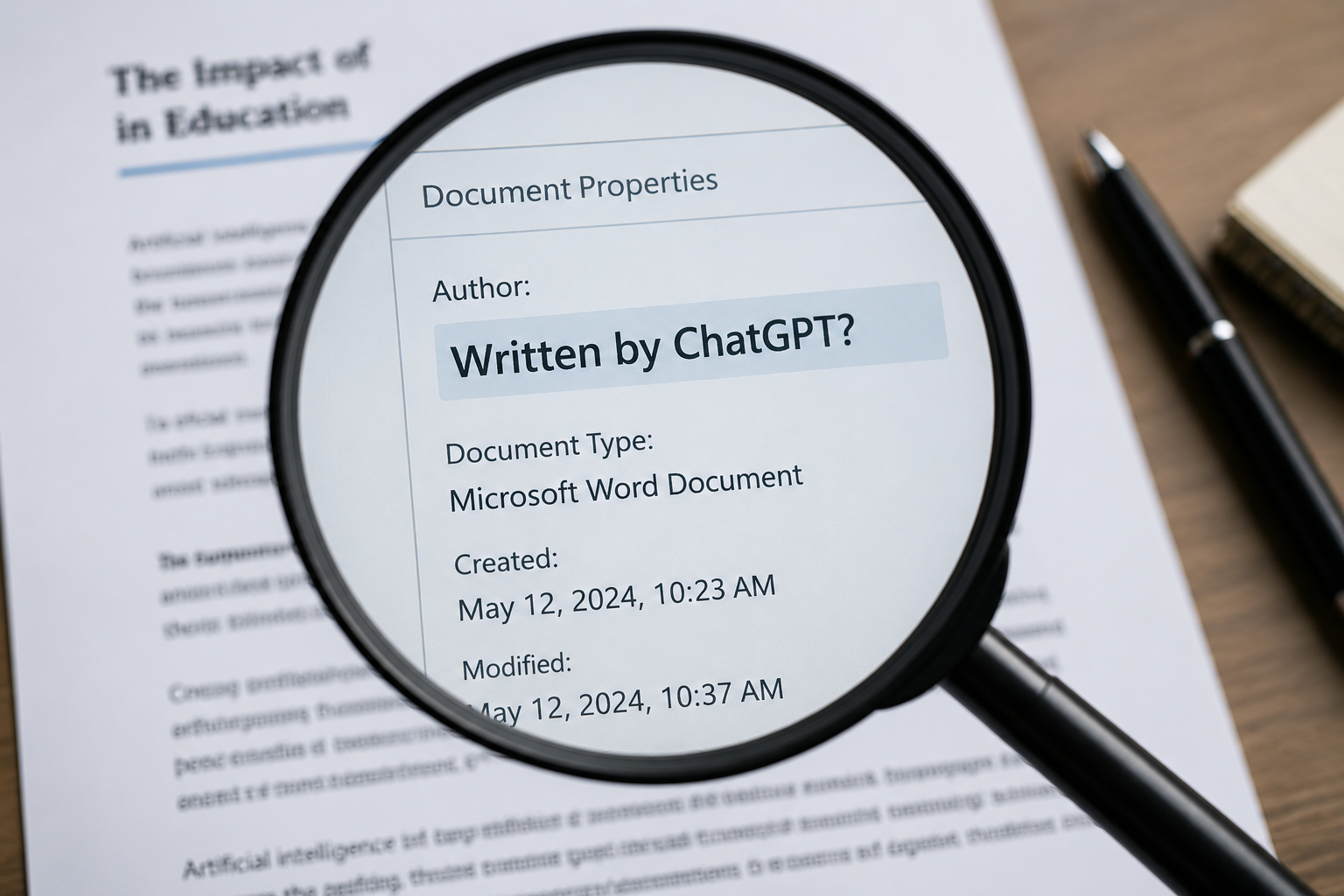
AI detectors have become one of the fastest-growing categories in educational technology.
Teachers use them.
Professors use them.
Businesses use them.
Parents use them.
The promise is simple: upload a piece of writing and discover whether artificial intelligence created it.
Unfortunately, reality is not quite that simple.
The Problem AI Detectors Are Trying to Solve
The concern is understandable.
Modern AI systems can produce essays, articles, emails, reports, and social media posts in seconds.
As these tools improve, distinguishing between human writing and AI-assisted writing becomes increasingly difficult.
Schools want to protect academic integrity.
Businesses want authentic communication.
Readers want to know whether what they are reading was written by a person.
Those are legitimate goals.
The challenge is that AI detectors are trying to answer a question that is often much harder than it appears.
What AI Detectors Actually Do
Many people imagine AI detectors work like plagiarism checkers.
They don’t.
A plagiarism checker compares writing against existing sources.
An AI detector usually does something different.
It looks for patterns: sentence structure, word choice, predictability, and statistical signals.
The software then estimates whether a piece of writing resembles text that an AI model might generate.
That distinction matters.
The detector is not discovering hidden metadata that says, “This paragraph was written by ChatGPT.”
AI detectors are making an educated guess.
Sometimes that guess is right.
Sometimes it is not.
Researchers Have Already Raised Concerns
Questions about AI detector accuracy are not limited to internet debates.
Researchers have been studying these systems for several years.
One of the most discussed studies came from researchers affiliated with Stanford University’s Human-Centered Artificial Intelligence program.
Their findings suggested that several popular AI detectors were significantly more likely to incorrectly flag writing from non-native English speakers as AI-generated.
The concern was not simply accuracy.
It was fairness.
If a system regularly mistakes human writing for AI-generated content, especially among certain groups of people, the consequences can become serious when those scores are treated as evidence rather than signals.
You can read Stanford’s article here: AI Detectors Biased Against Non-Native English Writers .
False Positives Are Real
One of the biggest misconceptions about AI detectors is that they provide certainty.
Most do not.
A detector may flag human writing as AI-generated.
A detector may also miss content that was heavily assisted by AI.
Researchers have repeatedly found examples of both.
This becomes especially important when serious consequences are attached to the result.
A student accused of cheating.
An employee accused of dishonesty.
A writer accused of misrepresenting their work.
In those situations, treating a detector score as proof can create problems of its own.
A detector score is evidence, not proof.
Even OpenAI Backed Away From Its Own Detector
One of the most revealing moments in the AI detector discussion came from OpenAI itself.
OpenAI previously released an AI classifier designed to identify AI-generated text.
The company later discontinued the tool, citing what it described as a “low rate of accuracy.”
That does not mean detection is impossible.
It does suggest the problem is harder than many marketing pages imply.
OpenAI’s announcement can be found here: New AI Classifier for Indicating AI-Written Text .
Be Careful With “Guaranteed” Claims
A detector company has a natural incentive to sound confident.
That does not mean the company is dishonest.
It does mean buyers should be cautious when a product promises certainty that the technology itself cannot reliably provide.
Phrases like “100% accurate,” “99% accurate,” “guaranteed AI detection,” “proof this was written by AI,” or “zero false positives” should immediately raise questions.
The better question is not whether a company sounds confident.
The better question is whether the company explains its limits clearly.
Trustworthy technology companies are usually willing to discuss uncertainty.
They explain what their tools do well.
They explain what their tools do poorly.
And they acknowledge that a detector score is evidence, not proof.
That distinction becomes especially important when real-world consequences are attached to the result.
A Real Example: Understanding GPTZero’s 99% Accuracy Claim
GPTZero publishes one of the more detailed benchmarking pages in the AI detection industry.
To their credit, the page explains methodology, performance metrics, false positive rates, detector versions, and test categories.
That level of detail is useful, and it is more transparent than many vague marketing claims.
But readers still need to understand what a benchmark can and cannot tell them.
GPTZero’s benchmarking page reports accuracy numbers above 99% in several categories.
At first glance, many people will read that as meaning, “If I scan a document, there is a 99% chance the result is correct.”
That is not necessarily what the benchmark proves.
A benchmark shows how a detector performed on a particular test, using particular datasets, under particular conditions.
That is useful information.
It is not the same thing as a guarantee for every real-world document.
Real-world writing is messy.
A student may write most of an essay herself and use Grammarly for cleanup.
A writer may use AI for brainstorming but not for drafting.
An employee may heavily edit AI-assisted text.
A non-native English speaker may write in clear, structured prose that looks “predictable” to a detector.
Those situations are harder than a clean test of fully human text versus fully AI-generated text.
That does not make GPTZero’s benchmark meaningless.
It means the number should be understood carefully.
A 99% benchmark is not the same thing as 99% certainty.
You can read GPTZero’s benchmarking page here: GPTZero AI Detection Benchmarking: The Industry Standard in Accuracy, Transparency and Fairness .
What Christians Can Learn From This
At first glance, AI detectors may seem unrelated to faith.
I think they raise a familiar question.
How do we evaluate truth when certainty is unavailable?
Christians have wrestled with that question for centuries.
Discernment is rarely about finding a single score, metric, or authority that removes all ambiguity.
Discernment involves evidence.
Context.
Humility.
Multiple sources of information.
A willingness to admit uncertainty.
In that sense, AI detectors may be useful tools.
But they should remain tools.
Not judges.
Useful tools should not become judges.
A Better Question
Instead of asking whether a detector can tell us with certainty that AI was involved, it may be more useful to ask how much confidence we should place in the result.
Those are different questions.
The first assumes certainty.
The second encourages discernment.
What This Means for Christian AI
When people evaluate Christian AI tools, they sometimes focus on the wrong signals.
They look for promises that a system will never make mistakes.
Never hallucinate.
Never produce incorrect information.
Never require human oversight.
History suggests we should be skeptical of those promises.
Trustworthy systems are usually not the ones claiming perfection.
They are the ones that clearly explain their boundaries, acknowledge uncertainty, and remain accountable to human judgment.
That principle applies whether we are discussing AI detectors, Bible software, search engines, or any other technology.
Trustworthy AI is not built by pretending mistakes are impossible. It is built by creating clear boundaries, preserving Scripture, and remaining accountable to human judgment. That is one of the reasons Mat44 is designed as a scripture companion, not a spiritual authority.
Final Thoughts
AI detectors can provide useful information.
They can identify patterns.
They can raise questions.
They can offer clues.
What they cannot do is replace human judgment.
Before buying an AI detector—or before trusting one completely—it is worth remembering that a score is not the same thing as certainty.
Discernment still matters.
And it probably always will.
Curious how this works in practice?
Try Mat44 and see how Brenda keeps the focus on Scripture, reflection, and trusted human guidance.
Try Mat44