Can AI Help Busy Christians Stay Spiritually Consistent?
AI can help remove friction from daily Scripture reading, but spiritual consistency should be built with grace, humility, and real life in mind.

Many Christians do not struggle with Scripture because they dislike the Bible.
They struggle because life is full.
Work starts early. Children need help. Parents are tired. Messages pile up. Meals have to be made. Appointments get moved. People mean to read Scripture, but by the time the day slows down, their attention is gone.
That is where technology can look appealing. A reminder, a short reading plan, a reflection prompt, or a simple way to return after missing a day can help.
But the question is not only whether AI can help busy Christians stay consistent.
The better question is what kind of consistency it encourages.
Consistency is not the same as performance
A daily Scripture habit can be deeply good. Small faithful rhythms shape attention over time. Reading a few verses each morning can change the way someone prays, responds, remembers, and hopes.
But Christian consistency should not become spiritual performance.
There is a difference between being invited back to Scripture and being pressured by an app. There is a difference between a gentle reminder and a system that trains someone to feel like a failure when life interrupts the plan.
That distinction matters.
Some apps are built around streaks, badges, notifications, and urgency. Those tools can be motivating for some people. They can also turn devotion into pressure.
The goal should not be to make Christians feel productive. The goal should be to help them return to Scripture with humility and hope.
Busy Christians need less friction, not more guilt
Good technology can remove friction.
It can make it easier to find the next passage. It can help someone remember where they left off. It can offer a short reflection question when the mind feels scattered. It can help a person who missed three days begin again without turning the missed days into a moral crisis.
That kind of support can be useful.
But when technology adds guilt, comparison, or pressure, it can quietly work against the spiritual purpose it claims to serve.
A Christian AI tool should not treat people like engagement metrics. It should not chase longer sessions for their own sake. It should not make people feel like holiness is measured by app activity.
A better tool helps people take the next faithful step and then lets them live their actual life.
AI can help with small moments of return
One of the most useful things AI can do for a Scripture habit is make returning easier.
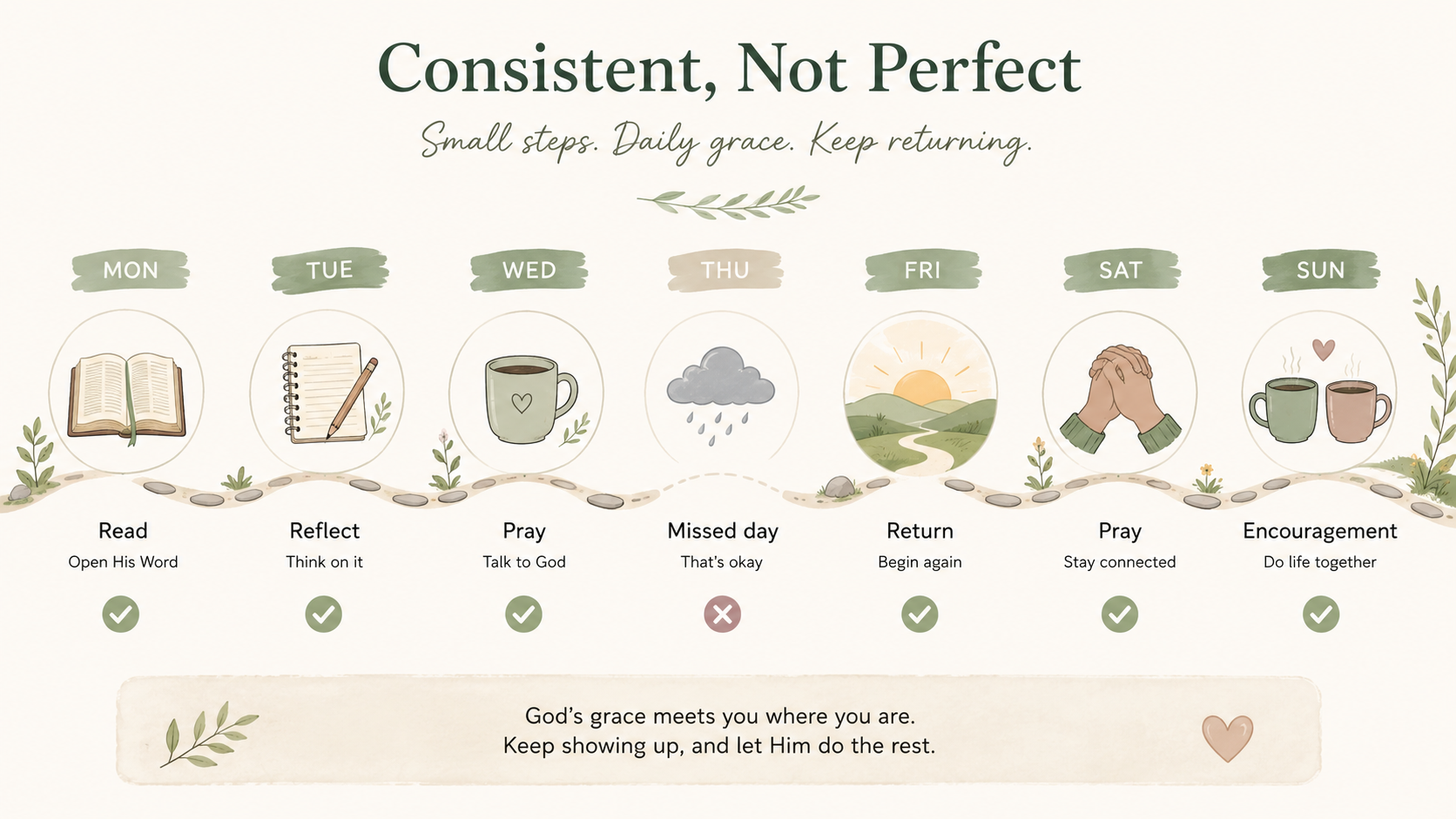
Returning matters because most people will miss days. A child gets sick. A work deadline moves. A family emergency happens. Someone travels, falls asleep early, wakes up late, or simply forgets.
A rigid system turns that into failure.
A grace-filled system says, "Start here."
AI can help by offering a simple reflection on the passage in front of the person. It can suggest one thoughtful question. It can summarize where the reading left off. It can help the person slow down long enough to notice what the verse actually says.
That is not a replacement for prayer. It is not a substitute for study. It is not a spiritual authority.
It is a small support for returning.
The best rhythm is realistic
A realistic Scripture habit is not built around the fantasy version of your life.
It is built around your actual life.
That means some days are short. Some days are distracted. Some days are rich and quiet. Some days are simply a verse, a prayer, and a decision to return tomorrow.
A Christian AI tool should respect that.
It should support ordinary Christians, not just people with perfect routines and quiet houses.
A good tool can help someone ask:
- What did I actually read today?
- What does this passage say about God?
- What word or phrase should I carry with me?
- Is there a question I should bring to a pastor, group, or trusted Christian friend?
- How can I return tomorrow without turning this into pressure?
That kind of reflection is simple, but simple is often what busy people need.
AI should not replace prayer
One danger with any faith-based technology is that the tool can become the place where people process everything.
Instead of praying, they ask the app.
Instead of sitting quietly with Scripture, they keep generating responses.
Instead of talking to a real person, they keep the conversation private and endless.
That is not spiritual consistency. That is dependence on a tool.
AI can help someone reflect, but it should never become the main listener in the Christian life. Prayer is not a productivity exercise. It is not content generation. It is not a chat interface.
Christian technology should make space for prayer, not crowd it out.
AI should not replace community either
Scripture reading is personal, but Christian formation is not meant to be isolated.
Churches, pastors, small groups, families, friends, mentors, and other believers help us see what we miss. They encourage us when we are tired. They correct us when we are wrong. They pray with us when life becomes too heavy to carry alone.
A Scripture app should not pull people away from that.
If AI helps someone form better questions before Bible study, that can be good. If it helps someone remember a passage to discuss with a pastor, that can be good. If it helps a parent prepare a simple family devotional, that can be good.
But if it becomes a private replacement for Christian community, it has gone too far.
The Mat44 approach
Mat44 is designed around daily Scripture habit, not endless app engagement.
The goal is not to keep people chatting as long as possible. The goal is to help them read, reflect, and return.
Brenda, the AI companion inside Mat44, is meant to stay tied to the passage. She can help with reflection and simple questions, but she is not designed to become a pastor, therapist, prophet, or spiritual authority.
That boundary matters because the app should serve the habit, not become the habit.
Scripture is the point.
What healthy consistency can look like
Healthy spiritual consistency does not have to look dramatic.
It might look like reading one passage before work. It might look like opening the Bible after the kids go to bed. It might look like listening to a chapter while washing dishes. It might look like returning on Friday after missing Tuesday, Wednesday, and Thursday.
A Christian AI tool can support that kind of rhythm when it is built with care.
It can encourage without shaming. It can remind without nagging. It can help without taking over. It can point back to Scripture instead of making the tool itself feel central.
That is the kind of support busy Christians need.
Consistency with grace
AI can help busy Christians stay spiritually consistent if it is designed with the right priorities.
It should make Scripture easier to return to. It should help people reflect without replacing prayer. It should encourage community, not isolation. It should avoid guilt-based streaks and spiritual performance.
The best Christian technology does not say, "You failed."
It says, "Come back to the Word."
Curious how this works in practice?
Try Mat44 and see how Brenda keeps the focus on Scripture, reflection, and careful boundaries.