The Difference Between AI Assistance and AI Authority
AI can be useful without becoming authoritative. The difference matters for Scripture, discernment, community, and Christian formation.
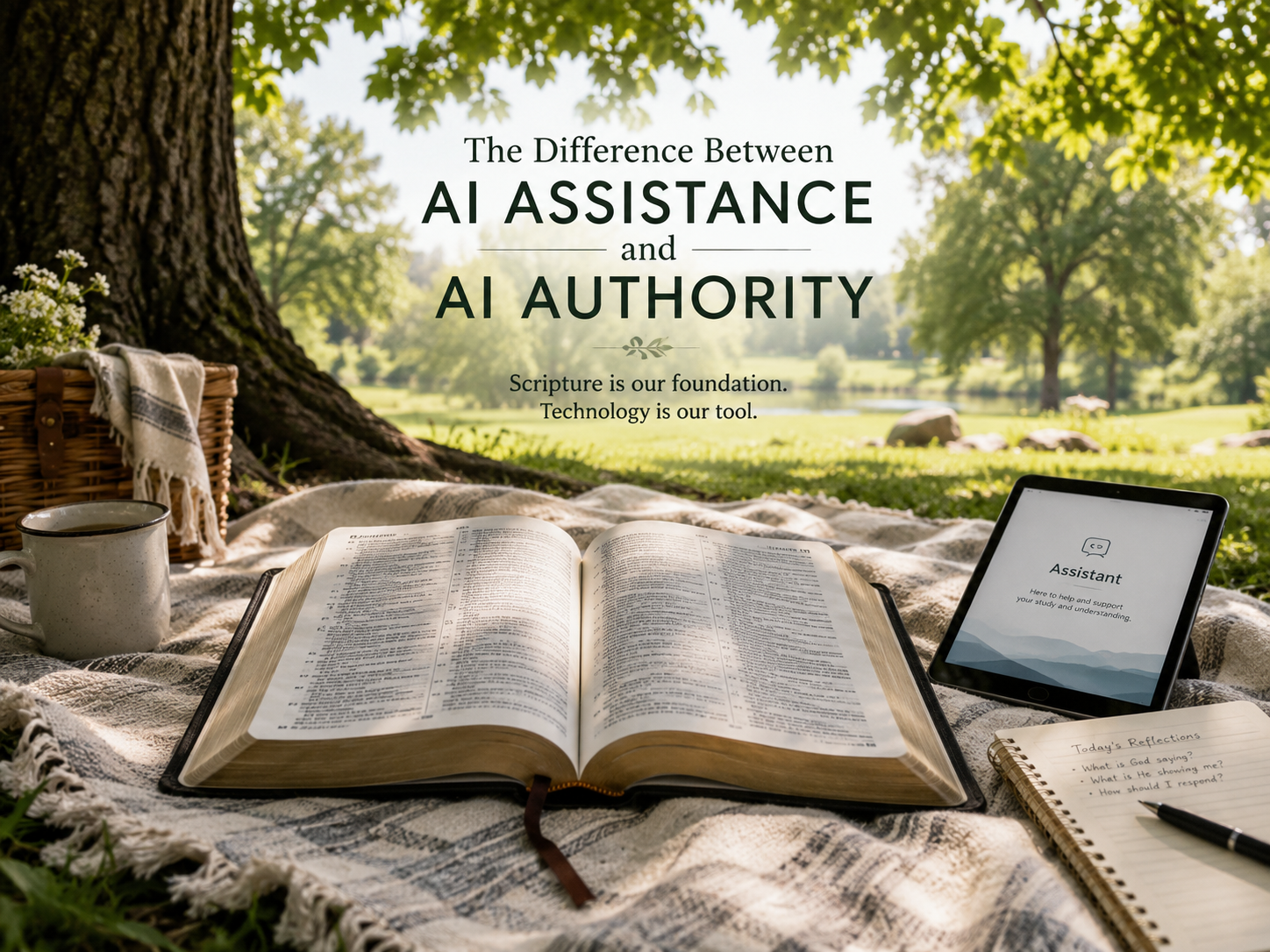
AI can be useful without becoming authoritative.
That distinction matters.
As Christian AI tools become more common, many of the most important questions are not only technical. They are questions about role, trust, formation, and authority.
A tool may help someone remember to read Scripture.
It may offer a reflection question.
It may organize notes.
It may explain a difficult word.
It may encourage someone to bring a question to a trusted church leader.
All of that can be assistance.
But assistance becomes something else when the tool starts functioning as the voice a person depends on for spiritual direction, theological certainty, moral decision-making, or personal discernment.
That is where Christians should slow down.
The question is not whether AI can ever be helpful.
The question is whether it is staying in its proper place.
Assistance supports what already matters
A good tool helps without becoming the center.
A calendar reminder can help someone remember a prayer meeting. A Bible app can make Scripture more accessible. A reading plan can help a person stay consistent. A journal prompt can help someone reflect more honestly.
None of those tools are the authority.
They support practices that matter.
AI can function in a similar way when it is carefully designed. It can help organize a Scripture habit. It can ask a simple reflection question. It can help distinguish between a Bible verse and a devotional thought. It can make a tool easier to use for people who feel overwhelmed.
That kind of assistance can be good.
It can remove friction.
It can support consistency.
It can help people return to Scripture.
But the tool should remain visibly secondary.
Authority is different
Authority asks for more than usefulness.
In Christian life, authority is connected to Scripture, doctrine, church tradition, pastoral care, community, conscience, and discernment. Different Christian traditions describe and order those sources differently, but few would say that an AI tool belongs in the same category.
A Christian AI tool should not behave as if it does.
It should not present itself as the final voice on doctrine.
It should not decide what a user should believe.
It should not replace pastoral care.
It should not make private spiritual judgments about a person's life.
It should not imply that a generated answer has the weight of Scripture.
Even when an answer sounds wise, it is still generated text.
That does not make it useless.
But it does mean it should be handled carefully.
The problem is not help. The problem is displacement.
The strongest argument for Christian AI is not that AI should teach Christians what to believe.
It is that technology can sometimes remove practical barriers.
Someone may struggle with consistency. Someone may not know where to start. Someone may want a simple prompt after reading a passage. Someone may need a low-pressure way to share encouragement with family or a small group.
There is nothing wrong with building tools that support those needs.
But displacement happens when the support tool becomes the main thing.
The app becomes the place a person turns first.
The generated answer becomes easier to accept than the slower work of study.
The chatbot becomes more available than community.
The interface becomes more emotionally rewarding than the practice it was meant to support.
That is not only a design problem.
It is a formation problem.
Technology shapes habits. It trains expectations. It can teach people to prefer speed over wisdom, certainty over discernment, and private answers over embodied community.
That is why Christian AI needs clear boundaries.
Scripture should not become background material
One of the risks of AI in Christian contexts is that Scripture can become the raw material for generated content rather than the center of the experience.
A tool might begin with a verse, but quickly surround it with summaries, explanations, emotional reflections, personalized advice, and suggested next steps. Before long, the generated material can feel more prominent than the passage itself.
That is a subtle shift.
It may not look dramatic.
But it matters.
If the AI's explanation becomes the main thing the user remembers, the tool has begun to move from assistance toward authority.
A responsible Christian AI tool should resist that drift.
It should keep Scripture visible.
It should distinguish the biblical text from reflection.
It should make the generated material feel secondary.
It should encourage the user to return to the passage, not move quickly past it.
A tool should not replace discernment
Discernment is not the same as receiving an instant answer.
Many Christian questions require patience. They may require prayer, study, repentance, counsel, community, humility, and time.
AI can make a quick answer feel normal.
That is not always bad. Some questions are simple. Some explanations are straightforward. Some support can be immediate without being irresponsible.
But Christians should be cautious when spiritual questions become optimized for speed.
A fast answer may be incomplete.
A confident answer may be poorly grounded.
A comforting answer may not be wise.
A personalized answer may feel more authoritative than it should.
A Christian AI tool should not train users to bypass discernment. It should support discernment by slowing down where needed, admitting limits, and pointing beyond itself.
The tool should be able to say: this question matters, and it belongs in prayer, Scripture, wise counsel, and real community.
Community matters because people are not prompts
AI tools respond to prompts.
Church communities respond to people.
That difference matters.
A prompt contains only what the user chooses to type. A person's life includes context, history, relationships, tone, patterns, accountability, and needs that may not fit into a text box.
Christian care often depends on those things.
A pastor may know the family situation behind a question. A small group leader may notice when someone seems isolated. A mentor may know when a person is repeating a familiar fear. A trusted friend may ask the question behind the question.
AI does not know people that way.
It can simulate concern. It can produce gentle language. It can generate a response that sounds attentive. But it does not belong to the user's real community.
That does not mean AI cannot assist.
It means it should not pretend to replace what only people can give.
The authority problem can be subtle
Most Christian AI tools will probably not announce, "I am your spiritual authority."
The danger is usually quieter.
A tool becomes always available.
It always responds.
It sounds calm.
It uses Christian language.
It remembers patterns.
It gives practical next steps.
It feels private.
It may even feel safer than asking a real person.
Over time, the user may begin to treat the tool as the first voice, the easiest voice, or the most trusted voice.
That is why design choices matter.
Does the tool make Scripture central?
Does it label generated reflection clearly?
Does it redirect sensitive questions?
Does it encourage real community?
Does it avoid emotional dependency?
Does it make room for trusted leaders?
Does it seem comfortable being only a tool?
Those details shape whether AI functions as assistance or begins acting like authority.
How Mat44 thinks about assistance
Mat44 was built to be a Scripture companion, not a spiritual authority.
That is an important distinction.
The goal is not to create an AI voice that Christians depend on for doctrine, pastoral care, or major life decisions. The goal is to help people build a daily Scripture habit, reflect carefully, and encourage one another without turning faith into a performance system.
Brenda, the AI assistant inside Mat44, is designed to stay bounded.
She can support reflection.
She can help keep the focus on Scripture.
She can redirect when a question belongs with trusted leaders, qualified professionals, or real community.
She is not meant to become the center of someone's spiritual life.
That is not a limitation to hide.
It is the point.
Christian AI should be useful enough to help and humble enough to remain secondary.
A practical test
A simple way to evaluate a Christian AI tool is to ask what it makes central.
- Does it make Scripture central?
- Does it make the app central?
- Does it make the AI response central?
- Does it make the user's growth look like engagement metrics?
- Does it point toward real community, or does it quietly keep the user alone with the tool?
- Does it treat generated reflection as support, or does it let generated text feel like the final word?
Those questions matter because the difference between assistance and authority is not always obvious at first.
A tool may begin by helping.
But if it slowly becomes the place a person turns for spiritual certainty, moral direction, or emotional dependence, it has moved beyond assistance.
Christian AI should know its role
AI does not need to be rejected in order to be kept in its place.
A Christian can use a tool without surrendering authority to it.
A church can think carefully about technology without pretending every new tool is dangerous.
A Scripture app can support habit formation without replacing Scripture, prayer, community, or church leadership.
The goal is not fear.
The goal is discernment.
Christian AI should be evaluated by whether it serves what is already sacred, not whether it can imitate sacred authority.
Assistance is welcome when it remains honest, humble, and bounded.
Authority belongs elsewhere.
Curious how this works in practice?
Try Mat44 and see how Brenda keeps the focus on Scripture, reflection, and careful boundaries.