Should Christians Fact-Check AI About the Bible?
Yes. Fact-checking AI is not a rejection of technology. It is part of using a powerful tool with Christian discernment, responsibility, and good stewardship.

Christians should fact-check what artificial intelligence says about the Bible.
That statement should not be controversial, and it should not be understood as fear of technology.
We check sermons against Scripture. We look up quotations from books. We ask whether a social media post represents a church teaching accurately. We compare translations and consult people who know more than we do.
AI should not receive an exemption simply because it is fast, impressive, or new.
It is another technological tool. Like other tools, it can expand access, save time, and help people do valuable work. It can also be used lazily, carelessly, or beyond the limits of what it does well.
The Christian question is not merely whether we can use it.
The Christian question is whether we will use it as good stewards.
Stewardship rejects both panic and passivity
New technology often produces two loud reactions.
One group treats the technology as a threat that should be rejected before it can corrupt anything valuable. Another group embraces it as inevitable and assumes that resistance, caution, or limits are signs of being left behind.
Christian stewardship offers a better path.
We do not need to become lemmings, following a tool simply because everyone else is using it. We also do not need to become afraid of every advancement we did not grow up with.
Stewardship asks what a tool is for, what it does well, where it creates risk, whom it affects, and what responsibilities remain with the person using it.
That is a more demanding response than either blind trust or total rejection. It requires learning, judgment, boundaries, and continued responsibility.
Every useful technology creates new responsibilities
Christians have navigated technological change before.
Printing, broadcasting, recorded sermons, Bible software, search engines, smartphones, and social media all changed how Christian information could be created and shared.
Each advancement made some good work easier. Each also created opportunities for poor teaching, manipulation, distraction, or misinformation to travel farther and faster.
The responsible response was never simply, "The technology exists, so whatever it produces must be useful."
Access does not remove discernment. Convenience does not cancel accountability.
AI belongs in that same history. Its novelty changes the skills we need, but it does not change the underlying responsibility to examine what we receive.
Fact-checking is one form of stewardship
Fact-checking can sound adversarial, as though the user begins with the assumption that the AI is lying.
That is not the best way to understand it.
Fact-checking means recognizing that the user remains responsible for what they accept, repeat, teach, or act upon.
The AI cannot take that responsibility from us. A confident interface cannot take it from us. A disclaimer cannot take it from us either.
If we repeat a false quotation, teach a passage without context, or use an AI answer to justify harmful advice, the speed of the tool does not make the result more faithful.
Good stewardship means using the assistance without outsourcing the judgment.
The Bereans offer a useful pattern
Acts 17 describes the Bereans receiving Paul's message eagerly while also examining the Scriptures daily to see whether what they heard was true.
Their examination was not treated as hostility toward teaching. Their openness and their verification belonged together.
That pattern translates well to modern technology.
We can receive useful help eagerly. We can appreciate a clear explanation. We can explore a question we may not have known how to ask.
Then we can open Scripture, examine the claim, and decide whether the answer deserves to be trusted.
Discernment is not the opposite of curiosity. It is what allows curiosity to remain responsible.
Use the tool, but test the claim
A practical fact-check does not need to become an academic research project every time.
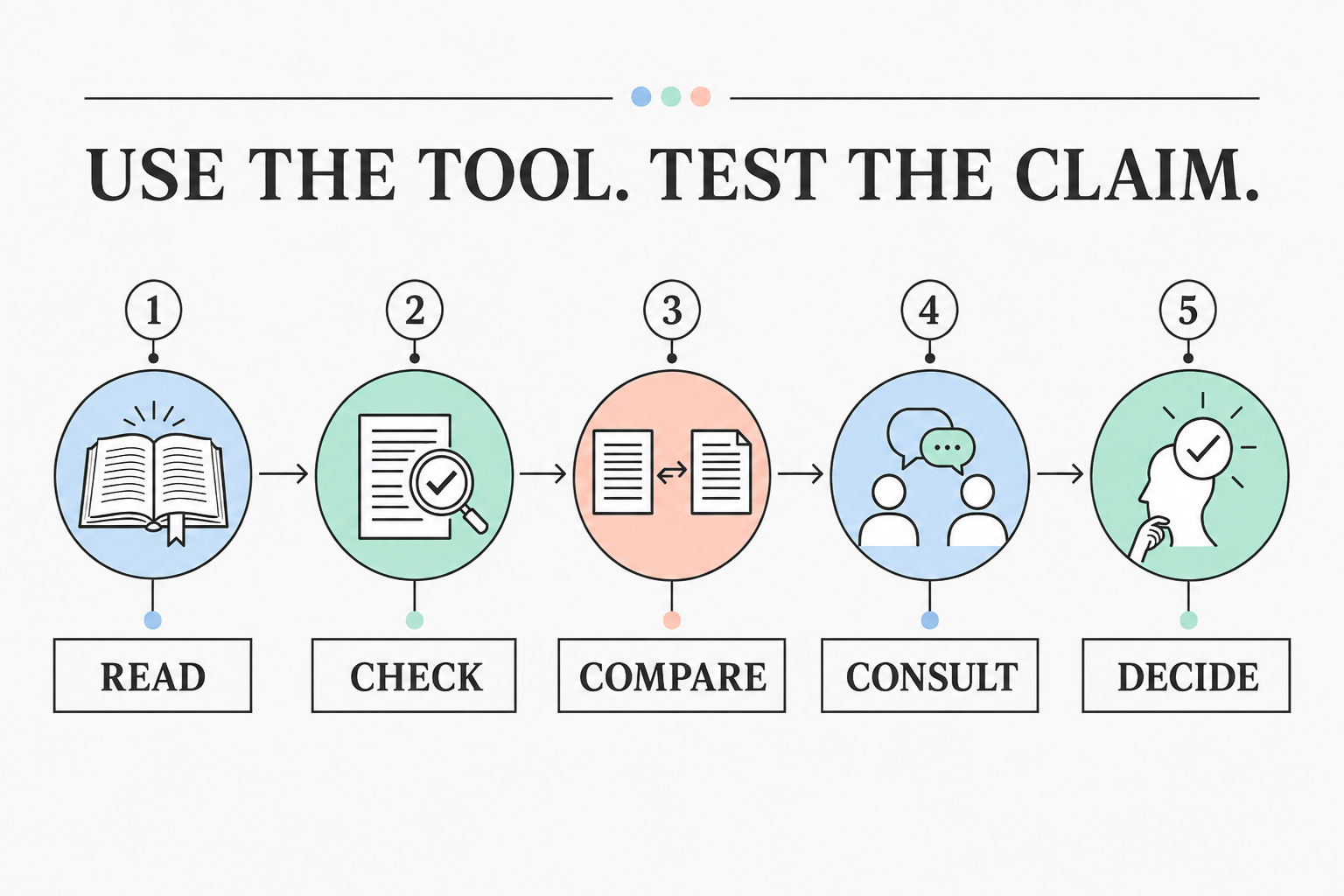
Read
Open the passage instead of relying on the AI's summary. Read the verses around it and notice what kind of text you are reading.
Check
Confirm that quotations, references, names, dates, and source claims are accurate. A citation should lead somewhere real and support the statement attached to it.
Compare
Compare translations when the wording matters. Compare the AI's explanation with a trusted study Bible, commentary, church resource, or primary document.
Consult
Ask a pastor, teacher, mature Christian, or qualified professional when the question reaches beyond simple information. Real people can understand history, relationships, consequences, and the local church in ways a general tool cannot.
Decide
Make your own responsible judgment about what to accept, share, or act upon. The AI can assist the process. It should not become the owner of the decision.
Not every Bible claim requires the same process
Stewardship is proportional.
If an AI identifies the location of a familiar parable, opening the passage may be enough. If it describes a disputed doctrine, consulting multiple perspectives matters. If it gives advice about abuse, mental health, legal trouble, or a family crisis, the conversation needs to move toward qualified human help.
The importance of the question should determine the depth of the verification.
This avoids two extremes: treating every minor answer as a crisis and treating every serious answer as disposable content.
Fact-checking also means identifying interpretation
Some answers cannot be verified in the same way as a date or quotation because they involve interpretation.
Christians may agree on the wording of a passage and disagree about how it relates to baptism, church authority, spiritual gifts, salvation, or the end times.
In those cases, responsible checking means asking whether the AI has represented the major positions honestly and whether it has labeled interpretation as interpretation.
A tool does not demonstrate confidence by hiding disagreement. It demonstrates integrity by helping users see where disagreement exists.
Developers are stewards too
Users are not the only people with responsibilities.
Christian AI developers decide how much authority an interface appears to claim. They decide whether sources are visible, whether limitations are explained, and whether the system encourages people to return to Scripture and real Christian community.
It is not enough to place a warning at the bottom of the screen and then design the rest of the product to encourage automatic trust.
Good stewardship should be visible in the product itself.
The tool should make careful use easier, not depend on every user remembering a long list of hidden risks.
Technology should increase our capacity, not replace our responsibility
AI can help Christians ask better questions, find useful background, organize study, and approach difficult material.
Those are meaningful benefits. We do not need to minimize them in order to talk honestly about limits.
But the value of a tool is not measured by how completely it removes us from the work.
Scripture still needs to be read. Claims still need to be examined. Wisdom still develops in relationship with God and other people. Decisions still belong to responsible human beings.
Good stewardship does not ask us to choose between using AI and thinking carefully. It requires us to do both.
Curious how this works in practice?
Try Mat44 and see how Brenda keeps the focus on Scripture, reflection, and careful boundaries.