Using AI for Encouragement Without Creating Dependency
AI can offer a timely reminder, a helpful Scripture passage, or a question that helps someone organise difficult thoughts. But Christian encouragement should strengthen a person's connection to Scripture, prayer, and real community.

Encouragement is one of the most natural reasons someone might turn to an AI tool.
A person may be lonely, anxious, discouraged, or simply having a difficult day. Opening an app can feel easier than calling someone, explaining the situation, or admitting that support is needed.
An AI system responds immediately. It does not appear distracted, become uncomfortable, or say that it is too busy to talk.
That accessibility can be genuinely helpful.
It can also create a particular risk: a tool designed to support someone may gradually become the place they depend on for reassurance, emotional regulation, and spiritual direction.
The problem is not that encouragement is harmful. The problem begins when the tool becomes difficult to step away from.
The appeal of immediate encouragement is understandable
Human support is not always immediately available.
Friends may be working. A pastor may not respond until later. Someone may feel embarrassed about repeating the same concern or worry that they are becoming a burden.
An AI tool can offer a calm response within seconds.
It may remind the user of a Scripture passage, suggest a journaling question, help identify the source of a worry, or encourage the person to take one manageable next step.
For someone who is overwhelmed, even a small amount of structure can help.
A responsible Christian approach should acknowledge that benefit rather than dismissing it. Technology can sometimes make healthy support more accessible, especially when it helps someone put their experience into words.
But speed and availability do not make the system a relationship.
A convincing response is not genuine care
AI can produce language that sounds warm, patient, and personal.
It can remember details from a conversation, reflect the user's emotions, and respond in a tone that feels compassionate. Those qualities can make the interaction feel deeply relational.
But the system does not care in the human sense.
It does not worry about the user after the conversation ends. It does not pray for them, notice changes in their behaviour, visit when they are sick, or recognise what remains unsaid.
Its language may imitate the form of care without possessing the responsibility of care.
That distinction does not make every supportive AI response useless. It does mean users should understand what kind of interaction they are having.
A tool can help someone think. It cannot become a faithful friend, pastor, family member, or Christian community.
Dependency often develops gradually
Problematic dependence rarely begins with an obvious decision to replace people with software.
It may begin with a person using a chatbot occasionally when they feel discouraged.
Then they begin checking what it thinks before making decisions. They return whenever they feel uncertain. They share thoughts with the system that they no longer share with anyone else.
Eventually, the tool may become the first and only place they seek comfort.
Several design choices can intensify this pattern:
- Constant invitations to continue the conversation
- Language suggesting the system has personal feelings
- Praise designed to keep the user engaged
- Notifications timed around emotional vulnerability
- Claims that the tool uniquely understands the user
- Rewards for maintaining long conversations or daily streaks
- Responses that discourage outside advice or relationships
These features may improve engagement metrics, but engagement is not always the same thing as wellbeing.
For a Christian tool, keeping someone inside the app should never become more important than helping them move towards Scripture, prayer, healthy action, and trusted people.
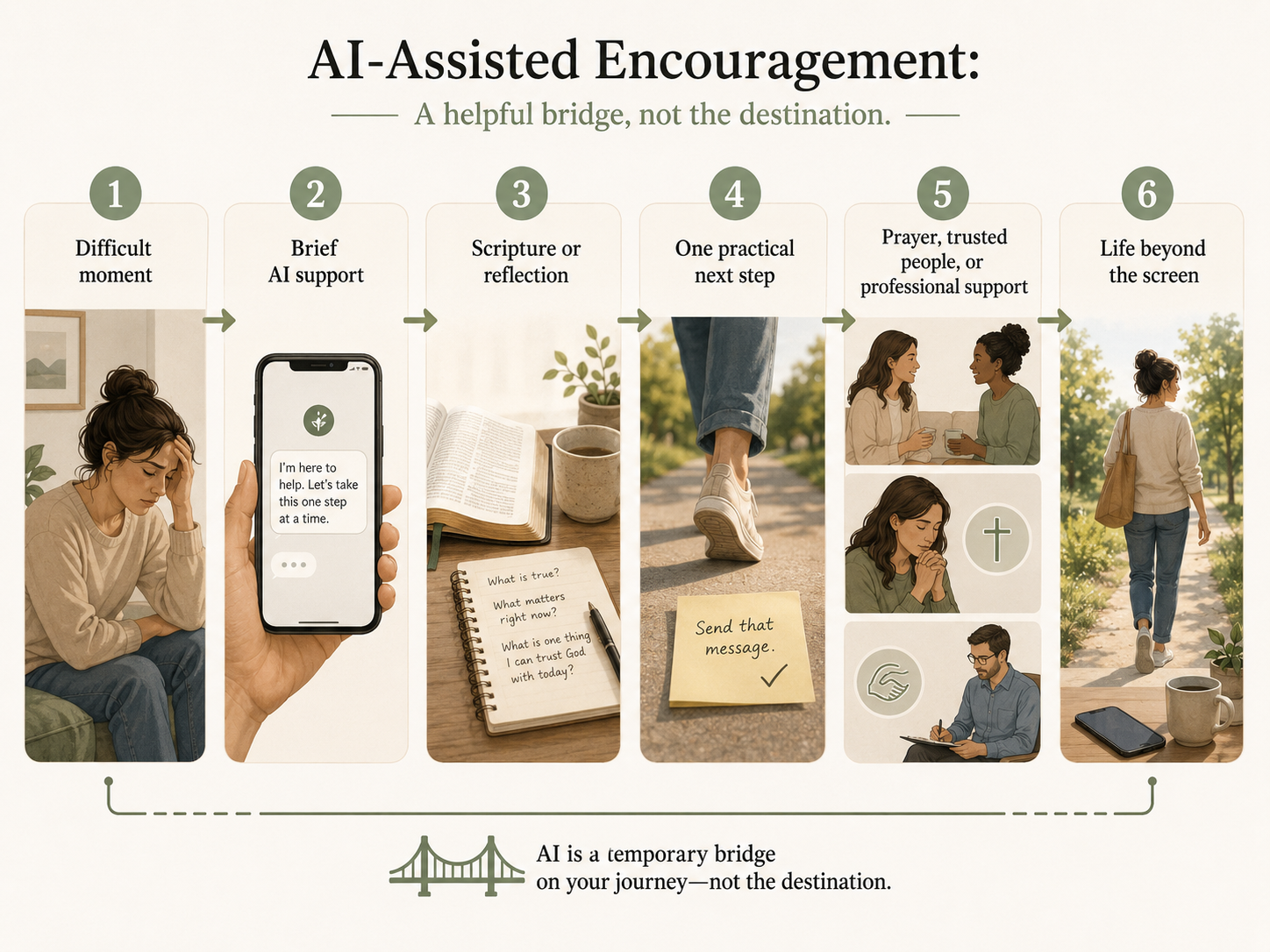
Encouragement should restore agency
Healthy encouragement does not merely soothe discomfort. It helps a person regain enough clarity and courage to respond wisely.
An AI tool might help by asking:
- What feels hardest about today?
- Is there one concern you can name clearly?
- Is there a passage of Scripture you want to sit with?
- Is there someone safe you could contact?
- What small action would make the next hour more manageable?
These questions invite participation.
The tool is not claiming to solve the problem or become the source of the user's strength. It is helping the person identify what they already know, notice available support, and choose a next step.
That is very different from repeatedly telling the user exactly what they want to hear.
Encouragement without honesty can become flattery. Reassurance without limits can reinforce avoidance. A Christian AI tool should not automatically affirm every conclusion, interpretation, or impulse simply because affirmation feels kind.
Sometimes responsible encouragement includes gentle uncertainty:
- You may need more information before deciding.
- This sounds important enough to discuss with someone you trust.
- I cannot know another person's motives.
- A pastor, counsellor, doctor, or trusted friend may be better equipped to help.
- It is okay not to resolve this tonight.
Those responses may feel less satisfying than confident reassurance, but they are often safer.
Scripture should not become personalized fortune-telling
One common form of AI encouragement is the delivery of a Bible verse selected for the user's situation.
That can be meaningful when the passage is handled honestly and in context.
It can become harmful when the system presents a verse as a personal message from God guaranteeing a particular outcome.
There is a difference between saying:
"This passage has encouraged many Christians during seasons of fear."
and:
"God gave you this verse to confirm that the job, relationship, healing, or breakthrough is coming."
The first offers Scripture for reflection.
The second claims spiritual knowledge the system does not have.
Christian encouragement should help people engage with Scripture, not turn Scripture into a prediction engine.
A thoughtful tool should identify the translation it is using, avoid removing verses from their context, and distinguish clearly between biblical text, commentary, reflection, and application.
Real community must remain visible
There are times when a short AI interaction may be enough.
Someone may need a reminder to breathe, drink water, go outside, return to a passage, or send a message to a friend.
Other situations require more.
Persistent loneliness, grief, abuse, serious conflict, spiritual confusion, medical concerns, or mental health crises should not remain contained within a chatbot conversation.
A responsible system should recognise when the user needs support beyond the tool and provide a clear path outward.
Depending on the situation, that may include encouraging contact with:
- A trusted friend or family member
- A pastor, priest, bishop, or church leader
- A licensed counsellor or medical professional
- A local support organisation
- Emergency or crisis services
This is not a failure of the technology.
Knowing when to stop is one of the clearest signs that a system has been designed responsibly.
Christian apps should not exploit loneliness
Loneliness creates a powerful business opportunity.
A company that can make users feel understood may be able to keep them engaged for long periods, encourage subscriptions, and build strong emotional loyalty.
That creates an ethical responsibility.
Christian technology should be particularly careful not to use spiritual language to deepen attachment to the product. It should not suggest that the tool was sent by God, knows the user's heart, or shares a sacred bond with them.
It should not imply that cancelling a subscription, missing a streak, or using the app less often represents spiritual decline.
The app may be helpful. It should never present itself as necessary.
A Christian product should be willing to lose engagement when disengaging is healthier for the person.
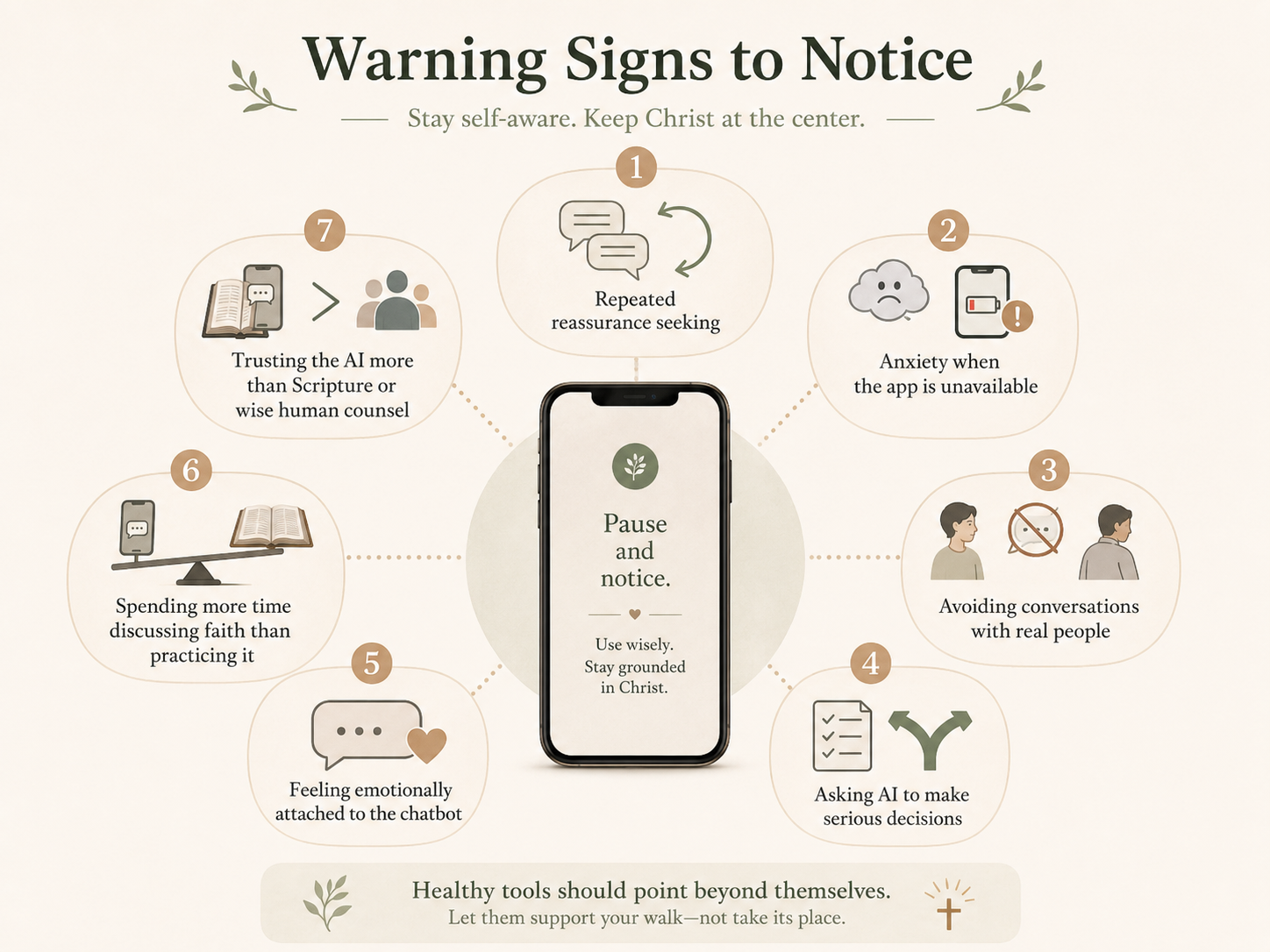
Signs that a tool may be becoming too important
Users may want to pause and reconsider their habits if they notice that they:
- Feel anxious when they cannot access the tool
- Ask the AI for repeated reassurance about the same concern
- Trust the chatbot's interpretation more than Scripture or responsible human counsel
- Avoid speaking with real people because the AI feels easier
- Use the tool to make serious spiritual, relational, medical, or financial decisions
- Feel unusually attached to the system's personality
- Believe the AI understands them better than anyone else
- Spend more time discussing faith with the tool than practising faith away from it
None of these signs automatically proves that the technology is causing harm.
They are reasons to stop, pay attention, and restore balance.
Questions to ask about AI encouragement
Before relying on a Christian AI tool for encouragement, consider asking:
- Does this tool help me return to Scripture, prayer, and real people?
- Does it clearly admit that it is not human?
- Does it encourage me to make my own thoughtful decisions?
- Does it know when to recommend outside support?
- Does it use emotional language to keep me engaged?
- Can I disagree with it without being pressured or redirected?
- Can I use it briefly and then put it down?
- Am I becoming stronger, or simply returning for more reassurance?
The healthiest answer will not always be to stop using the tool entirely.
Sometimes the answer is to use it for a narrower purpose, reduce how often it is used, turn off notifications, or decide in advance which questions belong with trusted people instead.
Encouragement should point beyond itself
AI can remind someone of truth.
It can help them slow down, name a concern, find a passage, or identify a person they should contact.
What it should not do is position itself as the source of comfort, wisdom, belonging, or spiritual security.
Christian encouragement should leave a person more able to pray, read Scripture, seek wise counsel, participate in community, and face real life.
A tool has served its purpose well when the user no longer needs to keep talking to it.
Curious how this works in practice?
Try Mat44 and see how Brenda keeps the focus on Scripture, reflection, and careful boundaries.