What Makes a Christian AI Tool Trustworthy?
Christian AI should be evaluated less by how impressive it sounds and more by how carefully it handles Scripture, uncertainty, authority, privacy, and human community.
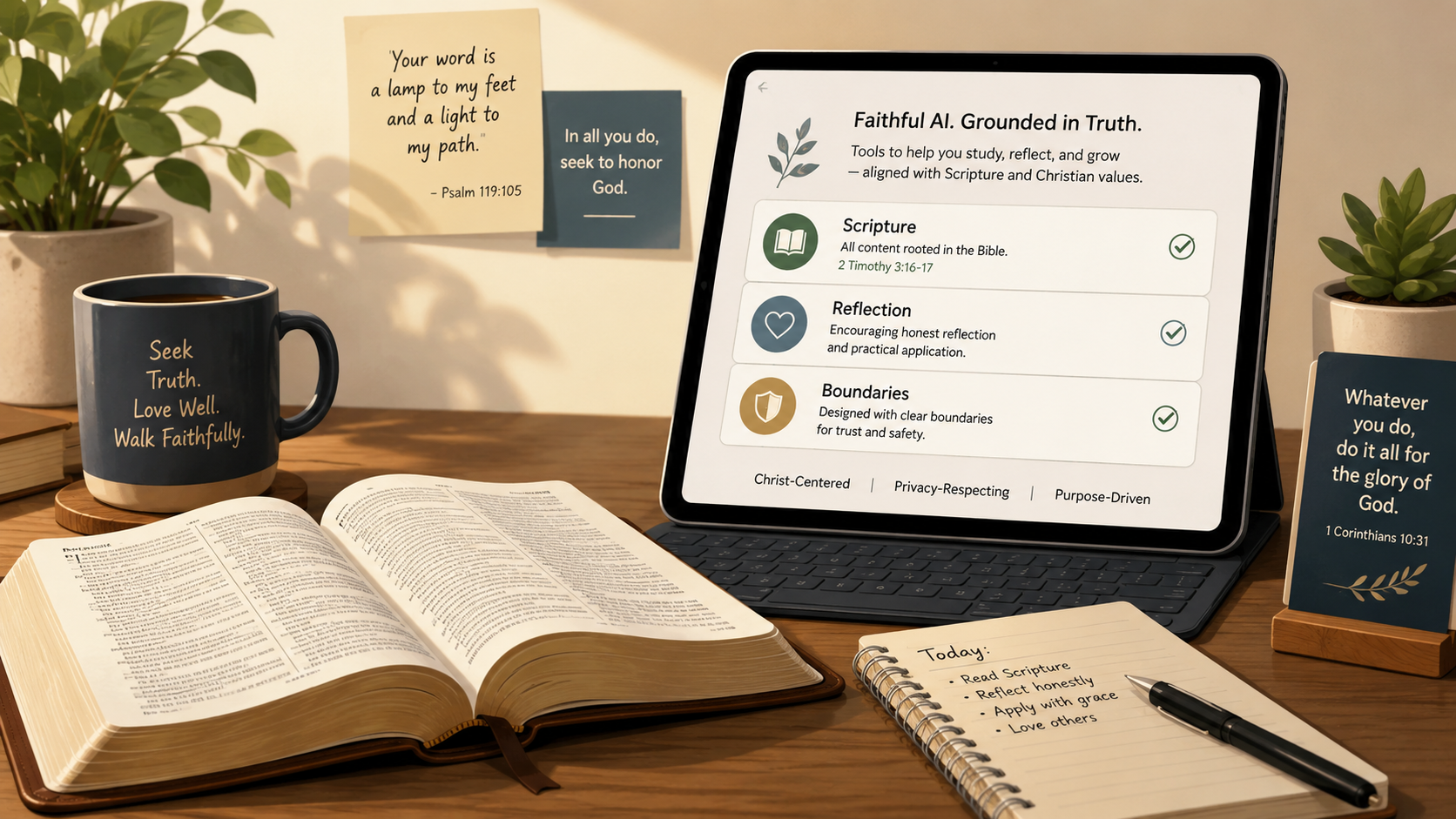
A Christian AI tool does not become trustworthy just because it uses Christian words.
As artificial intelligence becomes more common, Christians are being asked to trust apps, chatbots, devotionals, study tools, and recommendation systems with increasingly sensitive parts of life. Some of these tools may be genuinely helpful. Others may sound convincing without being clear about where their answers come from or what authority they actually have.
That is why trust has become one of the most important questions in faith-based technology.
There is a fair reason many Christians are cautious about AI. These systems can sound confident when they are wrong. They can flatten theological differences, blur the line between Scripture and commentary, or make spiritual topics feel more certain than they really are.
At the same time, Christians have always had to think carefully about new tools, from printing presses and radio to websites, Bible apps, and now AI. The question is not simply whether the technology is new. The better question is what kind of trust the tool is asking for, and whether it has earned that trust.
A Christian AI tool should be evaluated less by how impressive it sounds and more by how carefully it handles Scripture, uncertainty, authority, privacy, and human community. Trust has to be built, and in Christian AI, it should begin with clarity.
Source clarity matters
The first question is simple: does the tool clearly tell you what you are reading?
If a screen shows a Bible verse, the user should know whether it is actual Scripture from a named Bible translation, a paraphrase, a summary, commentary, devotional reflection, or AI-generated support.
Those categories are not interchangeable.
A verse from a Bible translation carries a different kind of authority than a generated reflection. A devotional thought may be useful, but it should not be presented as Scripture. A summary may help someone understand a passage, but it should not replace the passage itself.
This is one reason vague language like "Bible-based" is not enough.
"Bible-based" may mean the tool quotes Scripture directly. It may mean it was trained on Christian writing. It may mean it generates reflections inspired by biblical themes. It may mean it simply tries to sound Christian.
A trustworthy tool should not force users to guess.
It should label its sources clearly.
Translation clarity is also a trust issue
Christians do not all use the same Bible translation.
Some traditions prefer one translation for worship. Some churches use a specific version in teaching. Some families have strong preferences for readability, formal equivalence, tradition, or copyright reasons. Some languages have fewer available translations than English.
A Christian AI tool should be honest about which translation it is using.
It should not blend translations without saying so. It should not produce something that sounds like Scripture while quietly rewriting the verse. It should not paraphrase a passage and present that paraphrase as the Bible.
Translation clarity is not a technical detail. It is a trust issue.
A user should be able to tell the difference between the biblical text and everything around it.
Boundaries are a sign of seriousness
Trustworthy Christian AI should have limits.
That may seem strange in a market where many tools are advertised by how much they can do. But for faith-based technology, the willingness to stop is part of what makes a tool safer.
A responsible Christian AI tool should not try to answer every spiritual, theological, pastoral, medical, mental health, legal, or crisis-related question. It should know when to redirect the user back to Scripture, prayerful reflection, trusted leaders, qualified professionals, or real community.
This does not make the tool less useful.
It makes the tool more honest.
A Christian AI tool that claims too much should raise concern. A tool that admits its boundaries is easier to trust than one that acts like it can resolve every question with a polished paragraph.
In Christian contexts, overconfidence is not a feature.
Wisdom is different from speed
AI is often praised for speed.
It can generate answers quickly. It can summarize long texts quickly. It can produce lists, reflections, plans, and explanations almost instantly.
But speed is not the same as wisdom.
A Christian AI tool should not train users to treat fast answers as the highest good. There are parts of faith that require patience, study, prayer, conversation, correction, and time.
Some questions should slow us down.
A helpful tool can support reflection. It can organize thoughts. It can remind someone to read. It can help a user notice a question they might bring to a church leader, mentor, or trusted friend.
But it should not replace the process of discernment.
A trustworthy Christian AI tool should encourage wise judgment rather than bypass it.
Trusted sources should be visible
A Christian AI tool should be clear about what it is drawing from.
Does it quote Scripture directly? Which translation? Does it use church documents? Denominational materials? Public theological sources? User-provided notes? AI-generated summaries?
Different sources carry different levels of authority.
Scripture is not the same as commentary. Commentary is not the same as a personal reflection. A denominational teaching document is not the same as a general Christian blog post. An AI-generated answer is not the same as pastoral care.
A trustworthy tool should make those distinctions easier to see, not harder.
This is especially important because AI can make very different kinds of material appear visually similar. On a screen, a Bible verse, a generated summary, and a devotional paragraph may all look equally polished.
Good design should help users understand what they are reading.
Privacy and dignity belong in the conversation
Trust is not only about theological accuracy.
It is also about how people are treated.
Faith-related questions can be deeply personal. A person might be asking about grief, guilt, family conflict, spiritual dryness, fear, loneliness, church hurt, or confusion. Even ordinary devotional use can reveal private patterns about someone's life and beliefs.
A Christian AI tool should respect the dignity of the user.
That means privacy should not be an afterthought. The tool should not pressure people into oversharing. It should not use emotional vulnerability as a growth strategy. It should not make spiritual dependence on the app feel like the goal.
Christian technology should serve people.
It should not manipulate them.
Gamification belongs in this conversation too. Streaks, badges, reminders, goals, and progress markers are not automatically bad. Used carefully, they can help people build habits. But in a faith-based app, those same tools can also create pressure, comparison, guilt, or dependence if they become the center. A trustworthy Christian AI tool should be especially careful not to imply that app activity is the same thing as spiritual maturity. The goal should be faithfulness, wisdom, and love of God and neighbor, not engagement for its own sake.
A trustworthy tool points beyond itself
One of the clearest signs of a trustworthy Christian AI tool is that it does not make itself the center.
It should point back to Scripture.
It should encourage real community.
It should respect churches and traditions without pretending they are all identical.
It should make room for pastors, priests, bishops, mentors, parents, teachers, counselors, and trusted Christian friends.
It should be comfortable being a tool.
That may be the simplest test.
Does the AI behave like a tool that supports Scripture reading and reflection?
Or does it slowly begin to act like the authority?
A Christian AI tool does not need to be flashy to be useful. It does not need to answer everything. It does not need to sound profound every time.
It needs to be clear, humble, bounded, and honest.
How Mat44 thinks about trust
Mat44 was built around the belief that Scripture should remain the center.
That is why Brenda, the AI assistant inside Mat44, is designed with boundaries. She is not a pastor. She is not a replacement for church. She is not meant to become a spiritual authority.
The goal is simpler than that.
Mat44 helps people build a daily Scripture habit, reflect carefully, and share encouragement without turning faith into a social feed or performance system.
That means the app has to distinguish between Scripture and reflection. It has to avoid pretending AI has authority it does not have. It has to treat denominational differences with respect. It has to redirect when a question belongs somewhere else.
This is not because technology is bad.
It is because trust matters.
A practical checklist
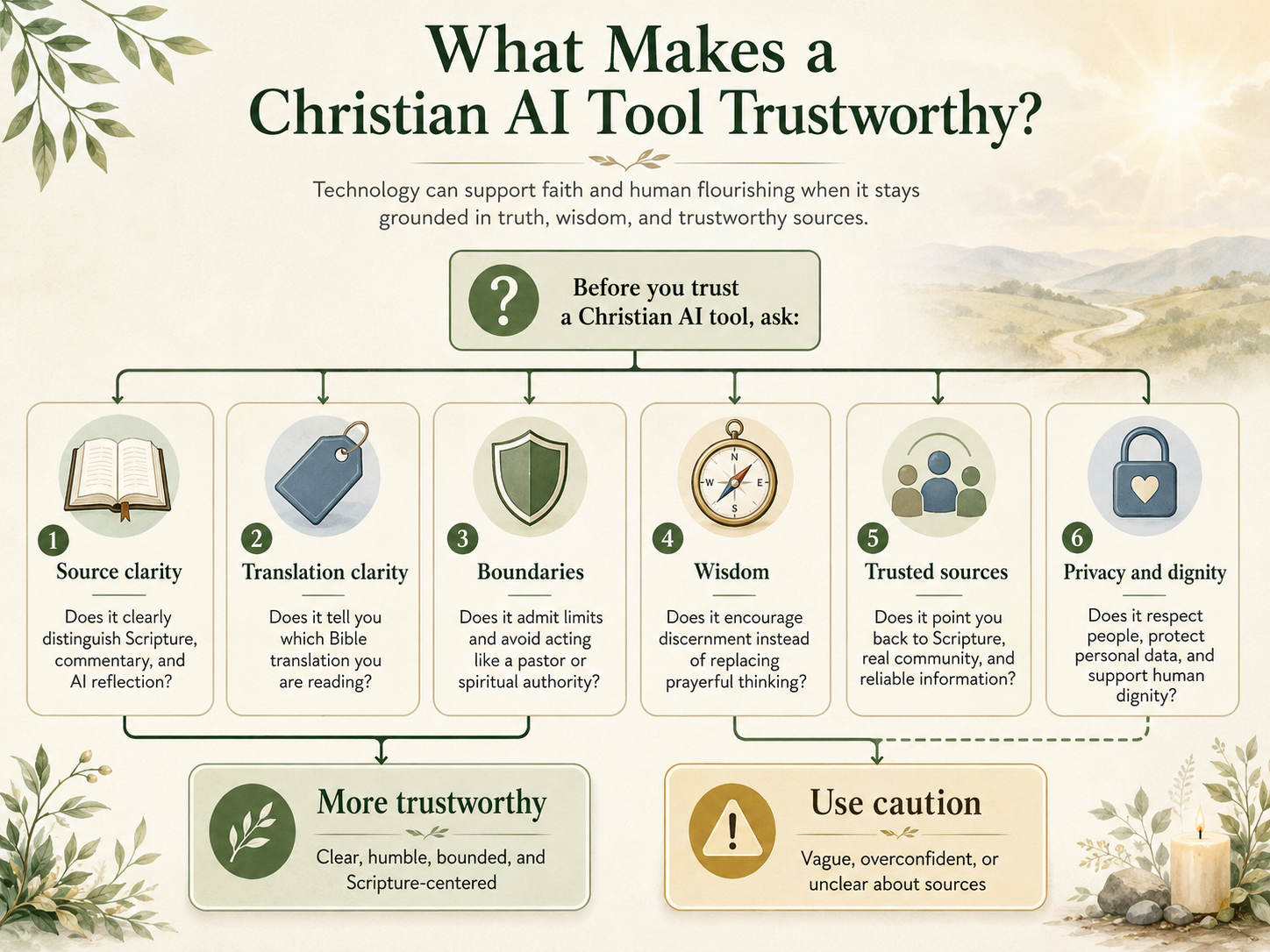
Before trusting a Christian AI tool, it is worth asking:
- Does it clearly distinguish Scripture, paraphrase, commentary, and AI-generated reflection?
- Does it tell you which Bible translation you are reading?
- Does it admit limits instead of answering everything?
- Does it encourage wisdom rather than replacing discernment?
- Does it point back to Scripture, trusted leaders, and real community?
- Does it respect privacy, dignity, and human vulnerability?
No tool will be perfect.
But those questions reveal a lot.
A Christian AI tool should not merely sound Christian. It should be designed in a way that reflects Christian seriousness: humility, truthfulness, care for people, respect for Scripture, and a willingness to stay within its proper role.
That is what makes trust possible.
Curious how this works in practice?
Try Mat44 and see how Brenda keeps the focus on Scripture, reflection, and careful boundaries.