Why “Bible-Based AI” Is Not Specific Enough
Christian users deserve to know when they are reading Scripture and when they are reading something else.
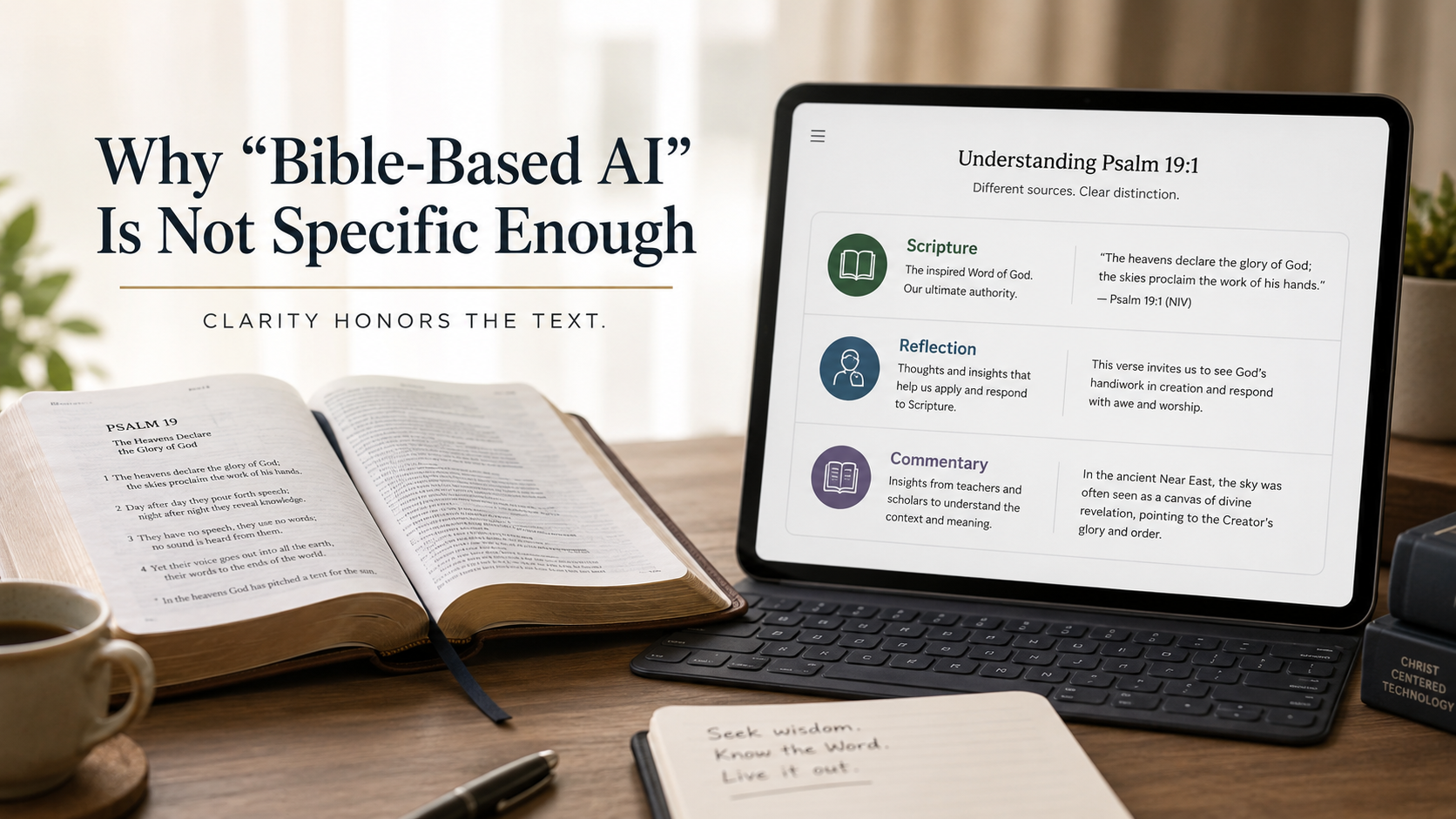
When an AI app shows you a Bible verse, how do you know it is actually Scripture?
That question sounds basic, but it matters.
A Christian app can quote a verse, paraphrase a verse, summarize a verse, blend translation language, or generate something that sounds biblical without actually being Bible text. To the average user, all of those can look similar on a screen.
That is a problem.
Scripture, paraphrase, commentary, and AI-generated reflection are not the same thing.
A responsible Christian AI app should make that difference obvious.
“Bible-based” sounds reassuring, but it is vague
The phrase “Bible-based AI” can mean many different things.
It might mean the app quotes an actual Bible translation.
It might mean the app summarizes biblical themes.
It might mean the app was trained on Christian writing.
It might mean the app uses a few verses as inspiration for generated reflections.
It might mean the app simply tries to sound Christian.
Those are not the same thing.
A user should not have to guess whether they are reading Scripture, commentary, paraphrase, devotional material, or AI-generated text. The difference matters because Christians do not treat all of those sources with the same authority.
A Bible verse carries a different kind of weight than a devotional thought.
A paraphrase may be useful, but it should not be presented as the biblical text.
An AI-generated reflection may be encouraging, but it should not be confused with Scripture.
Translation choice is a trust issue
Bible translation choice is not only a matter of personal preference.
It is also a matter of clarity, permission, and trust.
Many modern Bible translations are copyrighted. That does not make them bad. It simply means they have rules around quotation, reproduction, digital distribution, and commercial use. Bible Gateway’s page for the New International Version identifies it as a specific translation with a publisher and translation history, not a generic public-domain text that any app can freely remix.
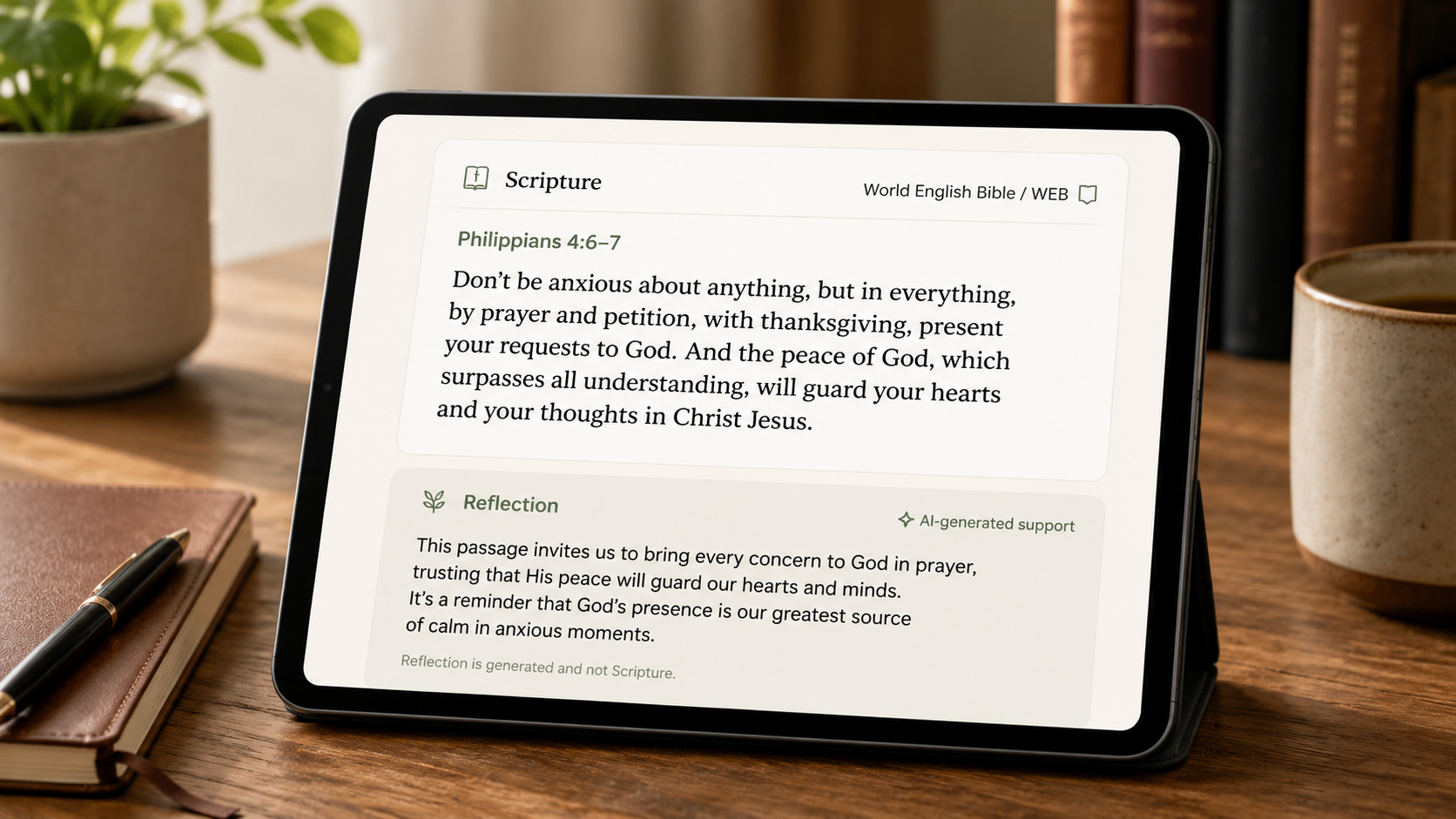
Mat44 uses the World English Bible as its primary English Scripture text because the WEB is public domain. The World English Bible’s own copyright page states that it is in the public domain and may be copied, published, distributed, quoted, and used freely.
That gives Mat44 a clean foundation for Scripture display.
It also helps preserve the distinction between the Bible text and anything Brenda, the app’s assistant, may generate in response to a user.
App Note: How Mat44 Handles This
Mat44 uses the World English Bible as its primary English Scripture text because it gives the app a clear, public-domain Scripture foundation. That matters because the Bible text should not be blended casually with generated reflections, paraphrases, or commentary.
Inside the app, Scripture and assistant-generated support are treated as different things. Brenda may help a user reflect, navigate, or return to the passage, but her words are not presented as Scripture.
That distinction is one of the most important design choices in Mat44. The app does not rely on vague “Bible-based” language. It keeps the source text and the support layer separate.
AI can sound biblical without being biblical
This is where AI changes the risk.
A normal Bible app can still have design problems, but it generally displays fixed text from a database. AI can generate new wording on the fly. That generated wording may be fluent, warm, and religious-sounding. It may even sound like a Bible verse.
But sounding biblical is not the same as being Scripture.
OpenAI’s own research on hallucinations describes the problem clearly: language models can generate plausible but false statements, and the tendency to guess instead of acknowledge uncertainty remains a challenge for AI systems.
In a Christian context, that risk is not abstract.
A model can invent a verse. It can misquote a passage. It can blend wording from different translations. It can summarize a biblical idea so loosely that the original meaning gets softened, sharpened, or redirected. It can produce something that feels spiritually moving but is not actually in the Bible.
That is why “Bible-based” is too weak as a trust claim.
Users need to know what the app is actually doing.
Clear labels protect the user
A responsible Christian AI app should be boringly clear.
If it is showing Scripture, it should identify the translation.
If it is paraphrasing, it should say so.
If it is offering a reflection, it should not present that reflection as Scripture.
If it is giving denominational context, it should not pretend all Christian traditions read every passage the same way.
If it does not know, it should say it does not know.
That kind of clarity may not sound exciting, but it is essential.
Christian users should not have to reverse-engineer the source of a verse or wonder whether an AI assistant invented a phrase.
Translation choice affects theology too
Translations make decisions.
They handle original languages, readability, idioms, manuscript traditions, and theological vocabulary differently. Most ordinary users do not need to study translation philosophy every morning, but Christian technology builders should still take it seriously.
An app that treats all translation wording as interchangeable is already being careless.
That does not mean a Christian AI app needs to settle translation debates. It does mean the app should avoid hiding the issue behind vague branding.
“Bible-based” is not enough.
“Uses the World English Bible for English Scripture display” is clearer.
“Reflection generated by the assistant” is clearer.
“Ask your church leader for application in your tradition” is clearer.
The more specific the app is, the safer it becomes.
What users should ask before trusting a Christian AI app
Before trusting a Christian AI or Bible app, users should ask practical questions.
These are not niche technical questions. They are basic trust questions about how Scripture is presented, identified, and distinguished from AI-generated content. A serious Christian app should be able to answer them plainly.
The Mat44 perspective
Mat44 is built around the belief that Scripture should stay central and clearly marked.
That means the app should not blur Bible text with AI text. Brenda can help with reflection, navigation, and gentle support, but Brenda is not the Bible. Her words should never be confused with the verse itself.
This is why translation choice, source clarity, and guardrails matter.
Not because Mat44 is trying to win a translation argument.
Because Christian users deserve to know when they are reading Scripture and when they are reading something else.
Curious how this works in practice?
Try Mat44 and see how Brenda keeps the focus on Scripture, reflection, and careful boundaries.
Try Mat44