Why Bible Translation Choice Matters in AI Apps
Bible translation is not a small detail in a Christian app, especially when AI is involved.
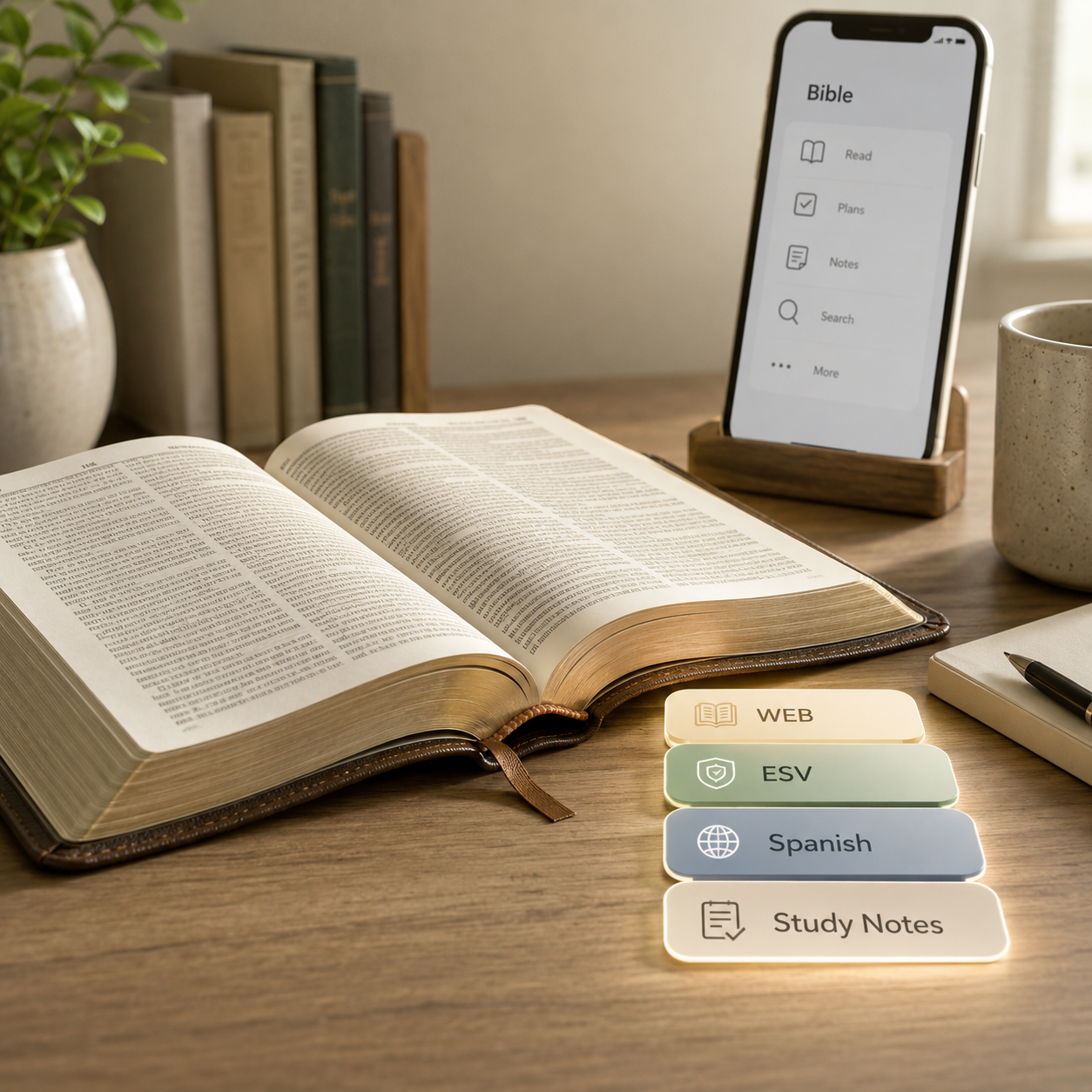
Bible translation is not a small detail in a Christian app.
It shapes what people read, how they understand a passage, what words they remember, and how they compare Scripture with teaching, devotionals, sermons, and study notes. For a simple Bible reading habit, translation choice may seem like a background setting. But when AI is involved, it becomes much more important.
A Christian AI tool should not treat “the Bible” as one vague block of religious text. It should be clear about what translation it is using, when it is paraphrasing, and when it is offering reflection or explanation.
That clarity matters for trust.
Different translations have different goals
Most Christians already know that Bible translations do not all sound the same. Some are more word-for-word. Some are more thought-for-thought. Some are written with modern readability in mind. Some preserve older phrasing because it is familiar, beautiful, or liturgically important.
That does not mean one faithful Christian must use only one translation. It does mean translation choice affects tone, wording, and sometimes the way a passage feels when someone reads it.
For example, a translation chosen for public reading may sound different from one chosen for close study. A translation used by a church tradition may feel more familiar to that community than a translation used mainly online. A Spanish-speaking Christian may also notice differences between formal Spanish, Latin American Spanish, and more conversational regional wording.
Those differences are not just technical. They are pastoral, devotional, and communal.
AI should not blur the line
One danger with AI tools is that they can make everything sound smooth.
A generated response may quote Scripture, summarize Scripture, explain Scripture, and apply Scripture in the same tone. If the app is not careful, a user may not realize where the Bible text ends and where the AI’s wording begins.
That is a problem.
Scripture should be distinguishable from paraphrase. Paraphrase should be distinguishable from commentary. Commentary should be distinguishable from personal application. A Christian AI app should make those boundaries visible instead of blending them together.
This is especially important because AI can sound confident even when it is being imprecise. A phrase may feel biblical without actually being a Bible verse. A summary may be useful without being Scripture. A devotional reflection may be encouraging without carrying the authority of the biblical text itself.
Those distinctions need to be protected.
Public domain translations are not a downgrade
Some apps use public domain or open-license Bible translations because they are easier to quote, display, and build around responsibly. That can be a good thing.
A public domain translation is not automatically less faithful or less useful. It may allow an app to show Scripture clearly, consistently, and legally without hiding verses behind licensing restrictions or replacing Bible text with vague summaries.
At the same time, Christian app builders should be honest about what translation they are using. If an app uses the World English Bible, it should say so. If it offers ESV as an option, it should say so. If it supports Spanish, it should be clear which Spanish text or wording approach is being used.
The user should not have to guess.
Translation choice affects AI responses
When AI is responding to a Bible passage, translation choice can shape the response in several ways.
It affects the exact words the AI sees. It affects which terms it repeats. It affects how a reflection is framed. It may even affect whether the AI notices an important repeated word or phrase in the passage.
That does not mean the AI should act like a scholar every time someone reads a verse. Most daily Scripture apps are not trying to replace formal Bible study. But even simple devotional tools need to be careful.
A good Christian AI app should be able to say, in effect:
- This is the Scripture text.
- This is the translation being used.
- This is a reflection on the passage.
- This is not a replacement for study, prayer, church, or pastoral counsel.
That kind of clarity builds trust.
Translation is also a community issue
Many Christians read Scripture in community. They hear it in church. They memorize it with family. They discuss it in small groups. They compare it with sermons, study Bibles, and denominational resources.
If an app uses one translation and a church uses another, that is not necessarily a problem. But the app should make the difference easy to understand. It should not create confusion by presenting AI-generated wording as if it were the exact Bible text people heard on Sunday.
This matters even more across languages.
A Spanish-speaking user may need Scripture and reflection in Spanish, but not every Spanish wording choice carries the same tone. A phrase that sounds natural in one country may sound stiff, overly formal, or strange in another. A responsible app should handle language with humility, especially when faith and Scripture are involved.
The Mat44 approach
Mat44 is built around the idea that Scripture should stay central and AI should stay secondary.
That means translation choice is not treated as an invisible technical setting. The app should be clear about the Bible text being shown, careful about when Brenda is reflecting on a passage, and cautious about not turning AI explanation into spiritual authority.
The goal is not to make AI sound impressive. The goal is to help people build a daily habit of reading Scripture with appropriate boundaries.
A Christian AI app does not need to answer every theological question. It does not need to replace pastors, teachers, study groups, or prayer. And it should not make Scripture feel like raw material for endless AI-generated content.
It should point people back to the text.
A simple test for Christian AI tools
When evaluating a Christian AI app, ask:
- Can I tell which Bible translation is being used?
- Can I tell the difference between Scripture and AI-generated reflection?
- Does the app make Bible text central, or does it bury Scripture under commentary?
- Does it respect the fact that Christians and churches may use different translations?
- Does it admit limits instead of overclaiming authority?
These are not small questions. They reveal whether a tool is designed for trust or just for engagement.
Translation choice is part of spiritual care
Bible translation choice matters because Scripture matters.
For Christian AI tools, the question is not simply, “Can this app generate helpful religious content?” The better question is, “Does this app handle Scripture with care?”
That care includes accuracy. It includes humility. It includes legal and licensing responsibility. It includes clear labels. It includes respect for churches, languages, and traditions.
A good Christian AI app should never make the user wonder whether they are reading Scripture, paraphrase, or machine-generated commentary.
The Bible text should be clear.
The AI should know its place.
And the reader should be gently guided back to Scripture itself.
Curious how this works in practice?
Try Mat44 and see how Brenda keeps the focus on Scripture, reflection, and careful boundaries.