Why Christian AI Should Admit When It Does Not Know
In Christian AI, confidence is not the same thing as trustworthiness. Sometimes the most faithful answer is to stop, redirect, and admit the tool has reached its limit.
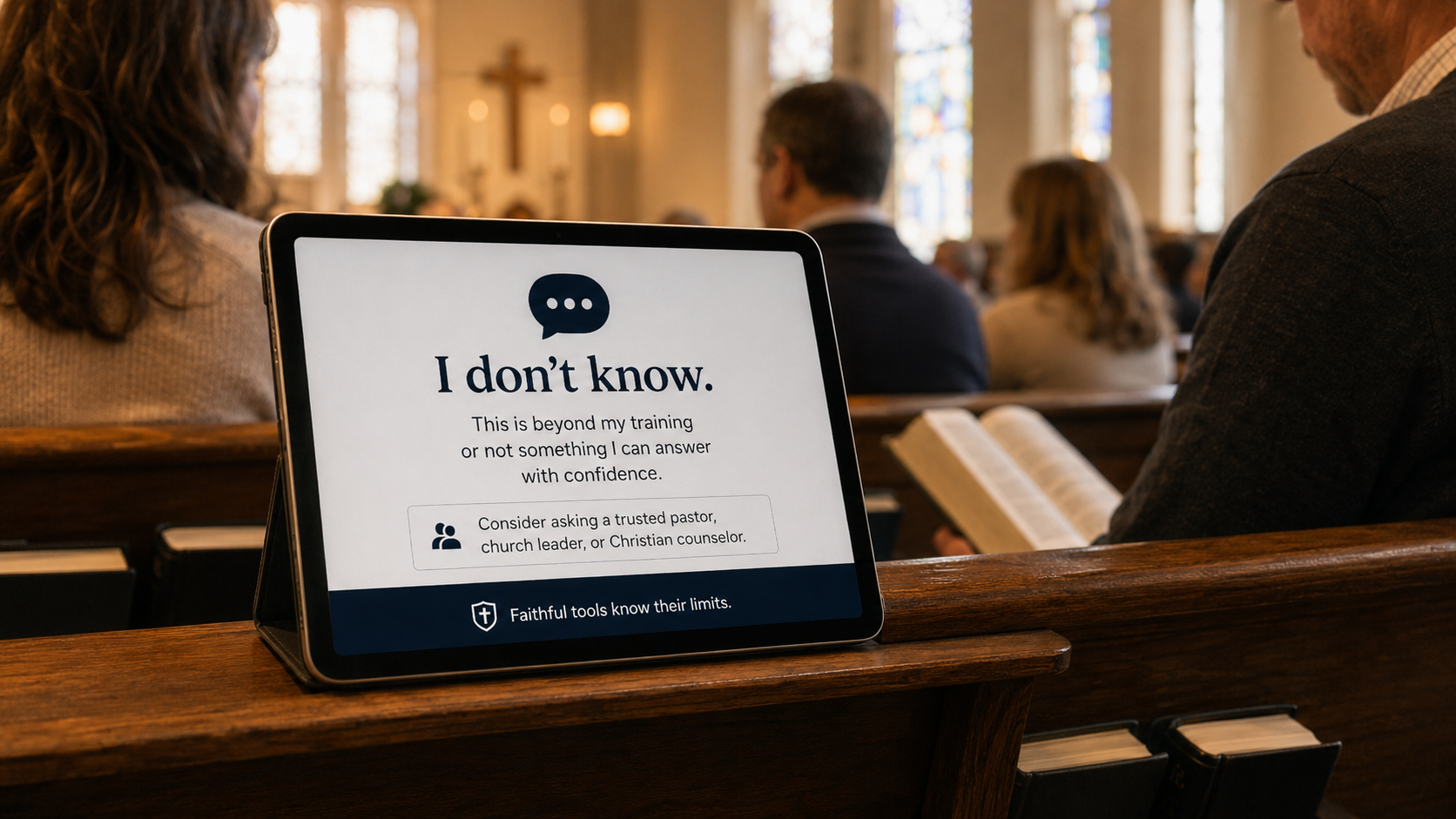
One of the most trustworthy things an AI tool can say is also one of the simplest:
I do not know.
That may not sound impressive. In a technology culture built around speed, confidence, and instant answers, admitting uncertainty can feel like failure. Many apps are designed to produce a response no matter what the user asks. If the answer sounds polished enough, it may even feel reliable.
But for Christian AI, confidence is not the same thing as trustworthiness.
A tool that answers every question may seem helpful at first. It may feel responsive, knowledgeable, and spiritually useful. But when the questions involve Scripture, theology, suffering, conscience, family conflict, mental health, church life, or personal discernment, a tool that never stops answering can quickly become unsafe.
Christian AI should be willing to say, "I do not know."
It should also be willing to say, "This is not mine to answer."
The pressure to answer everything
There is a strong pressure in AI design to make tools feel complete.
A user asks a question. The system responds. The answer appears immediately. The interaction feels smooth. That smoothness can create the impression that the tool understands more than it actually does.
This is not only a Christian concern. AI systems can make mistakes in ordinary settings too. They can summarize inaccurately, invent details, misunderstand context, or present uncertain information with too much confidence.
But faith-related questions raise the stakes.
A person may ask an AI tool whether a decision is sinful. They may ask how to understand a painful experience. They may ask about doctrine, spiritual anxiety, marriage, grief, prayer, forgiveness, church conflict, or doubt. They may not be looking for information only. They may be looking for guidance.
That is where overconfidence becomes a serious problem.
A Christian AI tool should not treat every question as if it belongs in a chatbot box.
Not every question is the same kind of question
Some questions are simple.
"What does this verse say?"
"What translation is this?"
"Can you help me reflect on this passage?"
"Can you remind me to read tomorrow?"
These are the kinds of questions a carefully designed tool may be able to support, especially if it clearly distinguishes Scripture from reflection and stays within its limits.
But other questions require more care.
"What should I do about my marriage?"
"Is God punishing me?"
"Should I leave my church?"
"Is this doctrine true?"
"What does God want me to do next?"
Those questions may include theological, pastoral, emotional, relational, or mental health dimensions. They may require context the tool does not have. They may need Scripture, prayer, wisdom, trusted leaders, qualified professionals, and real human care.
A Christian AI tool should not pretend those questions are the same as asking for a summary or a devotional prompt.
The honest answer may be: this is beyond what the tool should answer.
Humility is a design feature
In Christian contexts, humility should not be treated as a branding word.
It should show up in the design.
A humble AI tool does not try to occupy every space in the user's spiritual life. It does not turn uncertainty into confident-sounding advice. It does not generate theological claims without showing sources. It does not present itself as a pastor, priest, bishop, counselor, mentor, or spiritual authority.
A humble tool knows its role.
It can assist.
It can organize.
It can remind.
It can encourage reflection.
It can point back to Scripture.
But it should not act as if it can replace discernment, church community, pastoral care, or prayerful study.
That is why "I do not know" can be a sign of strength.
It tells the user the tool is bounded.
It tells the user the tool is not trying to become more important than it should be.
The danger of spiritual overconfidence
Overconfidence can sound very comforting.
An AI-generated answer may be gentle, polished, and full of Christian language. It may quote Scripture. It may offer a clear conclusion. It may even sound compassionate.
But sounding compassionate is not the same as being wise.
A tool can give an answer that feels emotionally satisfying while still being incomplete, contextless, or wrong. It can turn a complicated pastoral question into a neat paragraph. It can flatten denominational differences. It can use a verse correctly in one sense but poorly in another. It can make a person feel settled when they actually need conversation, correction, or care.
This is especially important because many people turn to digital tools privately.
They may ask questions they are embarrassed to ask someone else. They may ask when they are tired, lonely, afraid, or unsure. They may accept an answer because it arrives quickly and sounds calm.
That makes restraint even more important.
A Christian AI tool should be careful with people's vulnerability.
Good boundaries point people in the right direction
When a Christian AI tool refuses to answer something, the refusal should not feel cold or dismissive.
It should be a handoff.
The tool can say, in effect: this question matters too much for me to pretend I can answer it fully. Return to Scripture. Talk with a trusted church leader. Seek wise counsel. Bring this into real community. If safety, health, or legal concerns are involved, speak with a qualified professional.
That kind of response is not anti-technology.
It is good technology.
A helpful tool does not need to do everything. Sometimes its most faithful role is to help a user recognize where the next step belongs.
That may be a Bible passage.
It may be a conversation.
It may be prayer.
It may be a pastor, priest, bishop, mentor, counselor, doctor, or trusted friend.
The point is not that AI has no place.
The point is that AI should know its place.
Admitting limits builds trust
People often assume trust is built by having more answers.
But trust is also built by knowing when an answer should not be given.
A Christian AI tool that admits limits is easier to evaluate. The user can see that it is not trying to become a spiritual authority. They can see that it does not treat every question as content to generate. They can see that the design has been shaped by caution, not only capability.
That matters.
In faith-based technology, the goal should not be to keep the user inside the app as long as possible. The goal should be to serve the person faithfully.
Sometimes that means answering.
Sometimes it means clarifying.
Sometimes it means pointing to Scripture.
Sometimes it means stepping back.
A tool that never steps back is not more trustworthy.
It is simply more willing to talk.
How Mat44 thinks about uncertainty
Mat44 was built with the belief that Scripture should remain central and AI should remain bounded.
That means Brenda, the AI assistant inside Mat44, is not designed to answer every faith question. She is meant to support Scripture reading, reflection, and careful encouragement, not replace church, leaders, doctrine, prayer, or human wisdom.
When a question goes beyond her role, the better response is not to improvise.
The better response is to redirect.
That may mean pointing back to the verse. It may mean encouraging the user to talk with a trusted church leader. It may mean acknowledging that the question needs more context than an app can responsibly handle.
This is not a weakness in the design.
It is part of the design.
Because a Christian AI tool should not only ask, "Can we generate an answer?"
It should also ask, "Should we?"
A practical test for Christian AI
Before trusting a Christian AI tool, ask how it handles uncertainty.
- Does it admit when it does not know?
- Does it avoid answering questions that require pastoral care or deeper context?
- Does it distinguish Scripture from generated reflection?
- Does it point users back to trusted sources and real community?
- Does it make clear that the tool is assisting, not leading?
- Does it seem comfortable with limits?
These questions may reveal more than a feature list.
A tool that admits uncertainty is not less useful. It may be more trustworthy because it refuses to pretend.
Christian AI does not need to sound certain all the time.
It needs to be truthful.
It needs to be humble.
It needs to know when to answer, when to clarify, and when to stop.
That is part of what makes trust possible.
Curious how this works in practice?
Try Mat44 and see how Brenda keeps the focus on Scripture, reflection, and careful boundaries.