Why Families Need Safer Faith-Based Technology
Faith-based technology for families should help children and parents return to Scripture, prayer, and real community, not replace the people responsible for spiritual care.

Families are already surrounded by technology.
Children learn with screens. Parents schedule with screens. Churches communicate through screens. Bible apps, devotionals, videos, podcasts, group chats, livestreams, and learning tools all sit inside the same digital world.
That reality is not going away.
So the question is not whether Christian families will use technology. Many already do.
The better question is whether faith-based technology is being built carefully enough for families to trust it.
Parents are right to be cautious
Parents have good reasons to be careful with any app that discusses faith, identity, morality, fear, suffering, relationships, prayer, or Scripture.
Those are not neutral topics.
A tool that sounds warm, spiritual, and confident can feel safe even when it is not designed with enough boundaries. It can give answers that sound biblical without being careful. It can blur the line between Scripture and commentary. It can encourage private dependence on an app instead of conversation with parents, pastors, and trusted adults.
That does not mean every faith-based app is dangerous.
It means families need tools that are honest about what they are and what they are not.
Faith-based technology should not bypass parents
A safer Christian technology tool should respect the role of parents.
It should not position itself as the child's private spiritual authority. It should not encourage children to process serious questions alone with an AI companion. It should not make the app feel wiser, kinder, or more available than the adults God has placed in their lives.
Parents do not need technology that replaces family discipleship.
They need technology that supports it.
That might mean simple Scripture reading prompts. It might mean family discussion questions. It might mean a devotional structure that helps parents talk with their children instead of outsourcing the conversation.
The best faith-based tools should make family conversation easier, not less necessary.
Scripture should be clearly separated from AI-generated reflection
One of the most important safety issues in Christian AI is clarity.
Families should be able to tell the difference between Scripture, paraphrase, explanation, devotional reflection, and AI-generated response.
That difference matters because Scripture has a different kind of authority than an app-generated paragraph.
If a tool presents everything in the same smooth voice, children and adults may not know what they are actually reading. Is this Bible text? Is it a paraphrase? Is it commentary? Is it a generated reflection? Is it denominational interpretation?
Safer faith-based technology should make those lines visible.
Scripture should never be buried under the app's own voice.
Families need guardrails, not fear
Safety does not have to mean panic.
It does not require parents to reject every tool or treat every app as a threat. It does mean asking better questions before inviting a tool into family faith habits.
A safer faith-based tool should have guardrails around:
- What it claims to be.
- How it handles Scripture.
- When it refuses to answer.
- How it responds to sensitive situations.
- Whether it encourages real community.
- Whether parents and church leaders remain central.
Guardrails are not a sign that the tool is weak. They are a sign that the tool knows its place.
Christian AI should point families back to church
A family Scripture app should not quietly train people to become isolated Christians.
It should point back toward the church.
That does not mean every question requires a formal appointment with a pastor. But it does mean that hard questions, doctrinal confusion, personal struggle, grief, moral decisions, and spiritual distress should not be treated as private app-only conversations.
Families need embodied Christian community.
They need pastors, teachers, small groups, friends, grandparents, youth leaders, Sunday school teachers, and other believers. They need people who can listen, pray, challenge, encourage, and notice what an app cannot.
Technology can support that.
It should not replace it.
Children need more than correct answers
When people talk about AI and children, the conversation often focuses on accuracy.
Accuracy matters. A tool should not make up Bible facts, invent doctrine, or confidently misrepresent Scripture.
But children need more than correct answers.
They need formation. They need wisdom. They need examples. They need trusted adults who know them. They need space to ask questions without being handed a polished answer too quickly.
Sometimes the best response to a child's faith question is not an answer from an app. It is a conversation at the table.
Safer faith-based technology should preserve room for that.
Parents also need support
None of this means parents have to do everything alone.
Many parents feel overwhelmed. They want to help their children read Scripture, pray, ask questions, and understand faith, but they may not feel confident. They may be tired. They may not know where to begin.
A well-designed tool can help.
It can suggest a short passage. It can offer a simple discussion question. It can help a parent prepare a five-minute devotional. It can make the next step feel less intimidating.
That kind of support honors the parent's role instead of replacing it.
The Mat44 approach
Mat44 is built around the idea that Scripture comes first and AI stays secondary.
Brenda, the AI companion inside Mat44, is not designed to become a child's private pastor, a family's final doctrine source, or a replacement for church. She is designed to help with Scripture reflection inside careful boundaries.
For families, that matters.
A tool should help people read the Bible, think about the passage, and continue the conversation with real people. It should not create dependence on the app. It should not pretend to be more spiritually important than parents, pastors, Scripture, or the church.
Good faith-based technology should be humble enough to serve.
Questions families can ask before using a faith-based AI tool
Before using a faith-based technology tool with children or as a family, ask:
- Does it clearly show what is Scripture and what is generated commentary?
- Does it encourage parents to stay involved?
- Does it point people back to church and real community?
- Does it avoid acting like a pastor or spiritual authority?
- Does it have boundaries for sensitive questions?
- Does it encourage prayer, conversation, and Scripture reading outside the app?
Those questions are not anti-technology.
They are pro-discipleship.
Safe does not mean flashy
The safest faith-based technology may not be the flashiest.
It may not answer every question. It may not keep users engaged for hours. It may not promise a personalized spiritual mentor or instant certainty.
It may do something quieter and better.
It may help a family open Scripture, talk honestly, pray together, and return to church with better questions.
That is enough.
Families deserve tools that know their place
Families do not need faith-based technology that competes with parents, pastors, Scripture, or church.
They need tools that know their place.
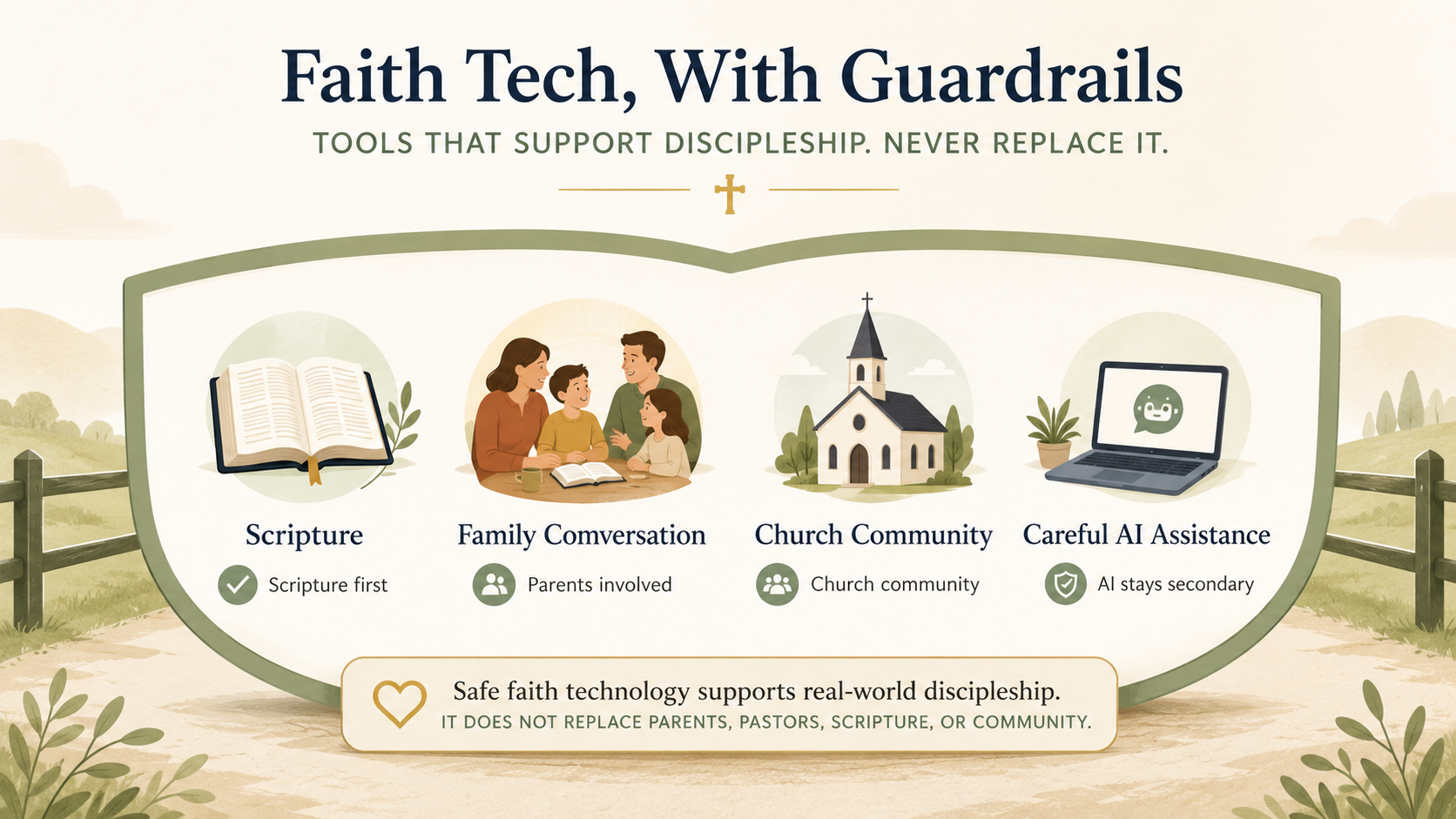
Safe Christian technology should support real-world discipleship. It should help families return to Scripture. It should make conversation easier. It should keep AI secondary. It should step back when real human care is needed.
Technology can serve a family's faith.
It should never try to become the center of it.
Curious how this works in practice?
Try Mat44 and see how Brenda keeps the focus on Scripture, reflection, and careful boundaries.