AI Is Not Magic: Why Christians Should Understand the Basics
You do not need to understand every technical detail of artificial intelligence, but a few basic concepts can make Christian conversations about AI calmer, wiser, and more honest.
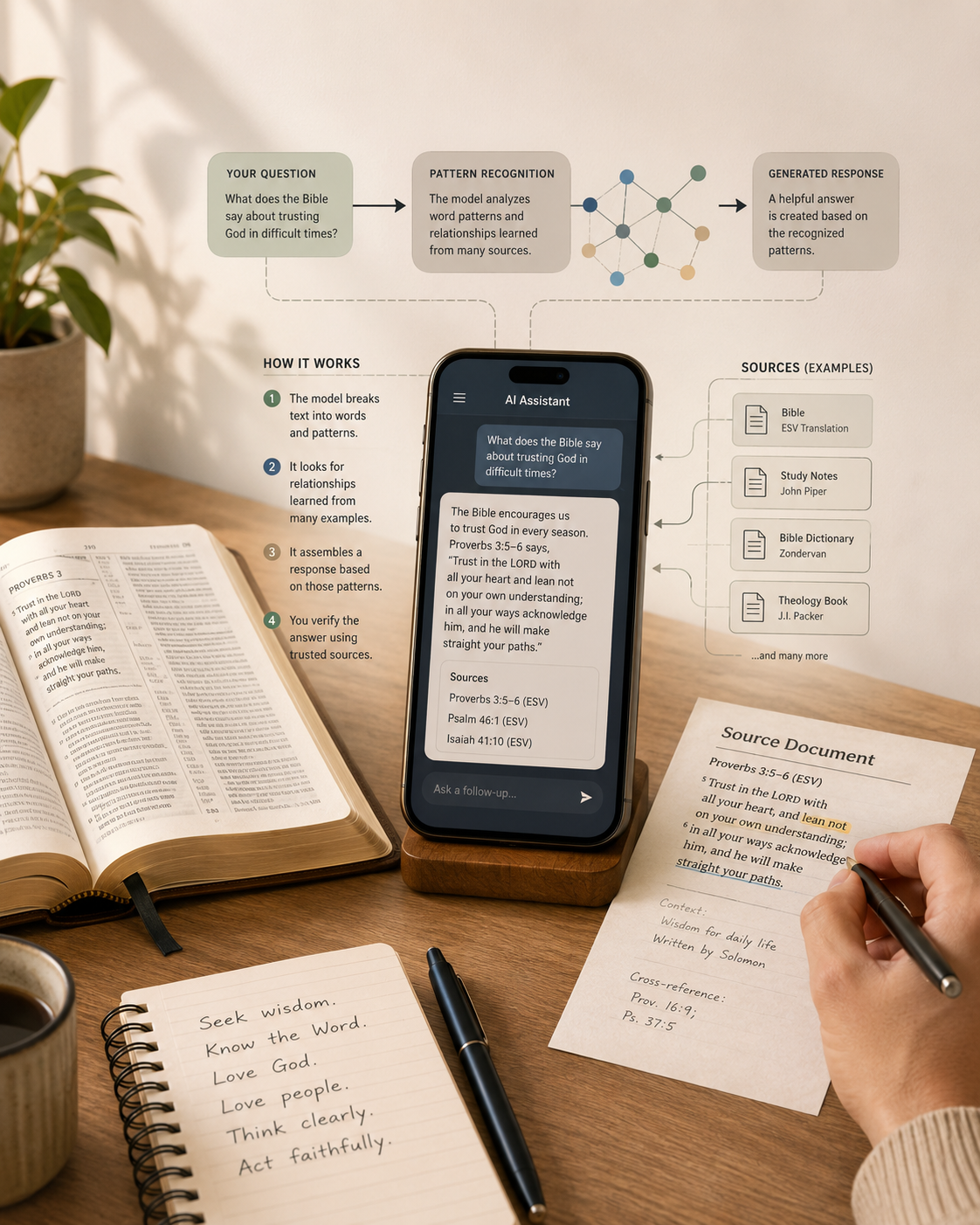
Artificial intelligence is often discussed in extremes. It is either described as a nearly supernatural intelligence that will transform everything, or as a mysterious threat that Christians should avoid entirely.
Both reactions are understandable. AI systems can produce surprisingly capable work, and the speed of recent development can make the technology feel difficult to evaluate.
But treating AI as magic makes discernment harder, not easier.
Christians do not need to become machine-learning engineers. We do need enough basic literacy to ask better questions, recognize exaggerated claims, and use tools according to their actual strengths and limitations.
Artificial intelligence is a broad category
Artificial intelligence does not name one machine, one mind, or one product.
It is a broad term for computer systems designed to perform tasks commonly associated with human intelligence, such as recognizing patterns, generating language, classifying images, making predictions, or assisting with decisions.
A spam filter, a recommendation system, an image-recognition tool, and a conversational chatbot may all use forms of AI while working in very different ways.
This matters because claims about AI are often too broad to be useful.
A concern that applies to an open-ended chatbot may not apply in the same way to a narrow system that sorts documents. A benefit in medical imaging does not automatically prove that a chatbot is qualified to answer spiritual questions.
Generative AI predicts plausible output
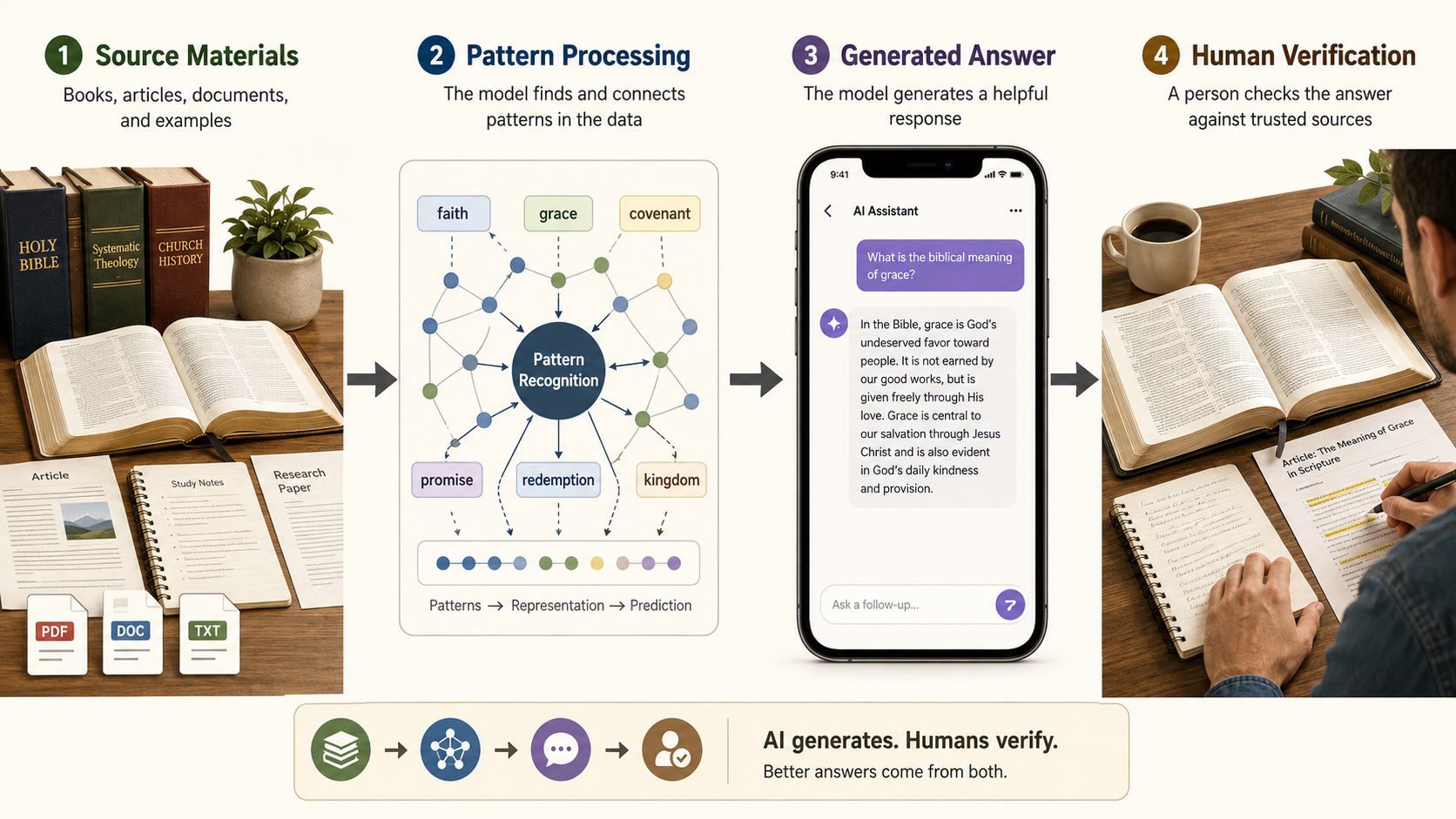
The chatbots most people now associate with AI are generative systems. They produce new text, images, audio, or other content based on patterns learned from large amounts of data.
A large language model does not retrieve every answer from a perfectly organized internal encyclopedia.
At a simplified level, it generates language by predicting what is likely to come next in context.
This is why it can write a clear paragraph, adapt its tone, summarize an idea, or imitate familiar structures.
It is also why polished language should not be confused with verified truth. A plausible sentence can still be false.
The model is not a person behind the screen
Conversational language encourages us to relate socially to a chatbot. We say that it knows, believes, understands, or wants something.
These shortcuts can be useful in ordinary conversation, but they can also create false expectations.
An AI system can model language associated with empathy without experiencing compassion. It can explain a theological view without holding a confession of faith. It can produce a prayer-shaped response without praying.
This does not make the output useless. It helps define the correct role of the tool.
A calculator does not understand mathematics as a person does, yet it can still assist us.
An AI system may help organize thoughts, surface questions, compare wording, or support a reading habit without becoming a spiritual being or authority.
Training data, instructions, and guardrails are different things
It is common to hear that a tool is trained on the Bible or Bible-based. Those phrases sound reassuring, but they do not tell us enough.
Training data influences the model's general patterns. A prompt tells the model how to approach the current interaction.
Product rules and guardrails shape what the system is allowed or expected to do. Retrieval systems may provide selected source material at the moment an answer is generated.
These layers are not interchangeable.
Quoting Scripture in a prompt does not guarantee that a model will stay within safe boundaries. Including Christian material in a knowledge base does not make every generated interpretation reliable.
Responsible evaluation asks how the whole system works.
Why basic AI literacy is a Christian stewardship issue
Christians already practice discernment around books, sermons, podcasts, teachers, and media.
We ask who created something, what claims it makes, what authority it assumes, and whether its fruit is healthy.
AI tools deserve the same seriousness.
Understanding the basics helps us avoid two unhelpful mistakes: giving a system more authority than it deserves, or rejecting every use because the technology feels unfamiliar.
UNESCO's work on AI competency emphasizes that people need to understand both the potential and the risks of AI so they can engage with it responsibly.
That principle applies beyond schools. Literacy is part of informed use.
Discernment becomes more practical when the technology is no longer surrounded by mystery.
Five questions that cut through the hype
- What specific task is this system designed to perform?
- What information does it use to produce an answer?
- Can it provide or identify reliable sources?
- What happens when it is uncertain or outside its intended role?
- Who remains responsible for checking and acting on the output?
These questions are more useful than asking whether AI is simply good or bad.
Technologies are built, configured, marketed, and used in particular ways. The design matters. The context matters. Human responsibility remains.
What this means for Christian AI
A Christian AI product should not depend on users believing the system is mysterious, spiritually perceptive, or uniquely authoritative.
It should explain its purpose in ordinary language and make its limits visible.
Mat44 uses AI as a supporting layer around a Scripture habit. The technology can help present reflection questions and maintain a conversational experience, but Scripture is the source text and the user remains responsible for discernment.
Pastors, families, churches, and real communities continue to occupy roles no software should claim.
AI is not magic. That is not an insult to the technology. It is the beginning of using it wisely.
Further reading
- UNESCO: AI competency frameworks for students and teachers
- UNESCO: Media and information literacy responses to generative AI
- NIST: Generative Artificial Intelligence Profile
Curious how this works in practice?
Try Mat44 and see how Brenda keeps the focus on Scripture, reflection, and careful boundaries.