Prompts vs. Guardrails: What Christians Should Know About AI Safety
When spiritual topics are involved, “please be careful” is not enough.
Artificial intelligence often sounds safer than it actually is.
A system may say it is respectful, careful, neutral, or faith-sensitive. It may promise to avoid harmful advice or respect Christian traditions. It may even be prompted to behave that way.
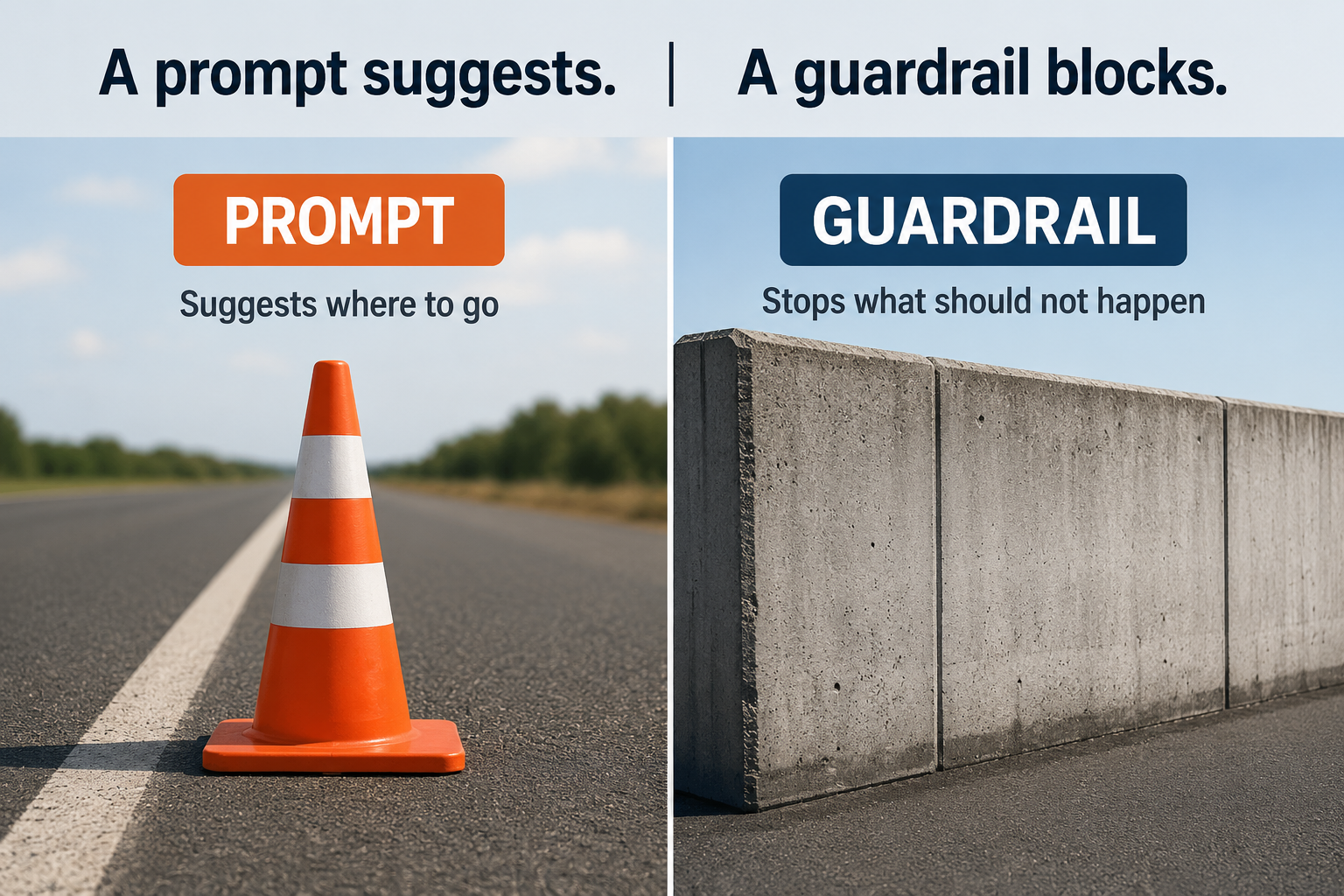
But a prompt is not the same thing as a guardrail.
That difference matters, especially when AI is being used around Scripture, prayer, doctrine, grief, suffering, family decisions, or spiritual authority.
What Is a Prompt?
A prompt is an instruction given to an AI system.
It might say:
“Answer in a warm tone.”
“Be respectful of Christian beliefs.”
“Do not be controversial.”
“Encourage users to talk to a pastor.”
Those instructions can be useful. They shape the way an AI responds.
But prompts are still requests.
They influence behavior, but they do not necessarily enforce boundaries.
A prompt can be ignored, misunderstood, overridden, or weakened by the way a user asks a question.
That is why a prompt alone is rarely enough for sensitive situations.
What Is a Guardrail?
A guardrail is different.
A guardrail is a boundary built into the system.
It does not merely ask the AI to be careful. It limits what the AI is allowed to do.
For example, a guardrail might prevent an AI system from giving medical or legal advice, claiming spiritual authority, settling denominational disputes, telling someone what God wants them to do, or making major life decisions for a user.
That kind of boundary matters because some questions should not be answered by AI, no matter how politely the user asks.
Why This Matters
AI systems are often used during emotionally sensitive moments.
People do not only use them out of curiosity. They use them when they feel lonely, confused, anxious, grieving, discouraged, or overwhelmed.
That does not mean AI should never be used in those moments.
It does mean the system needs real limits.
A prompt might tell an AI to respond gently.
A guardrail tells the system when not to answer directly.
That is a very different thing.
“Be Careful” Is Not a Safety System
It is easy to write a prompt that sounds responsible.
“Be kind.”
“Be biblical.”
“Respect all denominations.”
“Do not replace pastors.”
Those are good instructions.
But they are not a complete safety system.
The real test is what happens when a user asks something difficult.
“What church is the true church?”
“Should I leave my spouse?”
“Is God punishing me?”
“Tell me what God wants me to do.”
“Can you diagnose what is wrong with me?”
Those are not ordinary information questions.
They require wisdom, context, pastoral care, and sometimes professional help.
A trustworthy system should not simply produce a confident answer because it can.
It should know when to redirect.
Why This Matters More in the Age of Vibe Coding
Building software has become dramatically easier.
A person can describe an app idea in plain English and have a working prototype within hours. That is one of the most exciting developments in modern technology.
It has also created a new challenge.
Many builders assume that asking an AI to behave safely is the same thing as building safety into the system.
It isn’t.
A prompt might say, “Respect all denominations,” “Do not give dangerous advice,” or “Encourage users to talk to a pastor.”
Those instructions may help.
But they are still instructions.
They are not necessarily enforced boundaries.
In many cases, a builder may believe they have added guardrails when they have only added prompts.
The distinction matters because users rarely behave exactly the way the builder expected.
Questions are phrased differently. Edge cases appear. Conversations wander into territory nobody anticipated.
When that happens, the system falls back on whatever architecture exists underneath the prompt.
If no real guardrails exist, the AI may produce answers the builder never intended.
That does not mean vibe-coded applications are automatically unsafe.
Many are useful and well-intentioned.
It does mean that users should look beyond marketing claims and ask a deeper question: What actually prevents this system from crossing a line?
A trustworthy answer usually involves more than a prompt.
It involves architecture.
The Problem With Overconfident AI
One of the risks of AI is that it can make almost any answer sound calm and reasonable.
That can be helpful when the topic is simple.
It can be dangerous when the topic is spiritually or emotionally loaded.
A confident answer is not the same thing as a trustworthy answer.
A polished answer is not the same thing as a wise answer.
A fast answer is not the same thing as pastoral care.
This is why guardrails matter. They help prevent a system from confusing fluency with authority.
Good Guardrails Redirect Without Abandoning the User
A guardrail should not feel cold or robotic.
The best guardrails do two things at once.
They refuse to cross a boundary, and they still care for the person asking.
For example, a system should not tell someone whether to get divorced.
But it can acknowledge that the question is important and encourage the person to seek guidance from trusted leaders, counselors, or appropriate professionals.
A system should not declare which denomination is correct.
But it can explain that traditions understand the issue differently and encourage further discussion within the user’s own faith community.
A system should not pretend to pray on someone’s behalf.
But it can help the user think through their own prayer.
That balance is important.
Boundaries should protect users without making them feel dismissed.
Why This Matters to Mat44
Over the course of 15 months developing Mat44, a surprising amount of the work had very little to do with artificial intelligence itself.
The visible part of the app is relatively straightforward. Users see Scripture, reflection tools, and conversations with Brenda.
What they do not see are the boundaries underneath.
Much of the development effort was spent deciding where the system should stop, redirect, or refuse to act as an authority.
Should AI settle denominational disputes?
Should it tell someone what God wants them to do?
Should it provide legal, medical, or mental health guidance?
Should it pull theology directly from the open internet?
Should it generate content that sounds authoritative even when uncertainty exists?
Those questions are not primarily AI questions. They are architecture questions.
The difference matters because a system can be prompted to behave well while still lacking meaningful boundaries.
In Mat44, many of the most important decisions happen before AI generates a response. Some topics are redirected. Some requests receive boundaries instead of answers. Some information comes from reviewed internal sources rather than unrestricted internet retrieval.
That work is largely invisible to users.
It is also where much of the development effort went.
The result is not a system that can answer every question.
The result is a system designed to stay inside its intended role.
For a Scripture-centered application, that is not a limitation. It is the goal.
Bounded Knowledge Is Part of Safety
Guardrails are not only about refusing dangerous questions.
They are also about controlling what information the system is allowed to use.
This matters because the open internet is messy.
Some sources are helpful. Some are biased. Some are hostile. Some are simply wrong.
If an AI system can pull from anywhere, it may repeat stereotypes or treat low-quality material as if it were reliable.
For Christian AI, that risk is especially serious when discussing denominations, doctrine, and religious practices.
A safer system limits its knowledge sources.
It uses reviewed material.
It avoids pretending that every answer can be safely generated from whatever the internet happens to provide.
Sometimes the safest AI knows less.
What Users Should Ask Before Trusting an AI Tool
Most people do not need to understand every technical detail before using AI.
But they should ask better questions.
Does this system only use prompts, or does it have actual boundaries?
What happens when users ask for spiritual authority?
Does it redirect major life decisions to trusted people?
Does it preserve Scripture accurately?
Does it clearly separate Scripture from explanation or paraphrase?
Does it respect denominational differences?
Does it use bounded sources, or does it pull from the open internet?
Does it admit uncertainty?
Those questions reveal far more than a polished demo ever will.
Further Reading
For readers interested in AI safety and system design, these resources are worth exploring:
National Institute of Standards and Technology — AI Risk Management Framework
OWASP Foundation — Top 10 Risks for Large Language Model Applications
While these frameworks are not specifically Christian, they illustrate an important point: trustworthy AI systems require more than good intentions. They require boundaries, testing, and deliberate design decisions.
Final Thoughts
Prompts are useful.
Guardrails are necessary.
A prompt can ask AI to behave well.
A guardrail helps prevent it from behaving outside its proper role.
That distinction matters in any serious AI product.
It matters even more when the product touches Scripture, prayer, doctrine, grief, or spiritual guidance.
Users do not merely need AI systems that sound careful.
They need systems that are designed with real boundaries.
Because in sensitive situations, safety should not depend on the AI remembering to be humble.
It should be built into the system from the beginning.
Curious how this works in practice?
Try Mat44 and see how Brenda keeps the focus on Scripture, reflection, and real boundaries.
Try Mat44