AI Should Support Pastors, Not Compete With Them
Christian AI can be useful when it helps people return to Scripture, prepare thoughtfully, and ask better questions, but it should never pretend to replace pastors, churches, or real pastoral care.
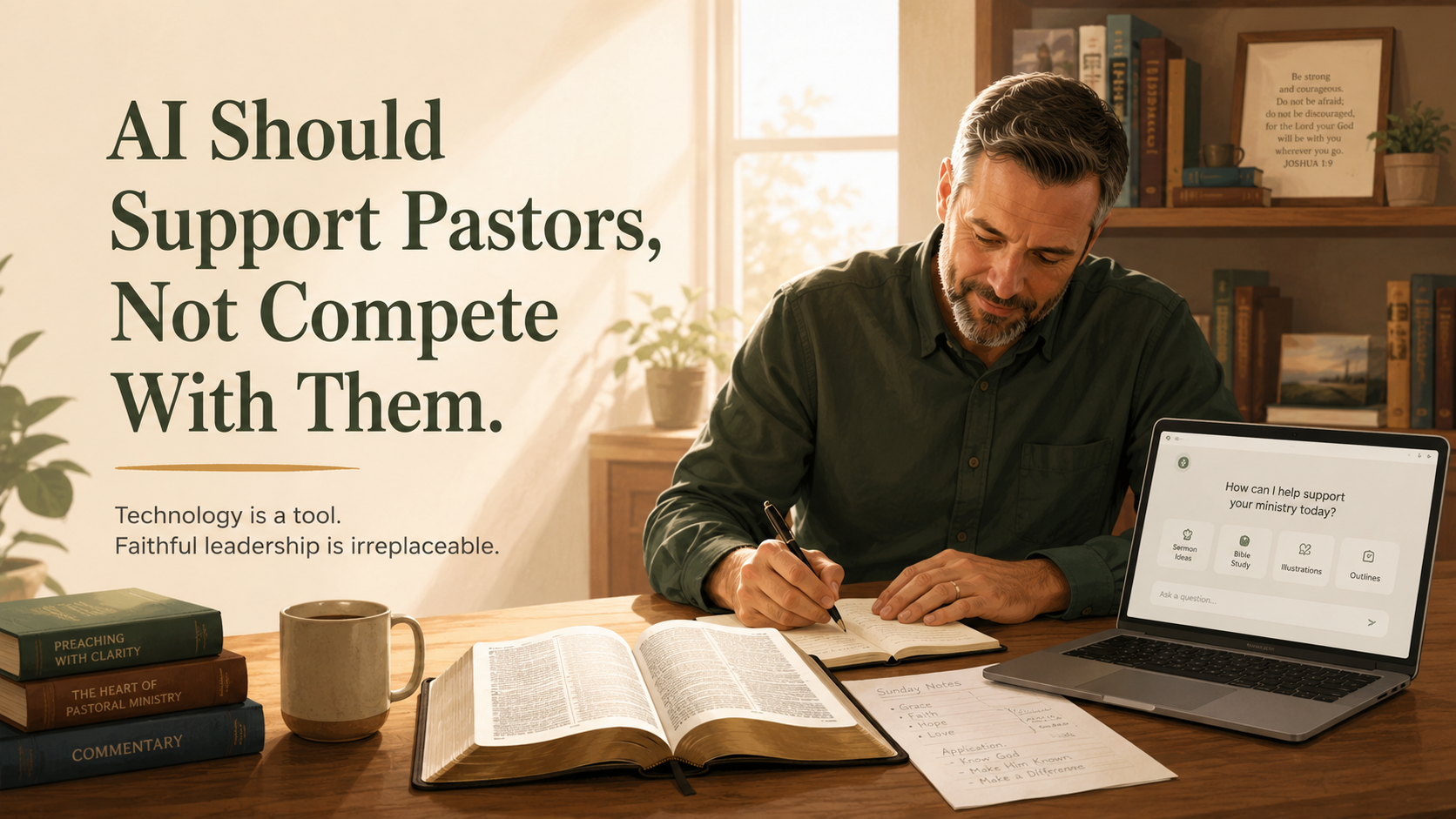
One of the biggest concerns Christians have about AI is not whether the technology can answer questions. It clearly can. The deeper concern is whether people will start treating those answers as spiritual authority.
That concern is fair.
A Christian AI tool can sound confident. It can summarize Bible passages. It can suggest discussion questions. It can help someone think through a devotional passage or find a place to begin reading. But none of that makes it a pastor.
Pastoral ministry is not just information delivery. It involves wisdom, accountability, presence, relationship, prayer, correction, patience, discernment, and care for actual people in actual circumstances.
AI can support some of the work around ministry. It should not compete with ministry itself.
The strongest concern deserves to be taken seriously
Some Christians are understandably cautious about faith-based AI because they can imagine the worst version of it: a chatbot acting like a spiritual leader, giving confident answers to fragile people, bypassing pastors, flattening denominations, and making private struggles feel like a customer-service interaction.
That is not a paranoid concern. It is a design concern.
A tool that invites people to ask it anything about faith, morality, suffering, doctrine, marriage, grief, church conflict, or spiritual crisis can easily drift into territory where a real pastor, counselor, parent, elder, priest, bishop, mentor, or trusted Christian friend should be involved.
The question is not only, Can AI respond?
The better question is, Should AI respond in this situation, and what should it point the person back toward?
Pastors do more than answer questions
A pastor is not valuable because he or she has instant access to information. Search engines already changed that part of the world years ago.
Pastors are valuable because they shepherd people.
They know the congregation. They notice patterns. They understand when someone is asking a theological question and when that question is really carrying grief, shame, loneliness, anger, fear, or confusion.
They can say, "This is not something to handle alone." They can pray with someone. They can bring in other leaders. They can encourage confession, reconciliation, patience, repentance, or rest in ways that are connected to a real community.
AI cannot do that. It can imitate the language of care, but it cannot become accountable to a person. It cannot watch over a soul. It cannot show up at the hospital, sit across the table, preach to a known congregation, or carry the burden of pastoral responsibility.
Where AI can help without taking over
There are still useful ways AI can support pastors and churches when the boundaries are clear.
For example, AI can help a pastor or ministry leader:
- Draft discussion questions for a Bible study.
- Organize notes around a passage.
- Create reading prompts for a devotional group.
- Explain a simple historical or literary context before deeper study.
- Suggest ways to encourage daily Scripture reading.
- Help people return to the actual biblical text instead of wandering endlessly through opinions.
Those are support tasks. They are not pastoral authority.
Used carefully, AI can reduce some of the friction around preparation, reading, and reflection. It can help a busy person begin again. It can help a church member ask a better question before a small group. It can help a pastor turn scattered notes into a clearer outline.
But the center should remain Scripture, prayer, church, and pastoral care.
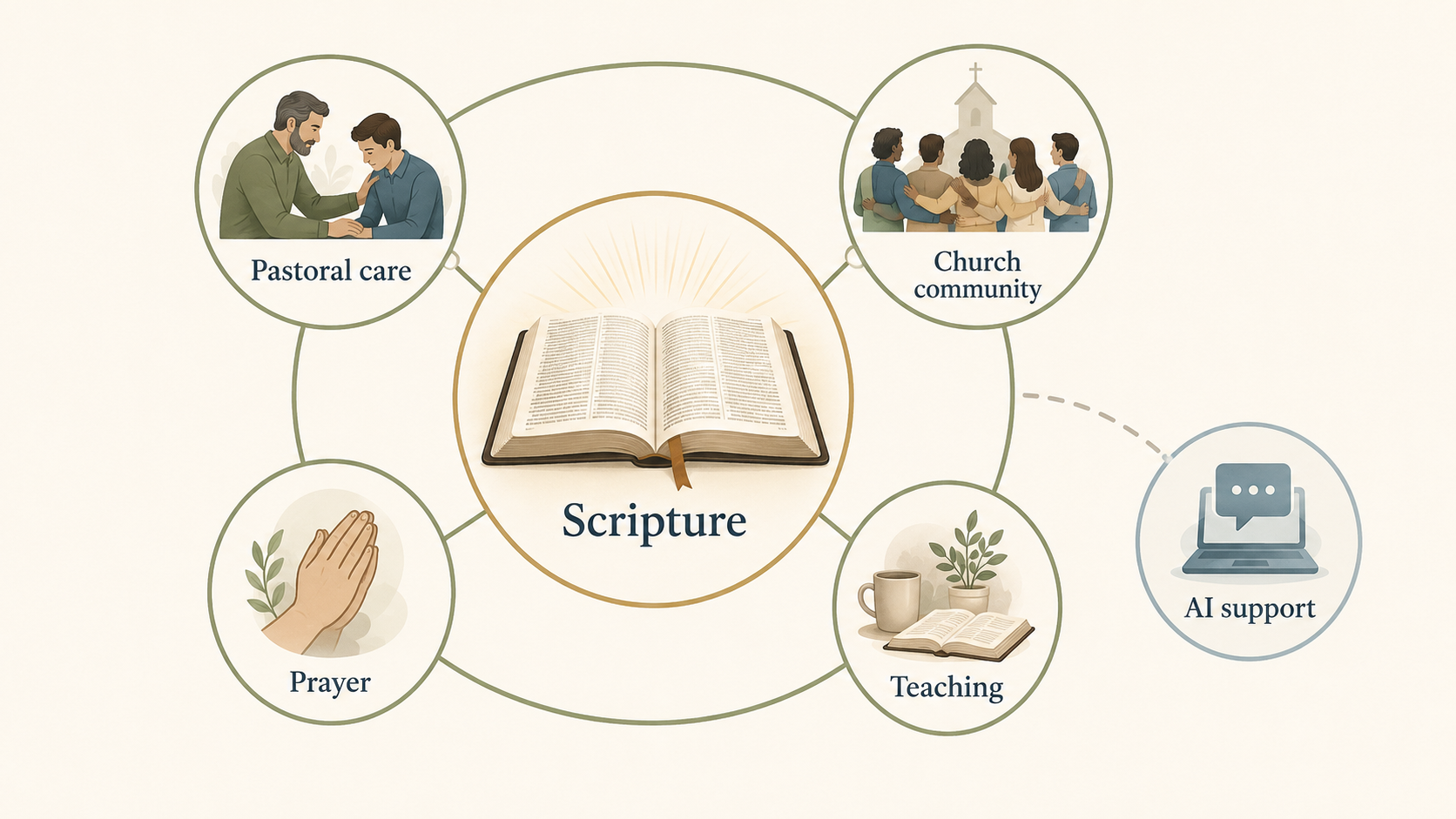
The danger is not help. The danger is hierarchy.
The problem with Christian AI is not that it helps people. Help can be good.
The problem comes when the hierarchy gets inverted.
If AI becomes the first place people go for spiritual counsel, the most trusted voice in their faith life, or the tool they rely on instead of Scripture and community, something has gone wrong.
A healthy Christian AI tool should make the proper order clearer:
- Scripture is primary.
- God is not replaced by a tool.
- Pastors and churches still matter.
- Human relationships are not optional.
- AI stays limited, transparent, and secondary.
This is why the language around Christian AI matters. A tool should not present itself as a pastor, spiritual director, prophet, priest, therapist, confessor, or final interpreter of Scripture.
It should be honest about what it is: a tool.
Good Christian AI should know when to step back
One of the most important design choices in a Christian AI tool is not what it answers. It is what it refuses to answer.
Some situations should trigger humility. If someone is in crisis, facing abuse, considering self-harm, dealing with serious mental health distress, wrestling with medical decisions, or asking for authoritative pastoral direction, the right response is not a polished paragraph.
The right response is to point toward real people and appropriate help.
That does not make the tool less useful. It makes it more trustworthy.
A Christian tool should not be designed to keep people inside the app at all costs. It should be designed to send them back to Scripture, prayer, family, church, and qualified human care when that is what the situation calls for.
Pastors may still have good reasons to use AI
Rejecting AI as a replacement for pastors does not mean pastors should never use it.
Many pastors already use tools that support ministry: Bible software, sermon archives, commentaries, calendars, email systems, livestream platforms, church management software, design tools, and translation resources.
The question is not whether a tool is allowed to exist. The question is whether it serves the church faithfully.
A pastor might use AI to brainstorm youth group questions, simplify an announcement, create a reading plan draft, compare wording, organize teaching notes, or think through how a passage may sound to a new believer.
That can be useful.
But the pastor still has to discern, edit, correct, reject, and shepherd. The tool does not get the final word.
For church members, AI should encourage deeper connection
A church member using a Christian AI tool should not be nudged away from church.
The better design is the opposite.
If someone asks a hard question, the tool can help them name the question more clearly before bringing it to a pastor or small group. If someone is trying to build a Scripture habit, the tool can help them stay consistent without pretending app usage equals spiritual maturity. If someone is confused by a passage, the tool can suggest observations while encouraging them to read carefully and seek wise Christian counsel.
AI should not become a private substitute for discipleship. It should become a bridge back to healthier habits and better conversations.
The Mat44 approach
Mat44 is built around this basic conviction: Scripture is the point. The AI is not.
Brenda, the AI companion inside Mat44, is not designed to act like a pastor. She is not designed to settle every doctrine question, provide personal spiritual authority, or keep people chatting endlessly.
The goal is more modest and, I think, more faithful.
Mat44 helps people build a daily Scripture habit. It supports reflection. It keeps the conversation tied to the Bible passage. It admits limits. It avoids pretending to be more than it is. And when a question belongs in real community, pastoral care, or professional help, the tool should step back.
That is not a weakness. That is the boundary.
A simple test for Christian AI tools
Before trusting a Christian AI tool, ask:
- Does it keep Scripture central?
- Does it admit uncertainty?
- Does it avoid acting like clergy?
- Does it point people back to real Christian community?
- Does it have clear guardrails for sensitive situations?
- Does it make AI feel secondary rather than spiritually authoritative?
Those questions matter because technology does not stay neutral in practice. The way a tool is designed teaches users what to trust.
If a Christian AI tool quietly trains people to trust the app more than Scripture, pastors, or Christian community, it is not just a tool problem. It is a formation problem.
Support is good. Substitution is not.
Christian AI can be helpful. It can lower the barrier to Scripture reading. It can support pastors and ministry leaders. It can help people ask better questions. It can encourage reflection and consistency.
But it should never compete for the role of pastor.
The best version of Christian AI is not the one that sounds most spiritual. It is the one that knows its place.
Scripture remains central. Pastors still shepherd. Churches still gather. People still need prayer, accountability, and real community.
AI can support that.
It should not replace it.
Curious how this works in practice?
Try Mat44 and see how Brenda keeps the focus on Scripture, reflection, and careful boundaries.