Can AI Help Christians Ask Better Questions About Scripture?
The most useful role for AI in Bible study may not be giving Christians answers. It may be helping us slow down long enough to ask better questions.
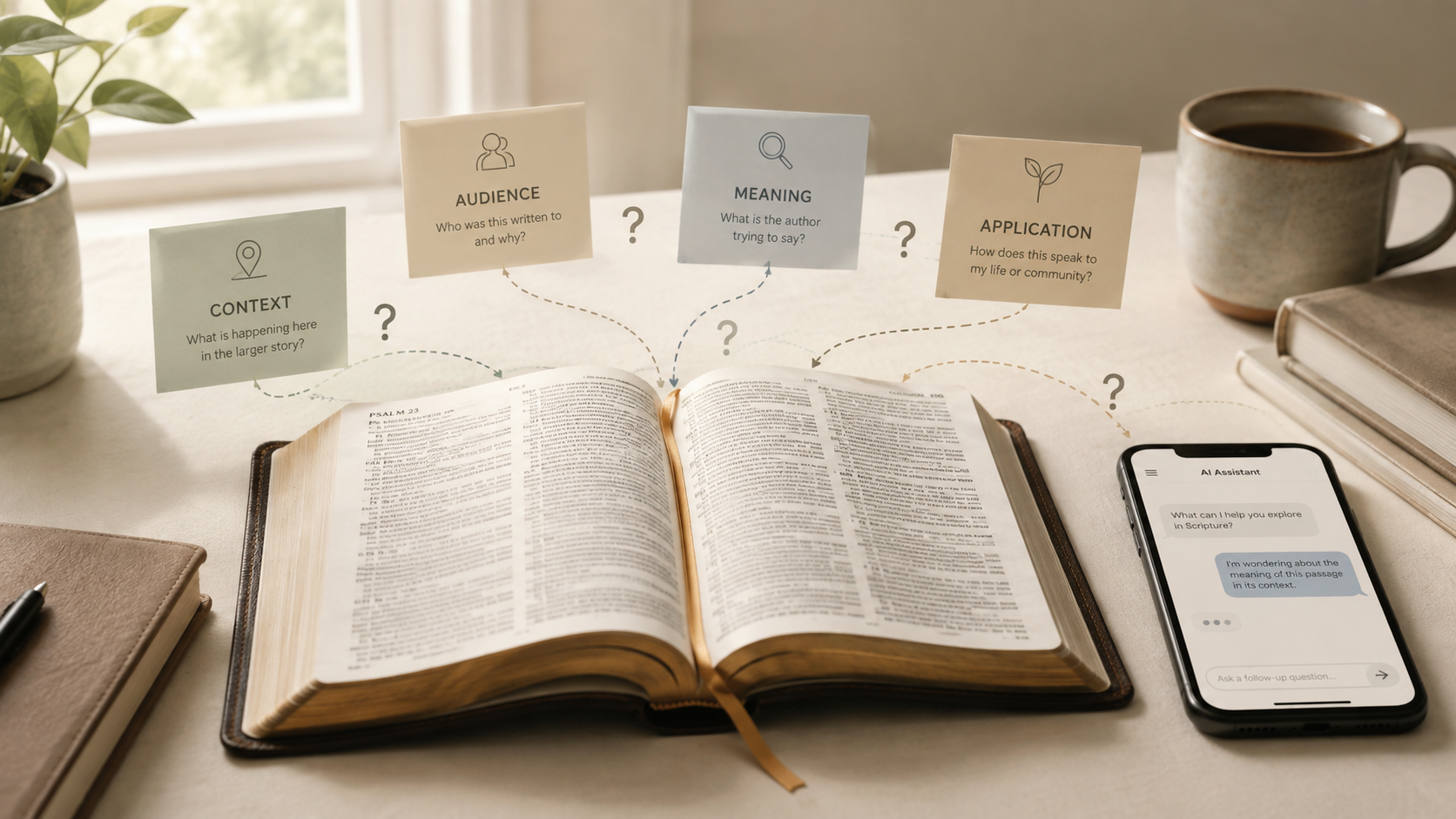
One of the strongest arguments for using artificial intelligence in Bible study is simple: it can answer questions quickly.
That is also one of the reasons Christians should be careful with it.
A fast answer can feel complete long before we have done the slower work of reading a passage carefully, noticing its context, comparing translations, considering who wrote it and why, or sitting with a difficult question long enough to understand what we are actually asking.
So perhaps the better question is not, "Can AI answer Bible questions?"
It obviously can produce answers.
The more interesting question is whether AI can help Christians become better readers of Scripture.
Good Bible study usually begins with questions
Careful Scripture reading has always involved questions.
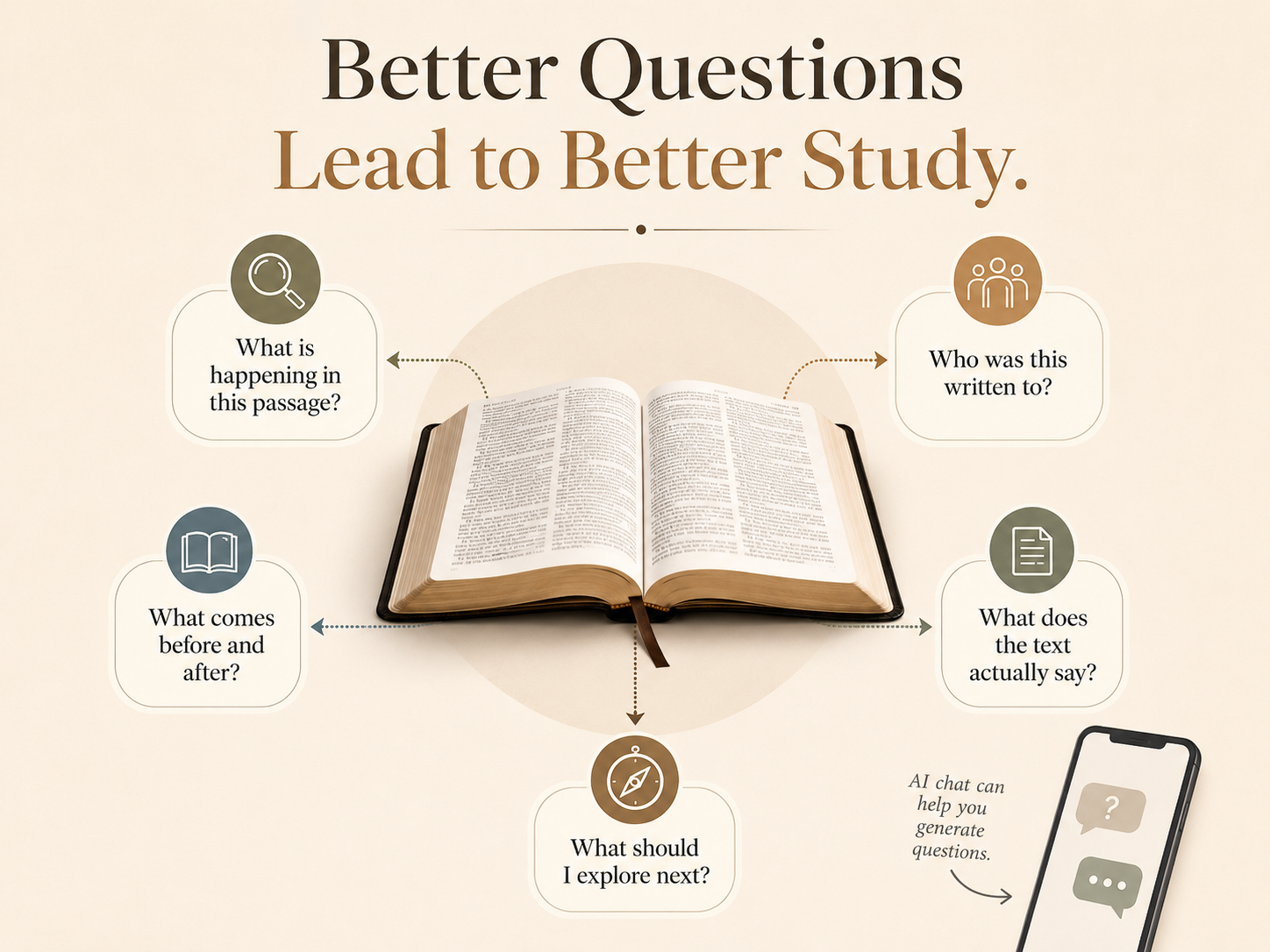
What is happening in this passage? Who is speaking? Who is being addressed? What comes before this verse? What comes after it? Is this poetry, narrative, prophecy, wisdom literature, a letter, or something else? Are there words or cultural details I do not understand?
Those questions are not distractions from Scripture. They are part of paying attention to Scripture.
A Christian who opens the Bible already convinced that a familiar verse means one particular thing may never stop to ask whether the surrounding passage supports that interpretation.
This is one place where a carefully designed AI tool can be helpful.
Instead of immediately producing a polished explanation, it can prompt the reader to notice what is actually on the page.
AI can help widen the questions
Imagine reading a passage and asking an AI tool, "What should I pay attention to here?"
A useful response might not begin with a conclusion. It might suggest several directions for study:
- Read the paragraph before and after the verse.
- Identify the original audience.
- Notice repeated words or ideas.
- Compare how several Bible translations render an important phrase.
- Ask what problem, event, or question the passage is addressing.
- Look for places where Christians interpret the passage differently.
None of those steps require the AI to become the authority.
In fact, they work best when the tool keeps redirecting attention away from itself and back toward Scripture.
Better questions can expose weak assumptions
Asking better questions also creates room for humility.
Sometimes the interpretation we first bring to a passage comes from a sermon we heard years ago, a devotional, a social media post, a favorite teacher, or simply the Christian environment in which we learned the verse.
That does not automatically make the interpretation wrong.
But it does mean we benefit from asking, "Is that actually what this passage says?"
A good AI-assisted study process can help surface assumptions without pretending that the AI itself has the final interpretation.
For example, it might point out that a verse is commonly quoted by itself and invite the reader to examine the larger chapter. It might identify that two Christian traditions understand a passage differently. It might suggest checking a commentary or talking with a pastor when a question becomes theological rather than merely informational.
That kind of assistance can strengthen discernment because it makes the process more visible.
There is still a serious limitation
AI can also generate bad questions.
It can misunderstand a passage, invent historical details, flatten theological differences, or confidently suggest a line of interpretation that does not actually fit the text.
That is why AI-generated study prompts still need the same scrutiny as AI-generated answers.
Christians should not assume that a question is wise simply because a computer generated it.
This is part of the larger problem discussed in How AI Can Sound Right and Still Be Wrong . Fluent language can create the appearance of understanding even when the underlying information is incomplete.
The goal is not to outsource discernment. The goal is to create more opportunities to practice it.
The tool should create a path back to the text
A healthy Christian AI experience should make it easier to move from a question to Scripture, not from a question to endless AI conversation.
That distinction matters.
If every question simply produces another screen full of generated content, the technology can quietly become the center of the study.
But if the tool says, in effect, "Here are three things worth noticing. Now go read the passage again," it is doing something very different.
This is also why What AI Can and Cannot Do With Bible Study matters. AI can organize information, suggest connections, summarize background material, and help readers identify areas they may want to explore. It cannot replace attentive reading, prayer, Christian community, or wise human teachers.
Questions are sometimes more valuable than answers
Modern technology tends to reward speed.
Search for something. Get an answer. Move on.
Scripture does not always work that way.
Some passages become clearer only after repeated reading. Some questions remain difficult. Some disagreements among faithful Christians cannot be resolved by producing one more paragraph of explanation.
That is not necessarily a failure.
As discussed in Why Faster Answers Are Not Always Better Answers , speed can sometimes work against reflection.
A tool that helps us slow down, notice more, and ask a second question before accepting the first answer may actually be more useful than one that tries to sound certain about everything.
What healthy AI-assisted Bible study can look like
A simple pattern might look like this:
- Read the passage yourself first.
- Notice what confuses, surprises, or interests you.
- Ask the AI for questions or areas worth exploring.
- Return to the passage and check those suggestions against the text.
- Use trusted commentaries, pastors, teachers, or other resources when the question requires more depth.
- Allow uncertainty to remain when the evidence does not justify confidence.
In that model, AI is neither forbidden nor elevated.
It is simply one tool in a much larger process of reading carefully and thinking faithfully.
The best Christian AI may not be the tool with the fastest answers. It may be the one that helps us become more careful with the questions.
Curious how this works in practice?
Try Mat44 and see how Brenda keeps the focus on Scripture, reflection, and careful boundaries.