Can AI Help During Spiritual Dry Seasons?
During a spiritual dry season, an AI tool may help someone return to Scripture, organize their thoughts, or rebuild a neglected routine. But it cannot manufacture faith, create spiritual intimacy, or replace the slow work of prayer, community, and trust.

Many Christians experience seasons when faith feels unusually difficult.
Prayer may feel flat. Scripture may seem distant. Worship may feel mechanical. A person may continue believing while feeling little comfort, clarity, or emotional connection.
These seasons are often described as spiritual dryness.
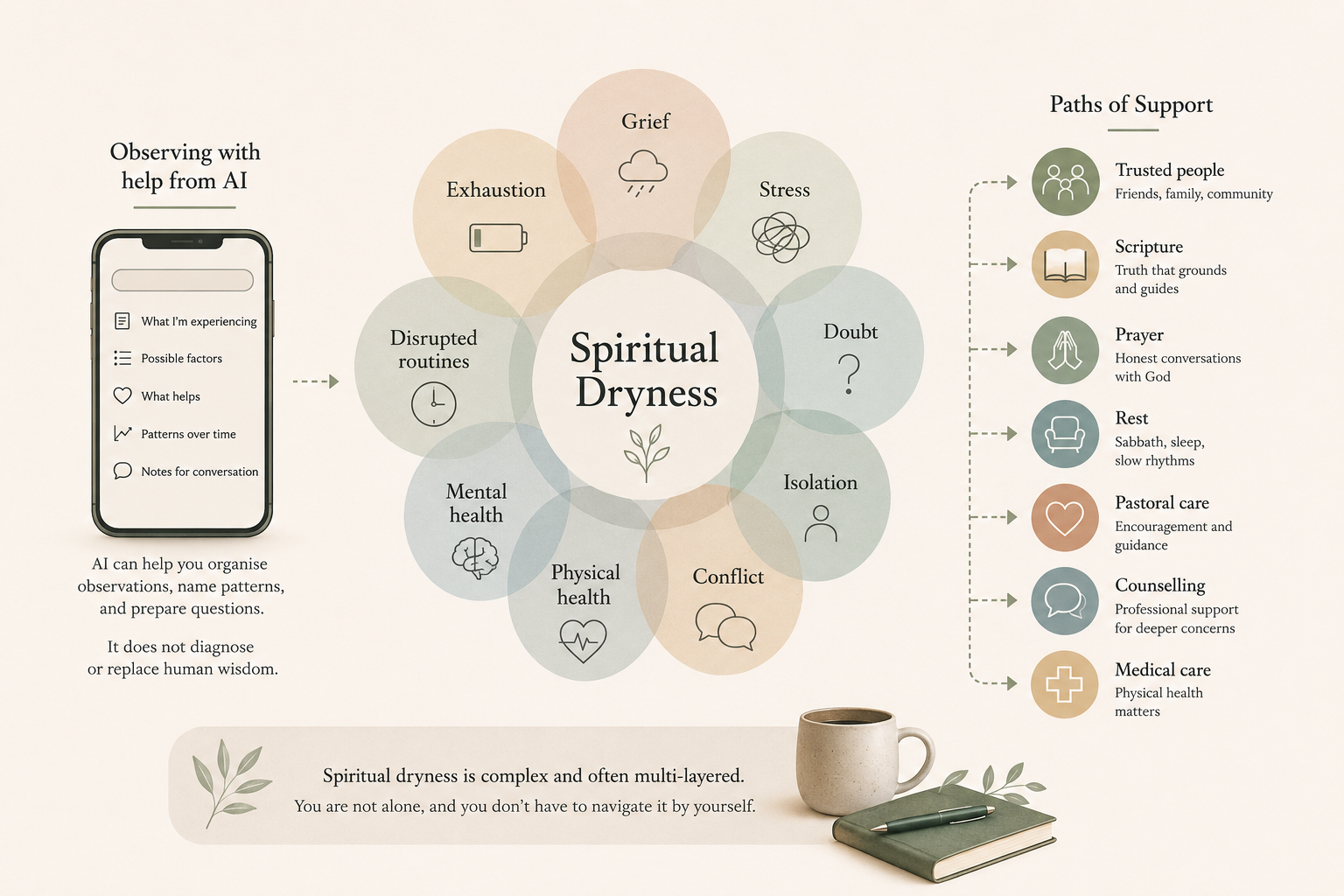
For some people, the experience lasts a few days. For others, it may continue through grief, stress, depression, illness, exhaustion, doubt, or major life changes.
When someone feels spiritually dry, an AI tool may seem appealing because it can offer immediate structure. It can suggest a passage, generate a reflection question, or help someone begin when they do not know what to say.
That support may be useful.
It also needs limits.
A tool can help someone return to a practice. It cannot create the spiritual reality the practice is meant to serve.
Spiritual dryness is not always a problem technology can solve
Modern apps are built around the idea that friction should be removed.
If a user stops engaging, the product may send reminders, simplify the process, personalize the content, or introduce rewards designed to bring them back.
That logic can be helpful for ordinary habits.
It becomes more complicated when applied to faith.
A person who is not reading Scripture regularly may benefit from a simpler routine. But a loss of spiritual motivation is not always a design problem. It may reflect grief, burnout, unresolved doubt, disappointment, isolation, or emotional exhaustion.
No notification system can resolve those realities by itself.
A Christian AI tool should be careful not to diagnose every dry season as inconsistency or lack of discipline. Sometimes a person needs a better routine. Sometimes they need rest, pastoral care, medical support, honest conversation, or time.
The absence of strong emotion does not mean the absence of faith
One danger during a dry season is the belief that faith is only genuine when it feels vivid.
A person may assume that if prayer feels difficult or Scripture does not produce an emotional response, something must be wrong with them.
Technology can unintentionally reinforce this idea.
An app may reward visible activity: completed readings, daily streaks, reflections written, questions answered, or minutes spent inside the product. Those measurements can show that a person used the app.
They cannot measure faithfulness, trust, spiritual maturity, or closeness to God.
A person may quietly read a short Psalm and feel nothing dramatic. That does not make the reading meaningless.
They may pray a few honest sentences without receiving immediate clarity. That does not mean the prayer failed.
A responsible Christian tool should avoid turning spiritual experience into a performance score.
AI can reduce the difficulty of beginning
During a dry season, starting may be the hardest part.
Someone may open the Bible and feel overwhelmed by where to read. They may want to pray but have no idea what to say. They may know they are discouraged without being able to explain why.
AI can help lower that initial barrier.
A tool might offer:
- A short passage rather than a long reading plan
- A simple explanation of unfamiliar language
- One reflection question instead of a full study
- A prompt for naming an emotion or concern
- A reminder of where the person stopped previously
- A suggestion to contact someone they trust
This kind of support can make the next step feel manageable.
The goal, however, should not be to create a perfect spiritual experience. It should be to help the person begin honestly.
The tool should not pretend to explain the season
Spiritual dryness can make people especially vulnerable to confident answers.
They may want to know why God feels distant, what lesson they are supposed to learn, or when the season will end.
An AI system should not claim to know.
It should avoid statements such as:
- God is testing you because you are about to enter a new season.
- Your spiritual dryness means you are resisting your calling.
- God has withdrawn His presence to teach you dependence.
- This verse is confirmation that your breakthrough is near.
These claims may sound spiritual, but the system has no basis for making them.
There may be many possible reasons for what the person is experiencing. Some may be spiritual. Others may be emotional, relational, physical, or circumstantial.
A careful tool can help the user consider possibilities without presenting speculation as revelation.
Scripture can be offered without being used as a quick fix
A Bible passage can provide comfort, language, perspective, or companionship during a difficult season.
But Scripture should not be used as a formula for producing a particular feeling.
A tool should not imply that reading the right verse will immediately remove doubt, grief, numbness, or exhaustion. Nor should it present a passage as proof that the user's situation will resolve in a specific way.
A better approach is modest:
- Here is a passage about waiting.
- Here is a Psalm that gives language to discouragement.
- Here is a section where a biblical writer speaks honestly about feeling abandoned.
- Here are a few questions to help you read slowly.
This keeps Scripture central while respecting both the text and the person's experience.
AI can help someone notice patterns
One potentially helpful use of technology during a dry season is reflection over time.
A person may not realize that their spiritual discouragement began alongside poor sleep, conflict, grief, illness, overwork, or isolation.
A tool can help organize observations such as:
- When did this begin?
- What has changed recently?
- Are there times when the heaviness feels stronger?
- Have you withdrawn from people who usually support you?
- Are you physically exhausted?
- Is there a particular disappointment or doubt you have avoided naming?
These questions do not explain the person's spiritual life.
They can help reveal context.
That context may point toward a healthier next step, such as rest, counseling, medical attention, pastoral conversation, reconciliation, or a simpler spiritual routine.
Dry seasons should not become engagement opportunities
A vulnerable user may return to an app frequently because they are searching for relief.
That creates a temptation for product designers.
The app could send more notifications, generate increasingly personal responses, offer emotional rewards, or imply that continued use will restore the user's spiritual life.
That would be a misuse of vulnerability.
A Christian tool should not treat spiritual distress as an opportunity to increase screen time, deepen emotional attachment, or sell access to more personalized reassurance.
It should be willing to say:
- You do not need to keep talking to this tool right now.
- Consider stepping away from the screen.
- A trusted person may be more helpful here.
- It is okay to keep your spiritual practice simple for a while.
- You may need support beyond an app.
The product should serve the person, not feed on the person's need.
Real people matter especially during spiritually difficult seasons
Spiritual dryness often becomes harder in isolation.
A person may withdraw because they feel ashamed, tired, doubtful, or unable to explain what is happening.
An AI tool may feel easier because it does not require vulnerability with another human being.
But ease is not always what the person most needs.
A trusted friend, pastor, priest, bishop, counselor, family member, or small group can offer something software cannot: presence, memory, accountability, discernment, and care that continues beyond one response.
A responsible Christian tool should make those relationships more visible, not less.
It can help someone prepare for a conversation by organizing what they want to say. It can suggest a simple message such as:
"I have been feeling spiritually disconnected lately, and I think I need someone to talk to."
That may be one of the most useful things the technology can do.
When professional support may be needed
Not every experience described as spiritual dryness is primarily spiritual.
Persistent numbness, hopelessness, anxiety, exhaustion, loss of interest, disrupted sleep, or difficulty functioning may also be connected to depression, trauma, grief, burnout, or another health concern.
An AI tool cannot diagnose the cause.
It should not tell someone that a mental health concern is simply a lack of faith, insufficient prayer, spiritual warfare, or failure to trust God.
When symptoms are intense, long-lasting, or interfering with daily life, support from a licensed mental health or medical professional may be appropriate.
Seeking that help does not require a person to abandon prayer, Scripture, or Christian community. These forms of support can exist together.
A simpler routine may be more faithful than an ambitious one
During a dry season, people sometimes respond by creating a demanding spiritual recovery plan.
They may commit to long reading schedules, extended prayer sessions, multiple devotionals, journaling, fasting, and daily app use.
That plan may last only a few days before becoming another source of guilt.
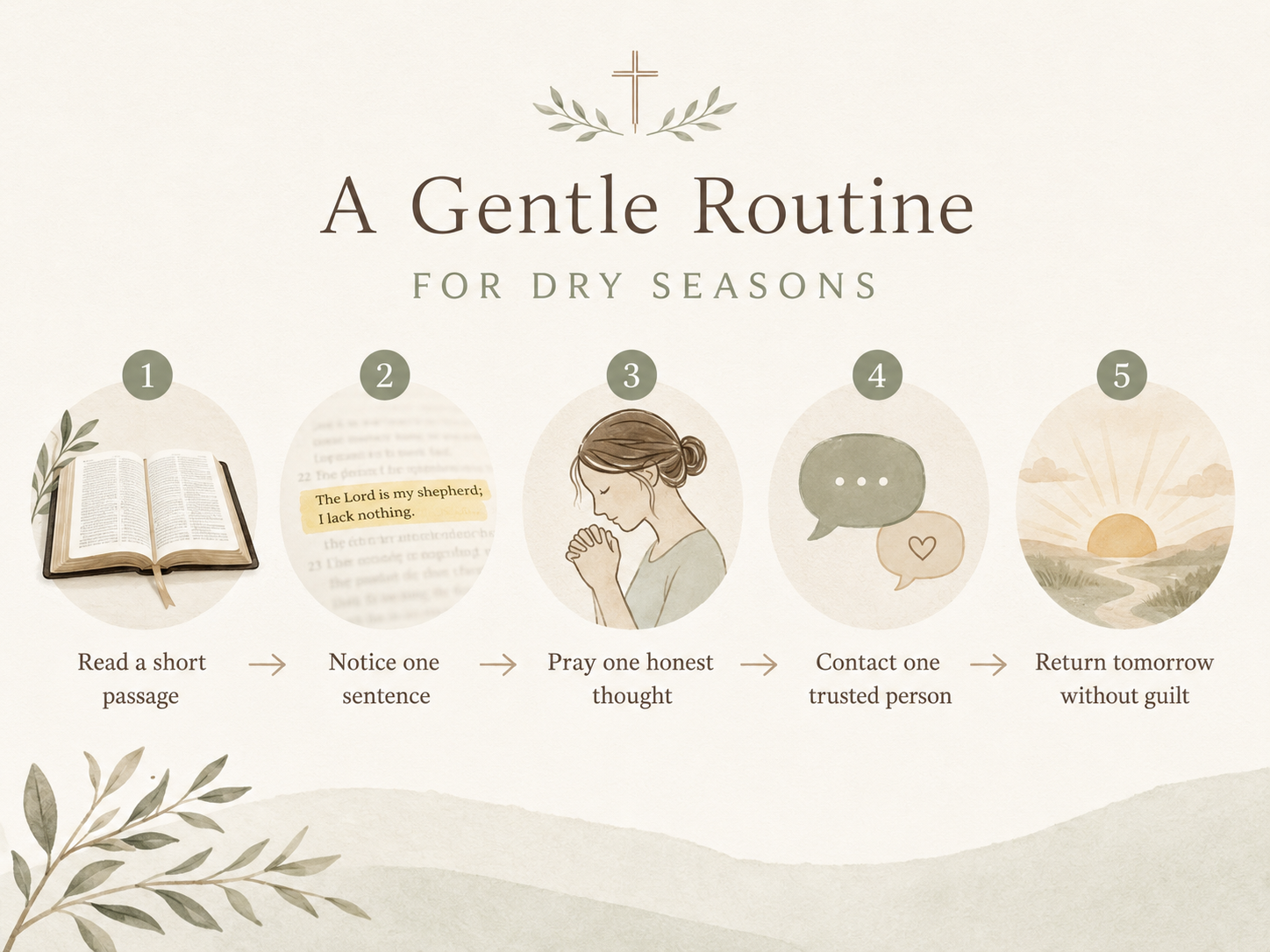
A smaller practice may be more sustainable:
- Read a short passage.
- Notice one sentence.
- Pray one honest thought.
- Contact one trusted person.
- Return tomorrow without trying to compensate for missed days.
AI can help keep that routine simple.
It should not make the user feel that more content, more prompts, or more interaction automatically means more faithfulness.
Questions to ask when using AI during a dry season
Consider asking:
- Is this tool helping me approach Scripture, or merely consuming more content?
- Does it respect uncertainty, or does it invent spiritual explanations?
- Does it encourage honest prayer rather than polished performance?
- Does it help me connect with trusted people?
- Is it making my routine simpler or more demanding?
- Do I feel pressured to keep engaging with it?
- Am I seeking support, or repeatedly searching for reassurance?
- Is there a physical, emotional, or relational concern I need to address?
These questions are not meant to create suspicion around every use of technology.
They are meant to keep the tool in its proper place.
A dry season does not need to be solved by an app
AI may help someone find a passage, form a question, recognize a pattern, or take the first small step back toward a neglected practice.
That can be valuable.
But the system cannot determine why God feels distant. It cannot promise when the season will end. It cannot create trust, worship, or spiritual intimacy on the user's behalf.
Sometimes faithfulness during a dry season looks remarkably ordinary.
It may mean returning to Scripture without feeling inspired. Praying without having the right words. Accepting help. Resting. Waiting. Remaining part of a community even when participation feels difficult.
A helpful tool can support those actions.
Then it should step aside.
Curious how this works in practice?
Try Mat44 and see how Brenda keeps the focus on Scripture, reflection, and careful boundaries.