Can AI Help You Prepare for Bible Study Without Doing the Study for You?
AI can be a useful study assistant, but preparing for the text is not the same thing as reading it for yourself.
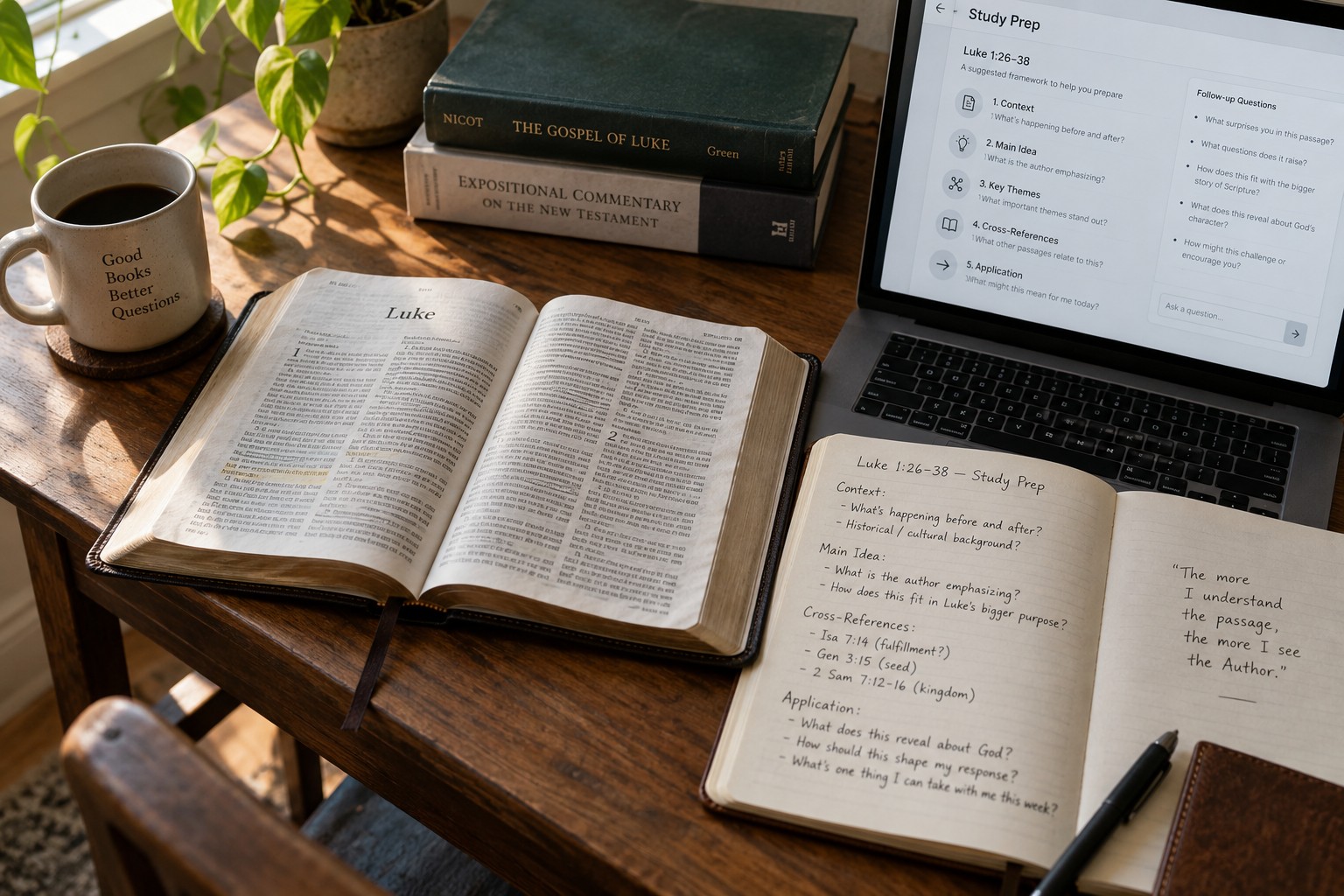
There is a strong case for not bringing AI into Bible study at all.
Scripture is not an information problem that needs to be optimized. Christians have read and studied the Bible for centuries without generative technology. The slowness of reading, writing notes, rereading a passage, consulting a teacher, or wondering about a difficult question is often part of the study itself.
If AI simply removes that work, it may produce more information while producing less engagement. That is a real concern.
But that is not the only way to use AI.
The more useful role may be more like a librarian at a long table: helping you gather background, organize questions, locate related passages, and point toward resources, then stepping back so you can read.
Preparation is not the same as study
Anyone who has taught a Bible study, Sunday school class, small group, or devotional knows that preparation can take time.
You may want to know who the book was written to. You may want a timeline, a map, key words, or related passages. You may want to see where a concept appears elsewhere or which questions will be most useful for group discussion.
None of that, by itself, is the study. It is preparation for the study.
That distinction gives AI a legitimate lane.
A tool can help collect information and organize it. The person still has to open the text, read it, test explanations, reflect, pray, and decide what the passage is saying.
Let AI do the logistics, not the listening
Some parts of study preparation are more mechanical than others. For example, an AI can help:
- list the passages that come immediately before and after a selected text;
- summarize basic historical background for further verification;
- generate a list of repeated words or themes to look for yourself;
- suggest cross-references;
- compare how a phrase is rendered in several translations;
- help organize discussion questions from notes you have already taken.
Those tasks can save time without pretending to do the reading for you.
The difference is whether the tool clears the path to Scripture or quietly becomes the destination.
Read the passage before the summary
One simple boundary changes the entire relationship with the tool: read the passage first.
If AI provides the summary first, the summary can become the lens through which the reader encounters the text. The person may start noticing only things that fit the generated explanation.
Reading first does something different. It lets the reader notice the surprising, confusing, uncomfortable, or unfamiliar parts before a system suggests what they mean. Those first observations are part of the study.
Use AI to generate questions, not just conclusions
The answer-machine model of AI is not especially well suited to responsible Bible study.
A more useful prompt might be almost the opposite: "What questions should I ask while reading this passage?"
That can produce a very different kind of assistance. Instead of closing the topic, the tool can open avenues for the reader to explore.
This connects directly to Can AI Help Christians Ask Better Questions About Scripture?. The value is not in making the AI the most important voice in the room. It is in helping the person read more carefully.

Background information still needs verification
AI is very good at producing a plausible paragraph of background information. That does not guarantee that the details are correct.
Historical dates, cultural customs, quotations, the meaning of a Greek or Hebrew word, and claims about what early Christians believed are all things a reader may want to verify.
This is exactly where Should Christians Fact-Check AI About the Bible? becomes practical. Good stewardship means using the speed of the tool without handing over our responsibility to test what it says.
Compare sources, not just AI outputs
An AI tool can help locate resources. It should not be treated as the resource.
For a serious study question, the next step might be to check a study Bible, a respected commentary, a translation note, a church resource, or a book from a scholar who has done deep work on the passage.
If the issue is denominational, it may be wise to consult sources from more than one Christian tradition. If the question affects theology, pastoral care, or church practice, a real person who knows your community may be far more useful than another generated answer.
A good study tool should make itself less necessary
This is one of the most important design tests for Christian AI.
After the tool helps you prepare, what does it do next?
Does it keep you in an endless chat? Does it try to generate another summary, another explanation, another question, and another reason to stay on the screen?
Or does it point you back to the Bible, your notes, your church, and other people?
Healthy preparation should make the tool feel less necessary as the study moves forward. If you cannot continue without the AI staying in the center, the boundary has probably shifted.
What about people who are short on time?
The strongest counterargument is that many Christians simply do not have the hours to do every part of preparation the long way.
Pastors have sermons to prepare. Parents are raising kids. Students have work. Small-group leaders are volunteers. A fast tool that gathers background or helps create a discussion plan can make serious study more realistic.
That is a real benefit, and we should not pretend otherwise.
The boundary is not "do not use speed." The boundary is "do not let speed eliminate encounter."
Five minutes of preparation that gets you back into Scripture can be more valuable than forty minutes of generated content that leaves the Bible unopened.
What a healthy AI-assisted prep workflow might look like
- Choose the passage. Know what you are actually planning to read.
- Read it once without AI. Notice what stands out.
- Use AI for prep. Ask for background, questions, cross-references, or resources to check.
- Verify what matters. Check claims, quotations, and theologically important explanations.
- Return to the passage. Read with the new questions in mind.
- Write your own notes. Do not let the generated summary become your personal reflection.
- Bring the study into community. Teach, discuss, ask, listen, and learn with actual people.
The goal is a better study, not a better chat
AI can prepare a table. It can help you find the map, stack the resources, and write the list of questions.
But you still have to sit down.
You still have to read the page. You still have to notice what is there, wrestle with what is difficult, and let Scripture shape your thinking.
The best use of AI for Bible study may be to do enough beforehand that you are more ready to pay attention when you open the Bible.
The tool can help prepare the study. It should not become the study.
Curious how this works in practice?
Try Mat44 and see how Brenda keeps the focus on Scripture, reflection, and careful boundaries.