Can Christian AI Respect Different Denominations?
Christian AI should not flatten Christianity into one generic voice. It should be honest about differences without turning into a debate machine.
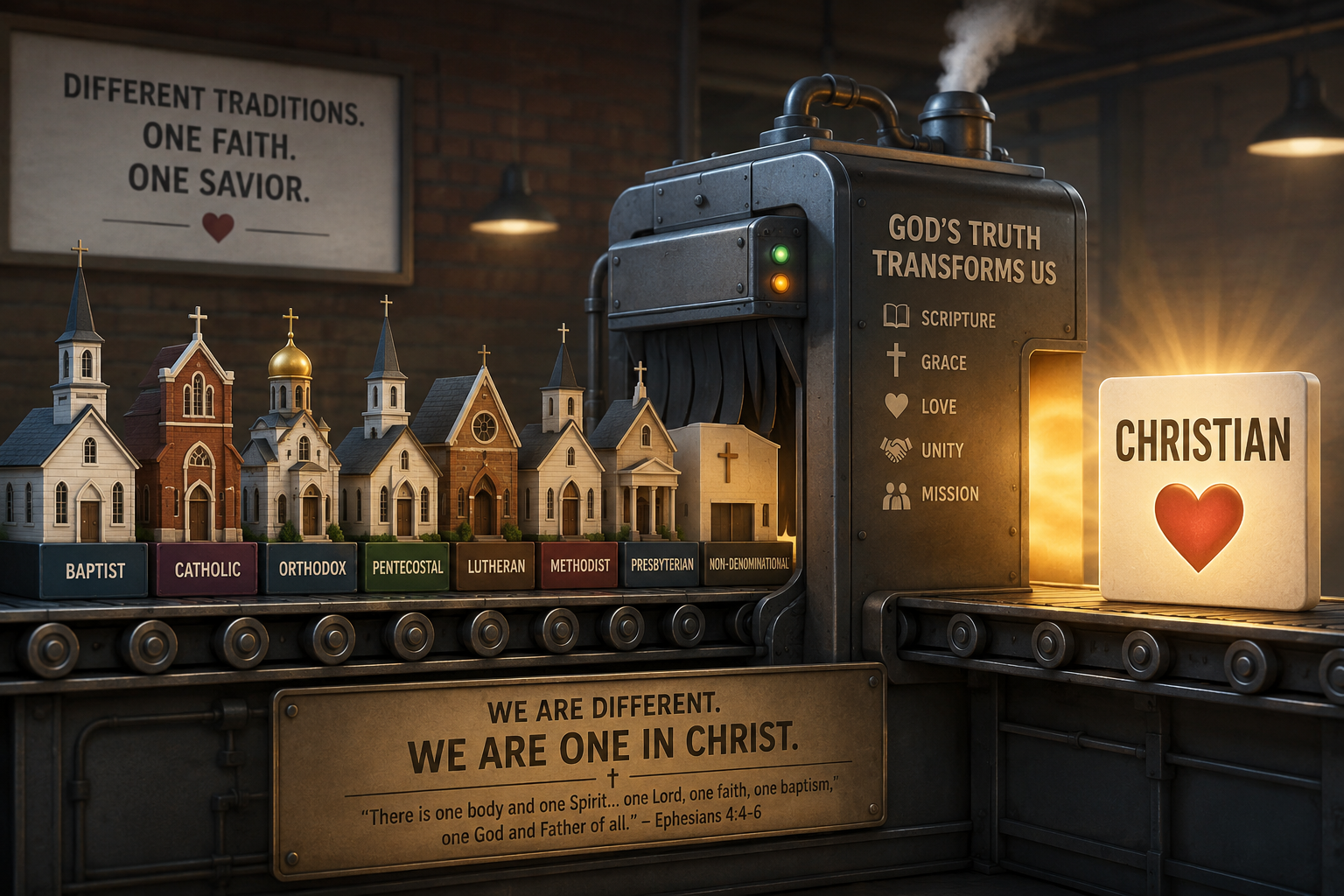
If you have spent much time around Christians, you have probably noticed something quickly: Christians agree on many things, and they also disagree on many things.
Some disagreements are minor. Others have been discussed, debated, and divided over for centuries.
That creates a real challenge for artificial intelligence.
How can an AI system discuss Christianity without flattening every tradition into one generic voice?
The Problem With “Generic Christian” AI
Many AI systems attempt to sound neutral.
In practice, that often means they unknowingly default to a particular tradition.
Sometimes the bias is obvious. Sometimes it is subtle.
The system may use language that feels Protestant, Catholic, Orthodox, Pentecostal, Reformed, Baptist, Evangelical, or non-denominational without realizing it.
The result is often frustration.
Users can feel like their tradition is being misunderstood, oversimplified, or ignored.
Respect Is Not the Same as Agreement
One of the most important lessons for Christian AI is that respect and agreement are not the same thing.
A system should be able to describe a belief without endorsing it.
It should be able to explain how a tradition understands a practice without declaring that practice correct.
It should be able to acknowledge differences without turning every answer into a debate.
Good Christian AI should be descriptive before it is interpretive.
That is not always easy.
But it matters.
Language Matters
Words carry history.
A Catholic may speak about priests and sacraments.
A Baptist may speak about pastors and ordinances.
An Orthodox Christian may describe tradition differently than a Pentecostal Christian.
A Methodist, Presbyterian, Lutheran, Anglican, Adventist, or non-denominational believer may hear the same word through a different set of assumptions.
Even when Christians are discussing the same topic, the vocabulary can change dramatically.
If an AI ignores those differences, users quickly notice.
Why Objectivity Is Hard for AI
This is where the challenge becomes more technical.
Artificial intelligence can summarize enormous amounts of information.
That sounds helpful until you remember that the internet is not a neutral place.
Some sources are thoughtful.
Some are polemical.
Some are inaccurate.
Some are openly hostile toward traditions they disagree with.
If an AI is simply allowed to pull information from the wider internet, it can easily absorb stereotypes, misconceptions, or exaggerated criticisms.
The result may sound objective while quietly reflecting the biases of whatever sources were most available.
That is one reason objectivity is surprisingly difficult for AI systems.
Bounded Knowledge Matters
One approach is to limit where the AI receives information.
In Mat44, denominational information is not pulled from the open internet during conversations.
Instead, denomination information comes from carefully written internal records designed to describe traditions fairly and consistently.
That does not make the system perfect.
It does make the system more predictable.
More importantly, it reduces the likelihood that the AI will repeat stereotypes, internet arguments, or inaccurate claims it happened to encounter elsewhere.
In other words, respectful AI often requires less information, not more.
The goal is not to know everything.
The goal is to know trustworthy things.
Why Boundaries Matter
The same principle appears throughout Christian AI design.
A system that can answer anything is not automatically a better system.
In many cases, the most trustworthy systems are the ones that know where their boundaries are.
The challenge is not building an AI that speaks confidently.
The challenge is building one that remains careful.
If you’d like to learn more about the difference between prompts and guardrails, see Prompts vs. Guardrails: What Christians Should Know About AI Safety .
What Mat44 Does Instead
Mat44 does not attempt to decide which denomination is correct.
It does not act as a theologian.
It does not try to settle centuries of debate.
Instead, it aims to describe traditions respectfully, use language familiar to the user, and keep the focus on Scripture, reflection, and trusted spiritual leaders.
When users want to go deeper, Mat44 can also point them toward sources, leaders, and resources that align with their own tradition — not necessarily mine.
That distinction matters.
The goal is not to make everyone think like I do.
The goal is to help people better understand their own tradition while remaining respectful toward others.
That is a more modest goal.
It is also a more realistic one.
Why This Matters for Evangelism
One side effect of modern Christianity is that many believers know someone is Christian without knowing much else about their tradition.
Unless the topic comes up directly, people may have little idea whether someone is Baptist, Catholic, Orthodox, Pentecostal, Lutheran, Methodist, Presbyterian, non-denominational, or something else.
That can create hesitation when sharing resources.
People often worry that a book, website, podcast, video, or app might accidentally misrepresent someone else’s tradition or immediately start arguing against it.
A tool that respects denominational differences changes that calculation.
When a resource acknowledges that Christians do not all use the same language, practices, and traditions, it becomes easier to share without reservation.
The goal is not to eliminate disagreement.
The goal is to create space for respectful understanding.
In a world where many Christians interact across denominational lines every day, that kind of humility can be surprisingly valuable.
Final Thoughts
Christian AI does not need to erase denominational differences to be useful.
In fact, pretending those differences do not exist often creates more problems than it solves.
Respect begins with acknowledging that traditions exist, understanding how they describe themselves, and resisting the temptation to turn every conversation into a debate.
The future of Christian AI should not be a generic Christianity with all of the edges sanded off.
It should be thoughtful enough to recognize differences, humble enough to describe them fairly, and honest enough to know where its understanding ends.
Curious how this works in practice?
Try Mat44 and see how Brenda keeps the focus on Scripture, reflection, and respectful denominational handling.
Try Mat44