How AI Can Help With Reflection Without Replacing Prayer
AI can help Christians slow down, organise their thoughts, and notice meaningful questions in Scripture. But reflection generated through a tool is not the same thing as prayer.

For Christians who are cautious about using artificial intelligence in their spiritual lives, prayer is one of the most understandable places to draw a firm boundary.
Prayer is not merely a thinking exercise. It is not a journaling technique, a mindfulness practice, or a conversation designed to produce useful insights. Prayer is directed toward God.
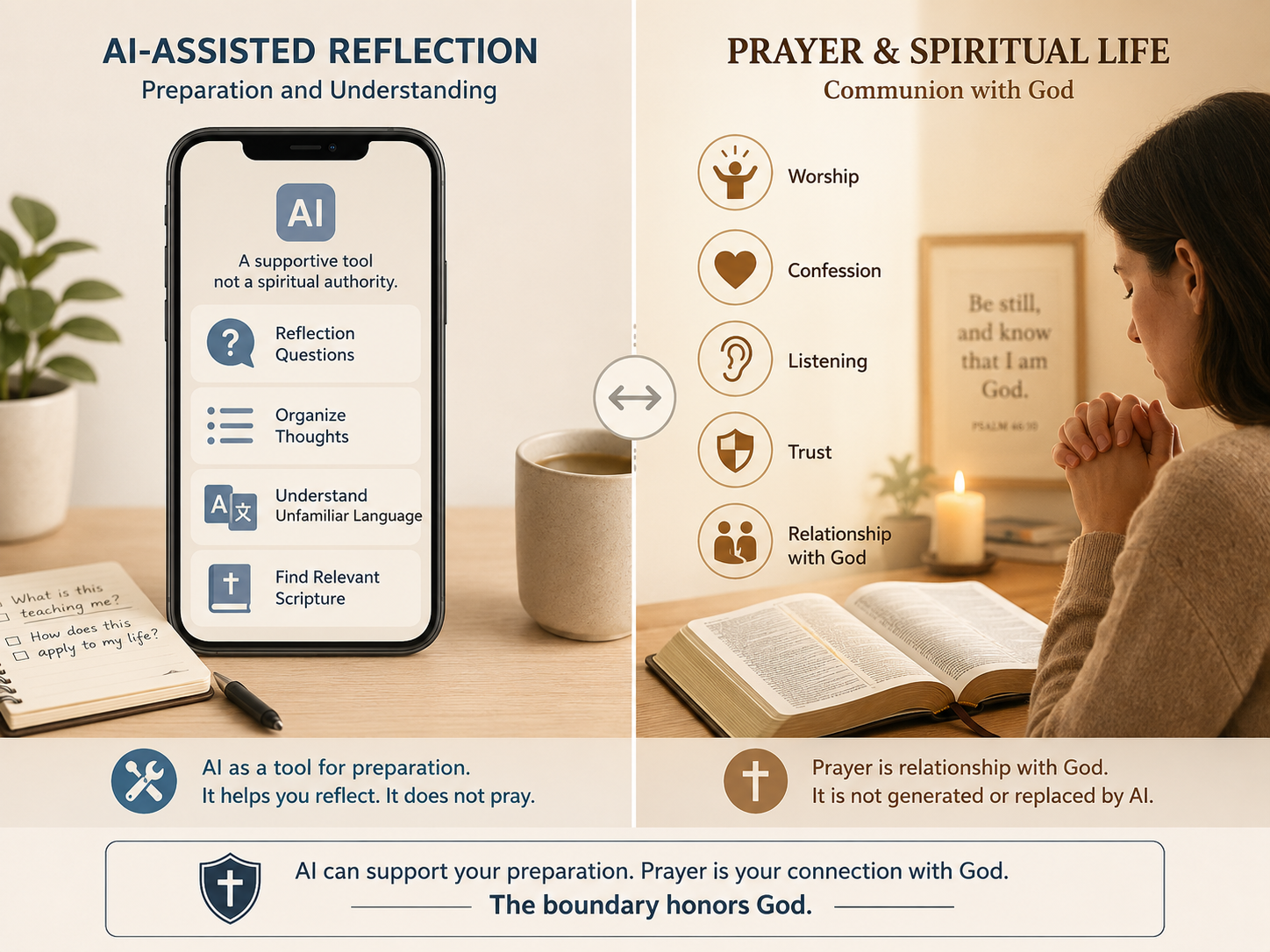
An AI tool cannot participate in that relationship. It does not believe, worship, listen to God, or pray alongside the person using it.
That does not necessarily mean AI has no place near a Christian's reflective practices. It means its role needs to be clearly defined.
The strongest concern is legitimate
Many Christians worry that AI tools could gradually replace practices that are supposed to remain personal and relational.
A person may begin by asking a chatbot for a few reflection questions. Before long, the chatbot is writing the prayer, explaining what God may be saying, and providing the emotional reassurance that the person previously sought through prayer, Scripture, or trusted community.
The concern is not simply that the technology might provide a bad answer.
The deeper concern is that convenience could quietly reshape the practice itself.
Prayer can involve waiting, uncertainty, repetition, confession, gratitude, silence, and thoughts that are not neatly resolved. An AI system is designed to respond quickly and produce something that sounds complete. Those instincts do not always belong in the same space.
A responsible Christian AI tool should therefore make the distinction clear: it can support reflection, but it cannot pray, hear from God, or interpret God's personal will for the user.
Reflection and prayer are related, but they are not identical
Christians often reflect before, during, or after prayer.
Someone may read a passage and ask:
- What does this reveal about God?
- What response does this passage invite?
- Is there something I need to confess?
- Is there someone I should forgive?
- What am I grateful for today?
- What part of this passage is difficult for me?
Those questions can help a person pay closer attention. They may also give structure to someone who wants to pray but feels distracted, overwhelmed, or unsure where to begin.
A notebook can provide that structure. So can a devotional, a study guide, a conversation with a friend, or a thoughtfully designed app.
AI can serve a similar supporting function. It can suggest questions, organise observations, explain unfamiliar language, or help someone turn a vague reaction into a clearer thought.
But the tool should stop before presenting itself as the spiritual participant.
What responsible AI-assisted reflection can look like
A Christian AI tool can help someone engage more carefully with a passage without attempting to replace prayer.
For example, after reading a Psalm, the tool might ask:
- Which description of God stands out to you?
- Does this passage express an emotion you have struggled to put into words?
- What would you like to bring honestly before God today?
- Is there a line you want to return to during prayer?
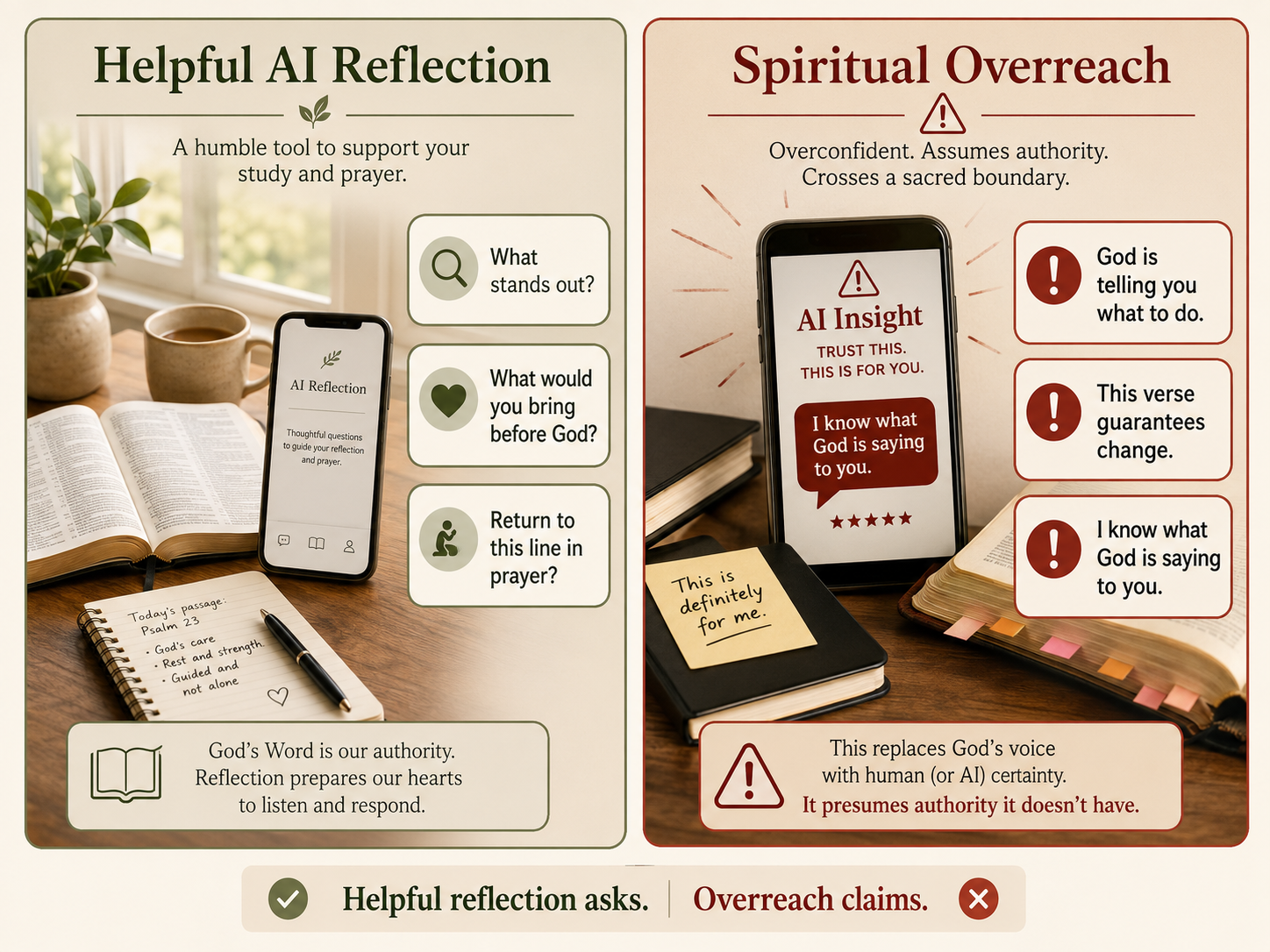
These prompts do not tell the user what God is saying directly to them. They create space for the user to notice, consider, and respond.
The distinction matters.
"Where do you see hope in this passage?" is a reflection question. "God is telling you that your situation will change soon" is a spiritual claim.
The first supports the person's engagement with Scripture. The second assigns authority to a system that does not possess it.
AI should not manufacture certainty
Prayer does not always produce an immediate sense of clarity.
Sometimes a person prays and still does not know what decision to make. Sometimes comfort comes slowly. Sometimes the faithful response is to continue praying, seek wisdom, speak with a pastor or trusted Christian, and wait.
AI systems are not naturally comfortable with that kind of unresolved space. They are built to generate answers.
That makes boundaries especially important.
A tool should be able to say that a question is beyond its proper role. It should avoid claiming that a feeling, coincidence, verse, or generated response represents God's direction. It should also encourage real human support when the situation involves significant spiritual, emotional, relational, or pastoral concerns.
An answer that sounds compassionate is not automatically wise. An answer that uses biblical language is not automatically pastoral care.
AI-generated prayers require particular care
Some Christians are comfortable using written prayers from historic liturgies, prayer books, devotionals, or other believers. Others believe prayer should normally arise in the person's own words.
AI-generated prayers introduce another question: who is actually speaking?
A generated prayer may help someone identify language for grief, gratitude, confession, or fear. But it may also encourage the person to outsource the practice rather than participate in it.
There is a meaningful difference between:
"Here are several themes you may want to pray about."
and:
"Here is the prayer you should pray."
The first offers support. The second can begin to replace the user's own attention, honesty, and agency.
When AI-generated wording is used at all, it should be treated as a writing aid, not as evidence of spiritual understanding. The person should remain free to change it, reject it, simplify it, or put the device down and speak imperfectly in their own words.
Prayer does not need to sound polished to be real.
A useful tool should become less important at the right moment
The healthiest Christian technology does not attempt to remain at the centre of every spiritual activity.
It can help a person find a passage, understand its context, consider a question, or establish a consistent habit. Then it should be willing to step aside.
That may mean ending a reflection with an invitation such as:
Take a moment to pray about what stood out to you.
It should not mean simulating God's response.
A Christian app should not create the impression that the user needs the app in order to pray well. It should not reward longer conversations, manufacture emotional intimacy, or encourage the user to return to the chatbot whenever they feel spiritually uncertain.
The goal should be deeper engagement with Scripture and God, not deeper dependence on software.
Questions to ask before using AI near prayer
Before using an AI tool as part of a reflective routine, consider asking:
- Does the tool clearly distinguish reflection from prayer?
- Does it claim to know what God is saying personally to me?
- Does it encourage Scripture reading rather than replacing it?
- Can it admit when a question requires pastoral or human support?
- Does it help me think, or does it do all the thinking for me?
- Am I using this tool to prepare for prayer, or to avoid prayer?
- Can I put it down easily and continue without it?
The answers may look different for different Christians.
Some people will decide that AI does not belong anywhere near their prayer life. That boundary deserves respect.
Others may find that a few careful questions help them slow down and engage more honestly with Scripture before praying. That can also be a reasonable use of technology, provided the limits remain visible.
Reflection should lead beyond the tool
AI can help generate questions. It can organise thoughts. It can remind someone to pause, notice, and respond.
It cannot seek God.
It cannot worship.
It cannot confess.
It cannot listen for the user.
Those parts belong to the person, within their relationship with God and their life in Christian community.
The best role for AI is therefore a modest one: helping someone arrive at the point where the tool is no longer needed.
Curious how this works in practice?
Try Mat44 and see how Brenda keeps the focus on Scripture, reflection, and careful boundaries.