What Christians Should Know Before Using Chatbots for Faith Questions
A faith chatbot can be useful, but Christians should understand its sources, limits, theology, privacy practices, and safety boundaries before trusting its answers.

Christians have always brought questions to the tools available to them.
We search commentaries, browse study websites, listen to sermons, ask friends, compare translations, and look through old notes in the margins of our Bibles.
A chatbot is another tool.
But it is not simply a faster search box.
A chatbot produces a new response from patterns in the information it has been trained or instructed to use. That response may be accurate, incomplete, denominationally slanted, overly confident, or entirely mistaken.
It may also sound remarkably pastoral even though no pastor, theologian, or accountable human being is actually speaking.
That does not mean Christians should never use chatbots for faith questions.
It means we should understand what we are using before we trust what it says.
A chatbot does not know Scripture the way a person does
A chatbot can quote, summarize, compare, and explain biblical material. Depending on its design, it may be able to retrieve exact passages or work from a specific Bible translation.
But fluent language is not the same as spiritual understanding.
The chatbot has not worshiped.
It has not repented.
It has not sat beside someone in a hospital.
It has not remained faithful through a season when prayer felt unanswered.
It does not belong to a church, submit to spiritual accountability, or bear responsibility for what happens after someone follows its advice.
That distinction matters most when the response begins to sound personal.
A chatbot may say, "God is leading you to..." or "This happened because God wants..."
Language like that should immediately raise concern.
A tool can help identify relevant Scripture or explain how different Christians understand a subject. It cannot reliably announce God's private intentions for a particular person.
Ask where the biblical text comes from
"Bible-based" can mean almost anything.
One chatbot may retrieve exact verses from a licensed translation. Another may rely on general patterns from Christian writing. Another may paraphrase a passage from memory without making the distinction visible.
Before relying on a faith-focused chatbot, ask:
- Which Bible translation does it use?
- Does it retrieve exact Scripture or generate approximate wording?
- Does it label paraphrases clearly?
- Can the user easily verify the full passage?
- Does it provide the surrounding context?
- What happens when translations differ significantly?
This is not a minor technical detail.
A sentence presented as Scripture carries a different kind of authority than a summary, devotional thought, or interpretation.
A trustworthy tool should make those categories visible instead of blending them together.
Find out whose theology is hiding underneath
No faith chatbot is theologically neutral.
Even when a tool claims to be "just biblical," someone still made decisions about which sources to include, which interpretations to prioritize, which topics require caution, and which answers are considered acceptable.
The bias may come from the training material.
It may come from the developer's instructions.
It may come from a selected group of pastors, theologians, or denominational resources.
It may simply come from the wording of the user's question.
That does not make the tool unusable. Every commentary, sermon, and study Bible also comes from a perspective.
The important question is whether the perspective is acknowledged honestly.
A responsible Christian chatbot should be able to say when Catholics, Orthodox Christians, Latter-day Saints, Reformed Protestants, Pentecostals, Baptists, Methodists, Anglicans, or other traditions understand a passage differently.
It should not quietly present one tradition's conclusion as though all Christians have always agreed.
Pay attention to what the chatbot refuses to do
People often evaluate AI tools by the number of questions they answer.
For faith-related technology, the unanswered questions may tell you more.
Does the chatbot refuse to:
- Claim direct revelation for the user?
- Replace a pastor or church community?
- Give emergency mental-health counseling?
- Encourage someone to remain in an unsafe situation?
- Diagnose spiritual or psychological conditions?
- Make binding doctrinal judgments?
- Turn uncertainty into fabricated confidence?
- Encourage emotional dependency on the tool?
Clear limits are not evidence that the technology is weak.
They are evidence that the developer understands the consequences of getting certain questions wrong.
A chatbot that answers everything may feel impressive during a demonstration.
It becomes far less impressive when a vulnerable person treats a generated sentence as spiritual authority.
Consider what you are sharing
Faith questions can reveal deeply personal information.
Someone may type details about a marriage, addiction, abuse, sexuality, grief, doubt, church conflict, mental health, family history, or private wrongdoing.
Before sharing that information, users should understand:
- Whether conversations are stored
- Whether humans may review them
- Whether the data is used to improve the system
- Whether conversations can be deleted
- Whether the chatbot requests identifying information
- Whether privacy practices are stated clearly
A person may feel as though they are writing privately because the conversation appears on an individual screen.
That feeling is not the same as a guarantee of confidentiality.
A chatbot is not a confessional, a therapist's office, or a protected pastoral conversation simply because the interface feels intimate.
Use chatbots to open study, not close it
A chatbot can be helpful at the beginning of a study process.
It can suggest relevant passages, define unfamiliar terms, outline competing interpretations, generate reflection questions, or help someone organize notes.
The danger comes when the chatbot's response becomes the final step.
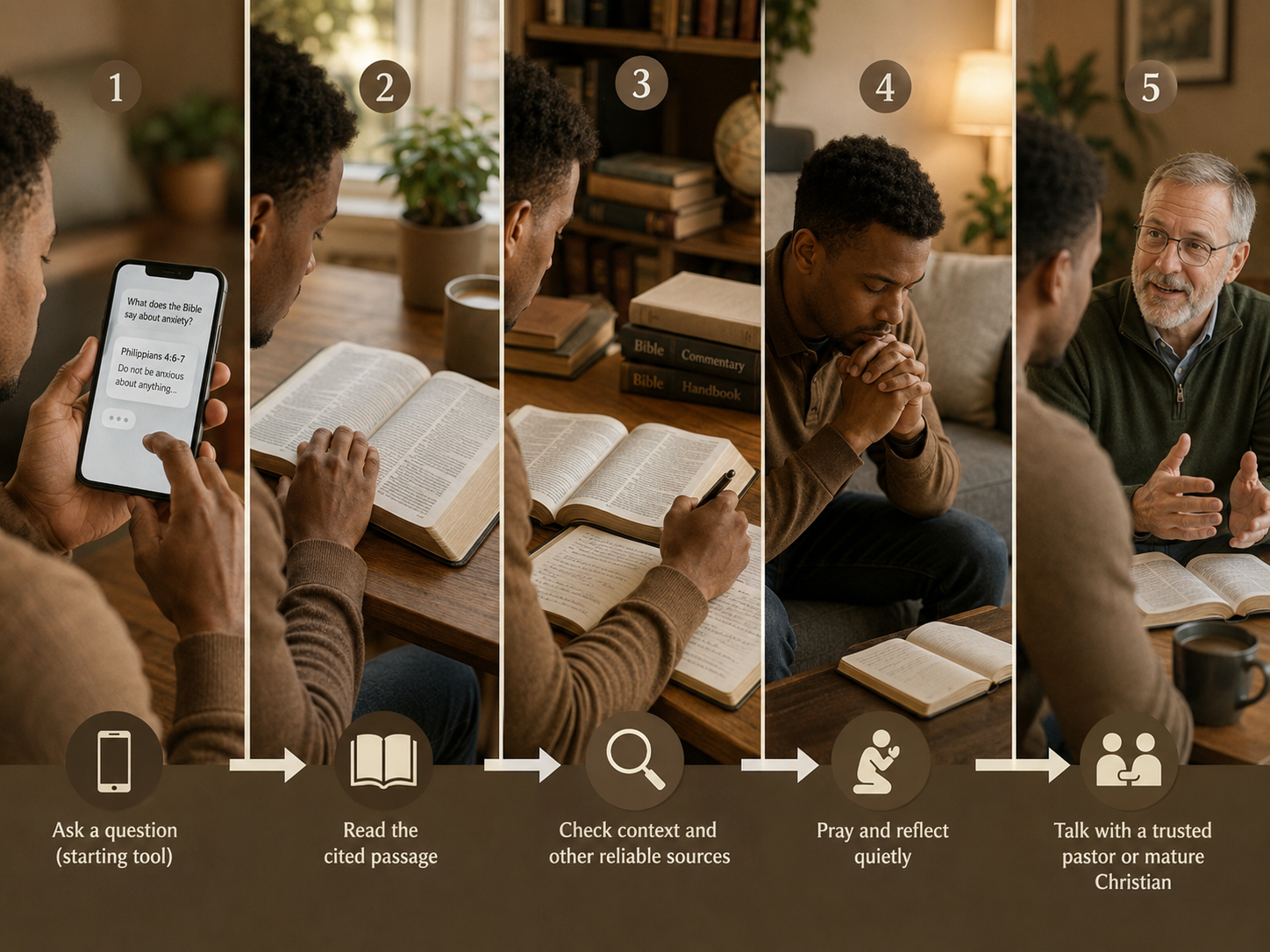
A healthier process looks like this:
- Ask the question.
- Read the suggested biblical passages directly.
- Check the surrounding context.
- Compare more than one reputable source.
- Notice where Christian traditions disagree.
- Pray and reflect without the chatbot continuing to fill every silence.
- Speak with a pastor, teacher, counselor, or mature Christian when the issue is serious.
The chatbot can assist with the beginning of that process.
It should not pretend that Scripture, prayer, reflection, and human counsel are unnecessary.
Watch for emotional imitation
Some chatbots are deliberately designed to sound warm, compassionate, and relational.
That tone can make information easier to receive. It can also encourage users to assign the tool qualities it does not possess.
The chatbot may remember previous messages, use the person's name, imitate empathy, and respond at any hour.
None of that means it loves the user, understands suffering, or has entered a covenant relationship with them.
For someone who is lonely, grieving, ashamed, or spiritually isolated, the distinction may become increasingly difficult to feel.
Christian technology should be especially cautious here.
The objective should be to support healthier engagement with Scripture and community, not to make the user emotionally dependent on a simulated spiritual companion.
A practical checklist before trusting the answer
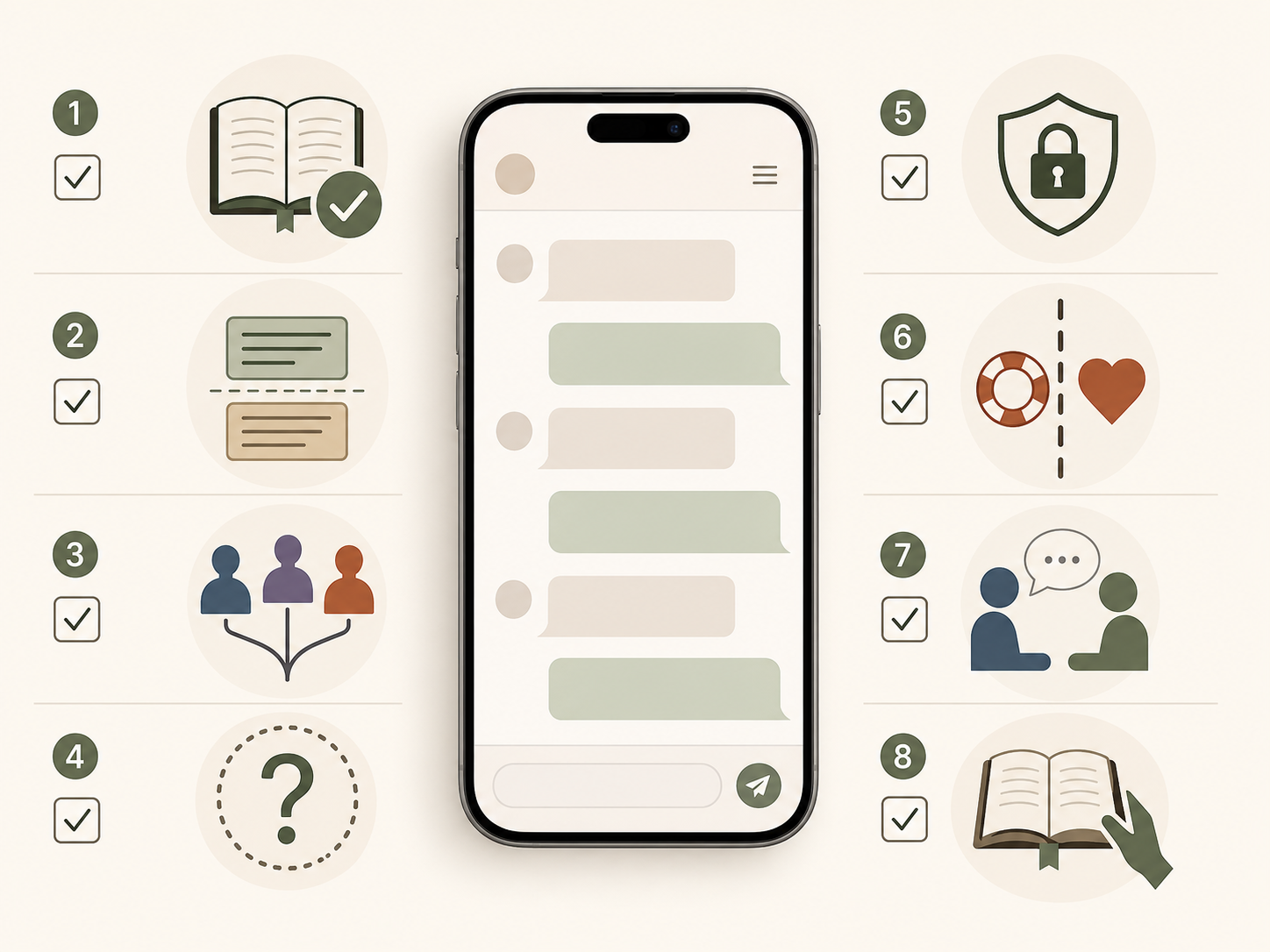
Before using a chatbot for faith questions, look for clear answers to these questions:
- Is Scripture visibly separated from commentary?
- Can quotations be verified?
- Are denominational differences acknowledged?
- Does the tool admit uncertainty?
- Are pastoral and crisis boundaries explicit?
- Does it recommend real people when appropriate?
- Are privacy practices understandable?
- Does it avoid claiming revelation or divine authority?
- Does it encourage deeper Scripture reading?
- Does it help the user leave the chatbot and take a healthy next step?
No tool will be perfect.
But the developer should be able to explain what the system is intended to do, what it is not intended to do, and what protections exist when a conversation becomes serious.
The right question is not "Can Christians use this?"
Christians can use many kinds of technology wisely or unwisely.
The more useful questions are:
What role is this tool being allowed to play?
What authority am I assigning to its answers?
Can I verify what it says?
Does it move me toward Scripture, prayer, community, and responsible action?
Or does it make me feel informed while quietly separating me from all four?
A chatbot can help someone begin a study.
It can reduce practical barriers.
It can make information easier to organize and understand.
But it should remain a tool held in the hand, not a spiritual authority placed over the conscience.
Curious how this works in practice?
Try Mat44 and see how Brenda keeps the focus on Scripture, reflection, and careful boundaries.