The Problem With Overconfident AI
The most dangerous AI answer is not always the obviously absurd one. It may be the polished, reassuring answer that gives users no reason to notice it is wrong.
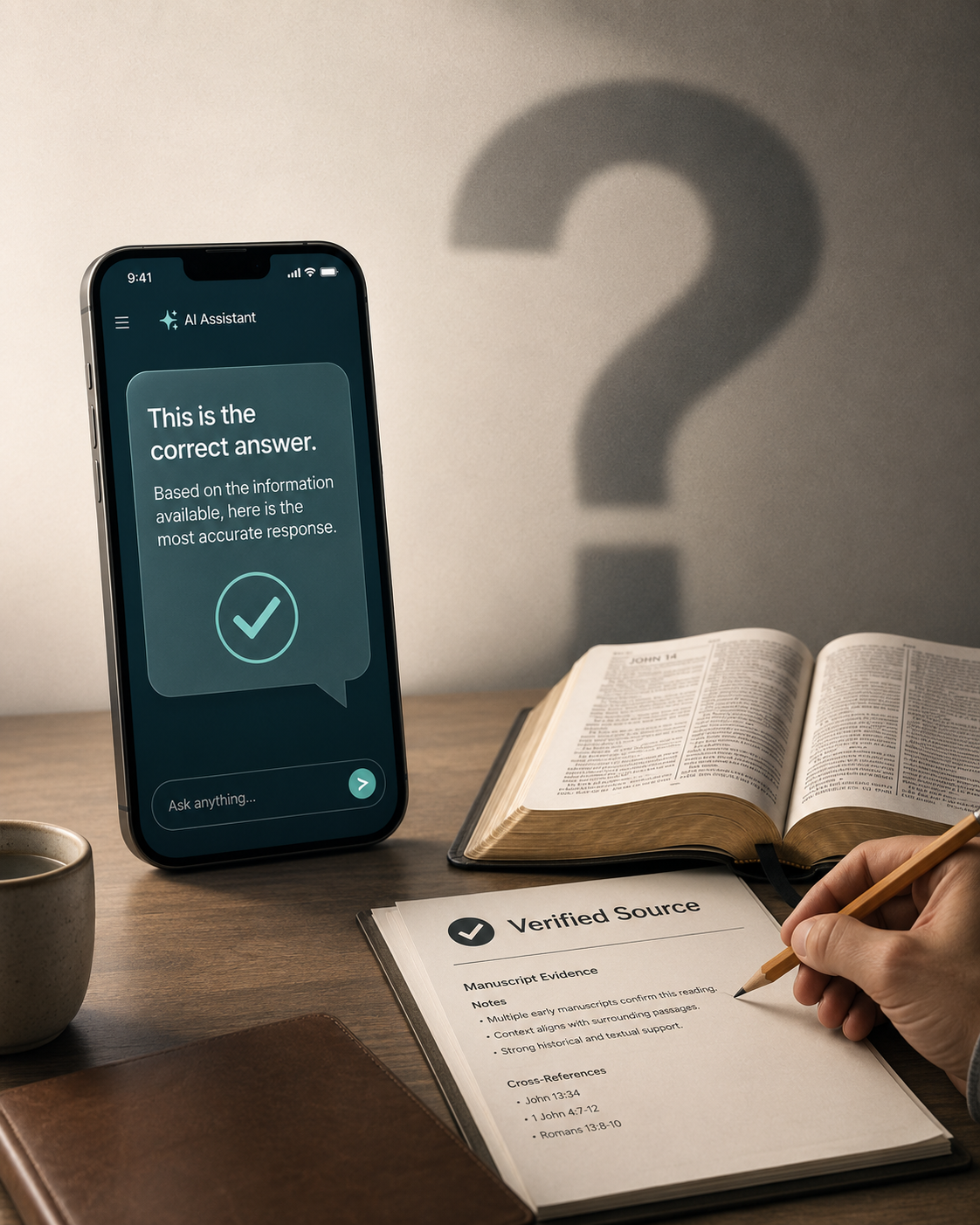
People often imagine an AI error as nonsense: a broken sentence, an impossible claim, or a response so strange that anyone would dismiss it immediately.
In practice, the harder errors are usually more convincing.
The answer is organized. The tone is calm. The explanation sounds complete. It may include dates, quotations, citations, or theological language.
The system does not hesitate, even when the underlying claim is false.
That combination of fluency and confidence creates a serious trust problem.
Why AI can sound certain without being certain
Generative language models are designed to produce plausible text in context.
They are very good at matching the shape of a useful answer. But the linguistic signals people associate with confidence do not necessarily reflect verified knowledge inside the system.
OpenAI describes hallucinations as plausible but false statements generated by language models.
Its research also points to a structural problem in evaluation: systems may be rewarded for guessing rather than admitting uncertainty.
A confident attempt can sometimes score better than an honest “I don’t know.”
This helps explain why simply telling a chatbot to be accurate is not enough.
The product must be designed to handle uncertainty, verification, and high-risk categories more deliberately.
Confidence changes how people receive an answer
Human readers use tone as a shortcut.
We naturally give more weight to answers that are specific, coherent, and delivered without hesitation.
That shortcut is often useful when dealing with a genuinely knowledgeable person.
With AI, however, style can outrun substance.
An uncertain answer may be presented in polished prose. A disputed interpretation may be stated as settled. A fabricated quotation may be formatted like a real citation.
Users who are unfamiliar with the topic have the least ability to detect the error and may be the most impressed by the presentation.
Faith questions raise the stakes
A wrong restaurant recommendation is inconvenient.
A fabricated Bible quotation, false historical claim, or overconfident statement about what Christians believe can shape a person’s understanding of Scripture, church tradition, or God.
The problem is not that every theological mistake creates immediate harm. Christians have always needed to evaluate teachers and interpretations.
The difference is scale and presentation.
AI can generate a personalized answer instantly, in private, with no visible congregation, editor, pastor, or source community around it.
A person in a vulnerable moment may also experience the system’s certainty as authority.
That is precisely when Christian AI should become more cautious, not more impressive.
Uncertainty should be a feature, not a failure
Users often prefer direct answers.
Product teams may worry that qualifications, caveats, and refusals make an AI tool feel less capable.
Yet a system that never shows uncertainty is not more trustworthy. It is simply hiding an important part of the truth.
Responsible Christian AI should be able to say:
- This interpretation is disputed among Christian traditions.
- I cannot verify that quotation.
- The biblical text does not directly answer that modern question.
- This is pastoral, medical, legal, or crisis territory that requires a real person.
- I may be mistaken; please check the cited source.
Humility is not a decorative tone choice. In a faith-based system, it is part of the safety architecture.
Sources help, but citations can also be fabricated
Asking for sources is a good habit, but the presence of a citation does not automatically solve the problem.
A generative system may invent a book title, misattribute a quotation, or produce a link that does not support the claim.
Better systems connect users to retrievable source material and make it possible to inspect what supports the answer.
Even then, users should distinguish between the source text and the AI’s interpretation of it.
For Scripture applications, that means keeping the biblical passage visible, labeling commentary clearly, and avoiding the impression that generated explanation carries the same authority as the text.

What developers should do
The NIST Generative AI Profile identifies confabulation, the confident presentation of false or erroneous content, as a risk organizations should measure and manage.
Practical responses can include testing, human review, source grounding, clear disclosures, incident monitoring, and restrictions on high-risk uses.
For Christian AI, developers should also ask whether the system:
- Separates Scripture from generated commentary.
- Names denominational differences instead of flattening them.
- Tests common failure cases involving quotations and references.
- Declines roles that belong to pastors, clinicians, attorneys, or emergency services.
- Uses a visible correction process when errors are found.
- Avoids marketing language that implies spiritual discernment or divine authority.
What users should do
Users do not need to distrust every AI response.
They should calibrate trust to the importance of the claim.
- Check the actual Bible passage rather than relying on a generated quotation.
- Open cited sources and confirm that they support the answer.
- Ask whether the claim reflects one Christian tradition or a broad consensus.
- Seek a pastor or knowledgeable person for consequential spiritual guidance.
- Treat emotional certainty and factual reliability as separate things.
The Mat44 approach
Mat44 does not attempt to make Brenda sound like the most confident spiritual voice in the room.
The product is designed to keep the Bible passage in view, support personal reflection, respect denominational context, and step back when the conversation exceeds the app’s role.
No AI system becomes error-free because it has guardrails.
The responsible goal is narrower: reduce predictable risks, make limitations visible, and avoid turning fluent language into unearned authority.
A Christian AI tool should not ask users to trust its confidence.
It should earn appropriate trust through transparency, sources, boundaries, and humility.
Further reading
Curious how this works in practice?
Try Mat44 and see how Brenda keeps the focus on Scripture, reflection, and careful boundaries.