The Future of Christian AI: Why It Should Be Humble
The best future for Christian AI is not one in which technology claims a larger spiritual role. It is one in which useful tools serve Scripture, respect people, acknowledge their limits, and know when to step back.

Conversations about the future of artificial intelligence usually focus on capability.
Will the next system reason more effectively? Will it remember more context, answer more questions, and speak more naturally? Will it become harder to distinguish an AI conversation from a human one?
Those questions matter. But Christians should also ask a different kind of question.
What kind of role should this technology be allowed to claim?
A Christian AI tool can become faster, smoother, and more personalized without becoming wiser. It can sound compassionate without knowing the person in front of it. It can generate theological language without possessing faith, spiritual discernment, or responsibility for the advice it gives.
More capability does not remove those limits.
It may make the limits easier to forget.
That is why I believe the future of Christian AI should be humble. Humility should not be an occasional disclaimer added after a confident answer. It should shape the tool's purpose, language, boundaries, interface, and stopping points from the beginning.
Humble Christian AI does not need to be timid or useless. It can help people begin reading Scripture, find relevant passages, organize questions, and reflect on what they have read.
But it should do those things without pretending to occupy a role that belongs to Scripture, the Holy Spirit, pastors, churches, families, trusted friends, counselors, doctors, or other real people.
Scripture should remain the authority
Christian AI will always have a design temptation: the generated response is usually the most immediate and personalized part of the experience.
The AI speaks directly to the user. It responds to the exact wording of a question. It can summarize, explain, encourage, and continue the conversation for as long as the user wants.
Scripture does not rearrange itself around each reader in the same way.
If an app is not designed carefully, the Bible may become a source the AI draws from while the AI response becomes the main event. A person may open the tool intending to read Scripture and leave having spent most of the time reading generated commentary.
That is the wrong hierarchy for a Scripture-centered tool.
Christian AI should make biblical passages easy to open, read, and verify in context. It should clearly distinguish the words of Scripture from generated explanation. It should never blur quotation, paraphrase, commentary, and application into one authoritative-sounding answer.
The technology can help the user reach the text. It should not quietly place itself above the text.
AI should admit uncertainty
Humility also requires honest language about what the system does not know.
AI can produce an answer that sounds clear, organized, and confident even when its information is incomplete or wrong. In a faith context, polished uncertainty can be especially persuasive because the answer may include familiar biblical language and recognizable theological ideas.
A responsible Christian AI should not treat confidence as a substitute for accuracy.
Sometimes the appropriate response is to say that several interpretations exist. Sometimes the tool should ask for clarification. Sometimes it should encourage the user to verify a reference or speak with someone who knows the person's circumstances.
Admitting uncertainty does not make a tool less trustworthy.
Pretending certainty where none exists does.
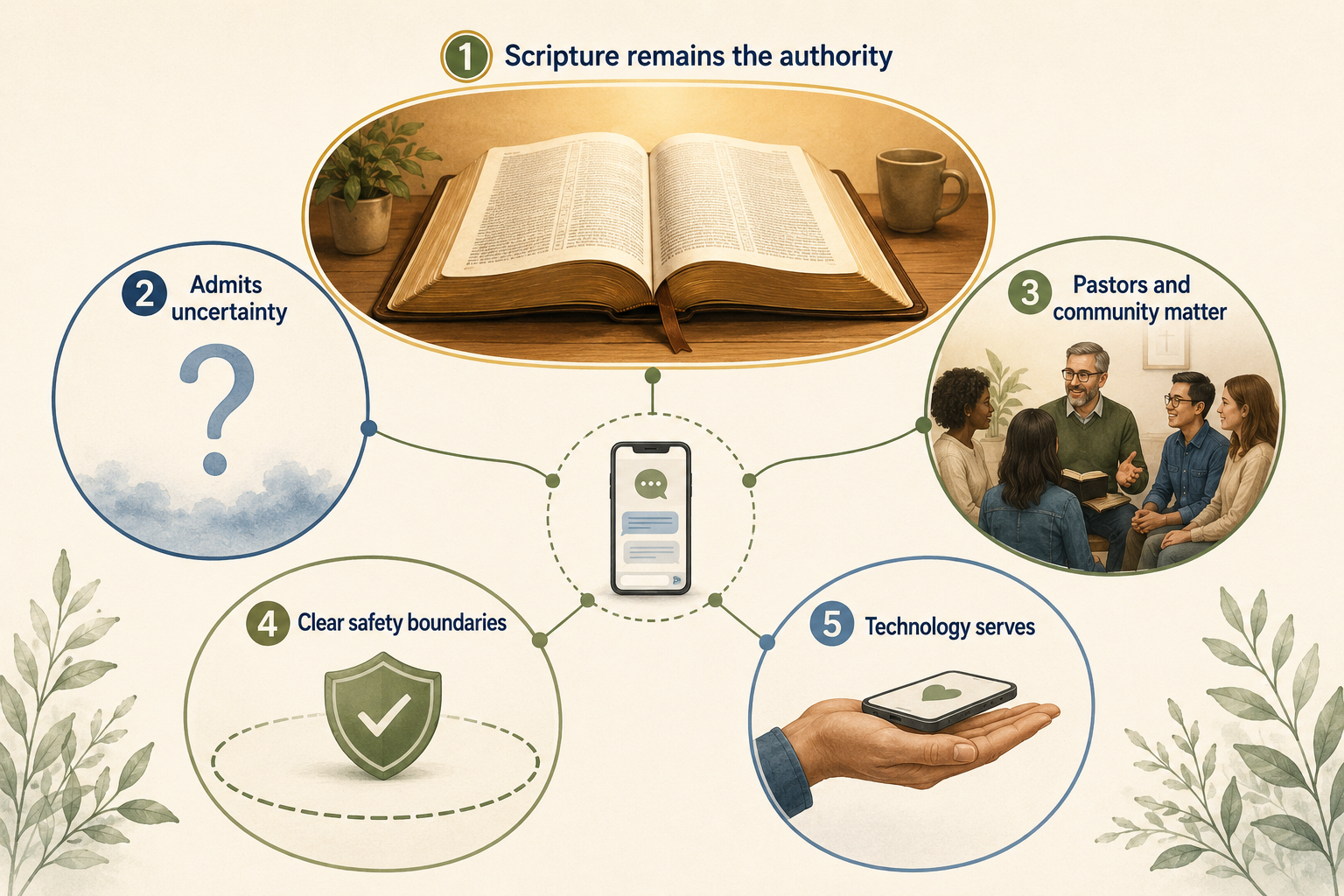
Pastors and Christian community still matter
AI can be available at a time when another person is not. That availability can help someone take a first step, particularly when the question feels too small, embarrassing, or unfinished to bring to someone else.
But availability is not relationship.
An AI does not share life with the user. It does not notice a change in behavior at church, remember a family conflict that was never entered into the app, or accept responsibility for what happens after a difficult piece of advice.
A pastor, trusted friend, family member, counselor, or doctor can ask questions rooted in an actual relationship. Real people can listen over time, recognize what is missing, offer practical care, and remain present after the conversation ends.
Christian AI should reinforce those relationships rather than compete with them.
That means a well-designed tool should be willing to say, in effect, "This is where a person matters more than another generated response."
Safety boundaries should be visible
Boundaries are often discussed as restrictions imposed on an otherwise capable product. In responsible Christian AI, they are part of the product's value.
A user should not have to discover the limits only after receiving a harmful or overconfident response. The tool's purpose should be understandable from the way it behaves.
It should not claim to speak for God. It should not diagnose a medical or mental health condition. It should not present itself as a pastor or counselor. It should recognize crisis language and direct people toward immediate human help. It should protect private information and avoid encouraging emotional dependence on the conversation.
These choices require more than placing a warning in the terms of service.
Good boundaries appear in the actual responses, the available features, the language of the interface, and the moments when the tool stops.
Technology should serve rather than lead
The business incentives behind digital products often reward more time, longer conversations, frequent notifications, and repeated engagement.
Those measures may tell a company that people are using the product. They do not necessarily show that the product is serving people well.
A Scripture app should not define success by how long it can keep someone looking at the app. A Christian AI conversation should not continue merely because another response can be generated.
Sometimes success means the user closes the phone and reads the passage. Sometimes it means pausing to pray. Sometimes it means writing down a question for a pastor or calling a trusted friend.
Technology serves when it helps a person take the next healthy step, even when that step leads away from the technology.

Humility must be designed into the product
It is easy for a company to describe its technology as humble, responsible, or Bible-based.
The more important question is whether users can see those values in the product itself.
Does the app make Scripture easier to verify? Does it separate biblical text from commentary? Does it handle denominational differences honestly? Does it acknowledge uncertainty? Are privacy and safety boundaries visible? Does it recommend pastors and real people when appropriate? Does it allow the conversation to end?
Humility is not a tone of voice layered on top of an ambitious system.
It is a decision about what the system is for.
Christian AI will likely become more capable, more conversational, and more widely available. Those changes can make useful tools easier to build and easier for people to access.
But the healthiest future will not be created by the Christian AI that makes the largest promises or claims the greatest spiritual role.
It will be created by tools that understand their responsibility, make their limits visible, and serve faithfully within them.
The future of Christian AI should be useful enough to help, humble enough to admit what it cannot do, and wise enough to point beyond itself.
See humble Christian AI design in Mat44
Try Mat44 and see how Brenda supports Scripture reading while respecting clear boundaries, theological differences, and the importance of real Christian community.