What Healthy AI Use Looks Like in a Christian Home
Healthy Christian technology use is less about banning AI and more about keeping Scripture, conversation, prayer, and real people in the center.

Christian families do not need to choose between pretending artificial intelligence does not exist and allowing it to become another always-present voice in the home.
There is a healthier middle.
AI can be useful for explaining unfamiliar words, suggesting study questions, organizing information, comparing ideas, or helping someone find a place to begin.
But a Christian home should still be shaped primarily by Scripture, prayer, conversation, worship, community, and the ordinary work of living faithfully with other people.
The goal is not to make AI part of everything.
The goal is to keep technology in its proper place.
Healthy use starts with what comes first
The order matters.
If every Bible question begins with opening an AI app, the tool can quietly become the first interpreter of Scripture.
A healthier pattern begins with the text itself.
Read the passage. Notice what stands out. Talk about it. Ask questions. Pray. Then, if a tool would genuinely help, use it to support the process.
That approach keeps AI from becoming the center of the experience.
It also reinforces one of the basic ideas behind The Goal Is More Scripture, Not More Screen Time .
Technology should make it easier to return to Scripture, not easier to avoid it.
AI should support family conversation, not replace it
One of the strongest parts of faith in a home is conversation.
Children ask questions. Adults disagree. Someone remembers a sermon. Someone else notices something in the passage that nobody had considered.
Those conversations are valuable partly because they happen between real people who know one another.
AI cannot recreate that relationship.
It can sometimes help the conversation along.
A family might ask for background on a Bible passage, a simple explanation of an unfamiliar term, or a few questions to discuss together.
But the best result is not another ten minutes of talking to the AI.
The best result is a better conversation among the people already in the room.
Children need different boundaries than adults
Healthy technology use also depends on who is using the tool.
Adults may be able to recognize uncertainty, compare sources, and notice when an AI response sounds too confident.
Children may not.
Younger users are especially likely to treat fluent, confident language as authoritative.
That means families should think carefully about whether children use AI independently, what kinds of questions they ask, and whether an adult is involved in the process.
A Christian AI tool designed for families should make those concerns visible rather than pretending every user needs the same experience.
It should also be comfortable handing questions back to parents, pastors, teachers, and other trusted people.
Not every faith question belongs on a screen
Some questions are primarily informational.
What does this word mean? Where does this event happen in the biblical timeline? What are several common interpretations of this passage?
Other questions are deeply relational.
What should I do about conflict in my family? How do I handle guilt? Why do I feel distant from God? What should I do when I disagree with my church?
An AI tool may help someone organize thoughts around those questions.
But the tool should not make itself the destination.
That principle is central to Why Christian AI Should Show Its Limits Clearly .
Healthy use includes knowing when to close the screen and talk to someone who knows you.
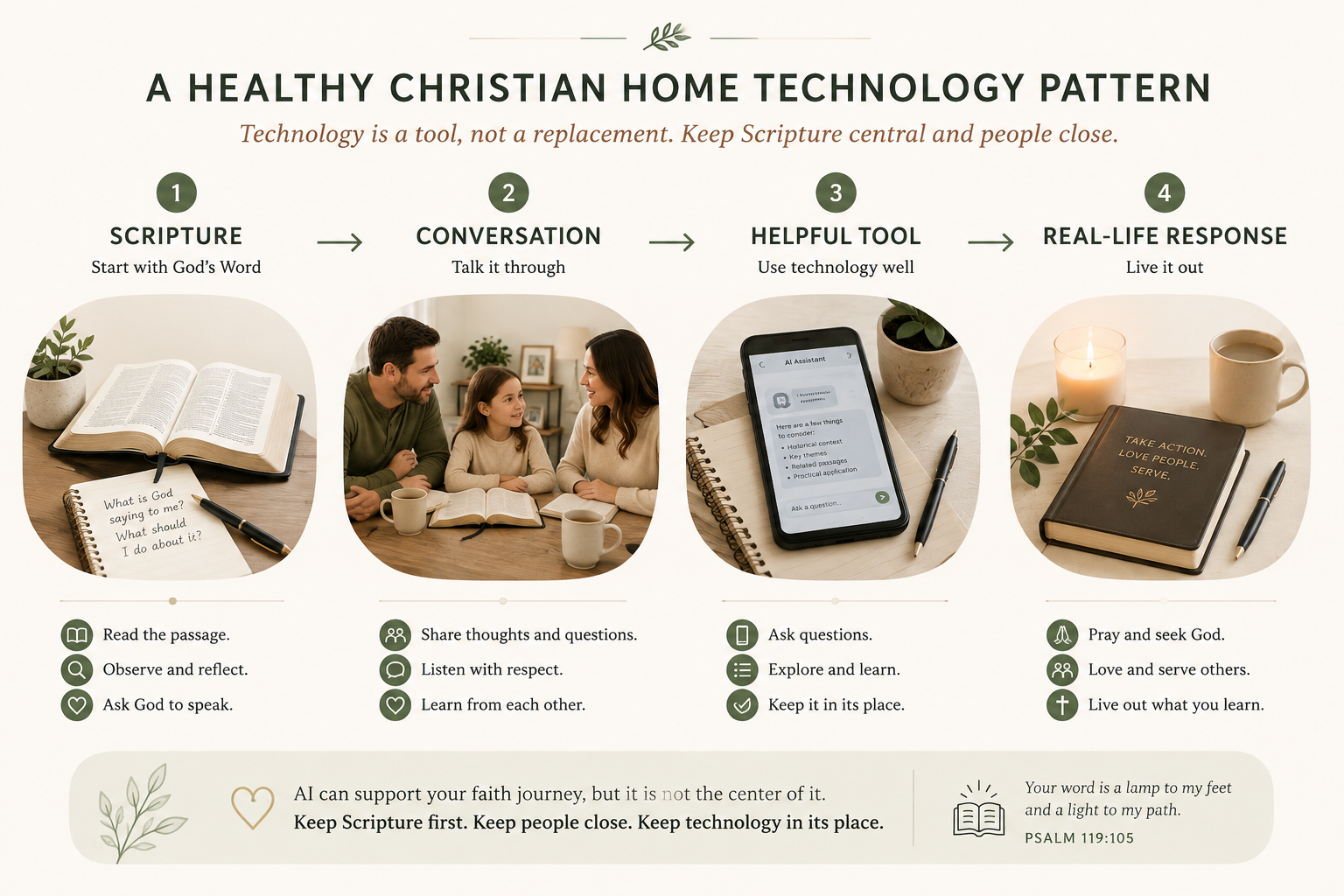
A simple healthy pattern
A Christian home does not need an elaborate technology philosophy to use AI thoughtfully.
A simple pattern can help:
- Start with Scripture.
- Talk about what you read with real people.
- Use technology when it adds something genuinely helpful.
- Check important claims against Scripture and trusted sources.
- Move from information toward prayer, conversation, worship, service, or practical action.
- Put the device down when it stops helping.
This pattern does not treat AI as inherently dangerous.
It also does not assume that because a tool is useful, more use is automatically better.
AI should not become the family's spiritual middleman
One unhealthy pattern would be allowing AI to sit between the family and nearly every part of faith.
Instead of reading Scripture, ask the AI what it says.
Instead of talking with a parent, ask the AI.
Instead of asking a pastor, ask the AI.
Instead of praying through uncertainty, ask the AI to resolve it immediately.
Individually, any one of those interactions may seem harmless.
Together, they can create a habit in which technology becomes the default mediator of spiritual questions.
That is not the role Christian AI should seek.
Convenience is useful, but formation matters more
Families naturally choose tools that make life easier.
There is nothing inherently wrong with convenience.
A Bible app is convenient. Search is convenient. Audio Scripture is convenient. Digital reading plans are convenient.
The question is what the convenience is producing.
Does it help someone read more carefully?
Does it create better conversation?
Does it encourage someone to return to Scripture?
Or does it slowly replace the harder practices it was supposed to support?
This is why Why Families Need Safer Faith-Based Technology is not simply about filtering bad content.
Safety also includes designing tools around healthy patterns of use.
Christian technology should lead back into real life
The strongest measure of healthy Christian technology use may be what happens after the screen is turned off.
Did the family talk?
Did someone open the Bible?
Did a question become a prayer?
Did someone ask a pastor for help?
Did a child learn that uncertainty can be discussed rather than instantly solved?
Did information lead to patience, service, repentance, encouragement, or another real-life response?
If technology points toward those things, it may be serving the home well.
If it increasingly replaces them, the family may need to reconsider the role the tool has been given.
Healthy Christian AI use is not about making technology central to family faith. It is about using technology in ways that keep Scripture and people central.
Curious how this works in practice?
Try Mat44 and see how Brenda keeps the focus on Scripture, reflection, and careful boundaries.