Why I Built Mat44 Around Boundaries First
Mat44 was not designed by building an unlimited Christian chatbot and adding safety rules later. Scripture, human responsibility, honest limitations, and real-world handoff were part of the foundation from the beginning.

Most technology products begin with a feature question.
What can we make the system do?
How quickly can it answer? How many conversations can it support? How personalized can it become? How often can we bring the user back?
Those questions are understandable. Features help people see what a product can offer.
But Christian technology also needs a different set of questions:
- What should this system never pretend to be?
- What kinds of authority should it refuse?
- When should it stop answering?
- How should it respond when Christians disagree?
- What would healthy use look like?
- How do we protect the dignity and responsibility of the person using it?
Those were not secondary questions for Mat44.
They shaped the product from the beginning.
The easiest product to build was not the product I wanted
It would have been easier to build a chatbot that simply answered every Christian question as confidently as possible.
Users generally like fast answers. Broad claims can sound impressive. Personalized spiritual language can feel warm and meaningful. An assistant that is always available may appear more useful than one that sometimes says, "This question belongs somewhere else."
But usefulness cannot be measured only by how often a system responds.
A Christian AI tool can produce a technically successful answer while still encouraging an unhealthy relationship with the technology.
It can make commentary feel more important than Scripture. It can flatten denominational differences. It can imitate pastoral language without accepting pastoral responsibility. It can continue a conversation when the person actually needs a doctor, counselor, pastor, family member, or emergency support.
I did not want Mat44 to become successful by quietly doing those things.
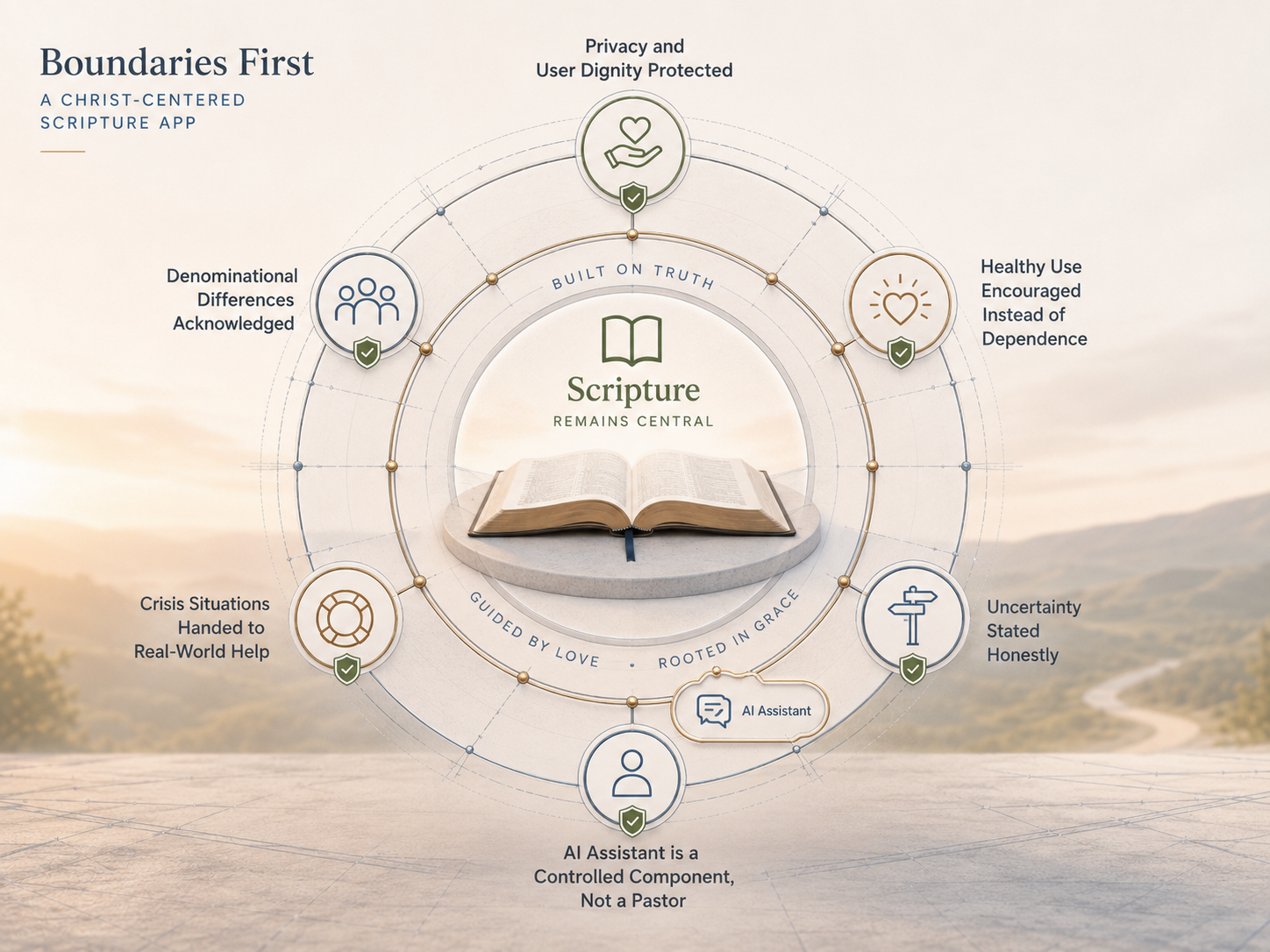
Scripture had to remain the center
Mat44 exists to help people build a consistent habit of reading and engaging with Scripture.
The goal is not to increase the amount of time someone spends talking to an AI assistant. The goal is not to make Brenda the most memorable voice in the experience.
The goal is more Scripture.
That means the app should continually point users back toward the biblical text. Explanations, questions, reflections, and supporting information should remain secondary.
This sounds simple, but it creates real design constraints.
A chatbot naturally invites continued conversation. Every answer can lead to another prompt. Every prompt can generate another answer. Without deliberate limits, the conversation itself can become the product.
Mat44 needed a different center of gravity.
Brenda may help someone notice a repeated theme, consider the context of a passage, or form a thoughtful question. But the experience should not imply that generated commentary is equal to Scripture.
The assistant serves the reading habit. The reading habit does not serve the assistant.
AI should not act like a pastor
A pastor does more than produce religious language.
Pastors teach within a particular community. They know people over time. They carry responsibilities, participate in church authority structures, respond to crises, and live with the consequences of their guidance.
An AI assistant does none of those things.
It may explain broad Christian perspectives. It may help a user prepare questions for a church leader. It may suggest passages related to a topic.
But it should not present itself as clergy, imply spiritual authority, or encourage the user to replace real Christian community with private chatbot conversations.
This is why "AI should not be your pastor" is more than a marketing phrase for Mat44.
It is an architectural boundary.
Denominational differences should be acknowledged honestly
Christians share important beliefs, but they do not agree about every theological question or church practice.
Baptism, communion, church authority, spiritual gifts, salvation language, sacraments, confession, Scripture translation, and many other subjects are understood differently across Christian traditions.
A generic Christian chatbot can easily blend these traditions together and present the result as though it were one universal Christian answer.
That may sound neutral, but it is not honest.
Mat44 was designed to recognize denominational context rather than pretending those differences do not exist. When traditions disagree, the system should say so. When a question depends on the teaching of a particular church, the user should be encouraged to speak with a leader from that community.
Denominational respect does not require deciding that every interpretation is equally correct.
It requires accurately representing disagreement and refusing to disguise one tradition as universal Christianity.
Uncertainty should be visible
AI systems often sound more certain than the evidence allows.
The language may be smooth, organized, and persuasive even when the answer is incomplete or mistaken.
In Christian contexts, that confidence can be especially misleading because the response may sound pastoral, biblical, or spiritually mature.
Mat44 needed room to say:
- Christians disagree about this.
- This depends on your church tradition.
- This answer should be verified.
- The biblical text does not directly settle every detail.
- I may not have enough context to answer responsibly.
Those statements may make an AI assistant appear less impressive.
They also make it more trustworthy.
A system that admits uncertainty protects the user from confusing confidence with authority.
Crisis handoff had to be part of the system
Some conversations should not remain inside an AI tool.
If someone describes immediate danger, abuse, self-harm, suicide, a medical emergency, or another serious crisis, the system should not continue as though the user had asked an ordinary Bible-study question.
It should respond compassionately, clearly, and directly.
It should encourage immediate contact with real-world help and avoid pretending that generated conversation is an adequate substitute.
This boundary cannot be added only as a disclaimer at the bottom of the screen.
It must shape how the system recognizes and responds to serious situations.
A handoff is not the AI giving up.
It is the system recognizing that human safety matters more than continuing engagement.
Privacy and dignity are spiritual concerns too
Faith questions can be deeply personal.
People may discuss grief, guilt, family conflict, church experiences, temptation, fear, doubt, trauma, or questions they have never voiced elsewhere.
That makes privacy more than a technical feature.
It is part of treating the user with dignity.
Christian technology should not encourage people to expose more personal information than the system needs. It should not make intimacy with the tool feel like a spiritual achievement. It should be transparent about what the AI can and cannot understand.
Respecting dignity also means preserving responsibility.
The user should remain free to disagree, verify, leave the conversation, involve another person, or decide that AI is not the right tool for the question.
Healthy use matters more than endless engagement
Many technology products are designed around retention.
More sessions, longer conversations, more notifications, more streaks, and more frequent returns are treated as signs of success.
Those measurements are not automatically wrong. Consistency can help someone build a Scripture habit.
But engagement becomes unhealthy when the product creates guilt, dependence, anxiety, comparison, or pressure to return for its own sake.
A Christian Scripture app should be willing to encourage users to close the screen.
Read the passage. Write in a notebook. Pray. Talk with someone. Attend church. Rest. Come back tomorrow.
The healthiest outcome may be that the technology becomes less central to the person's day while Scripture and real relationships become more central.
Features first and boundaries first lead to different products
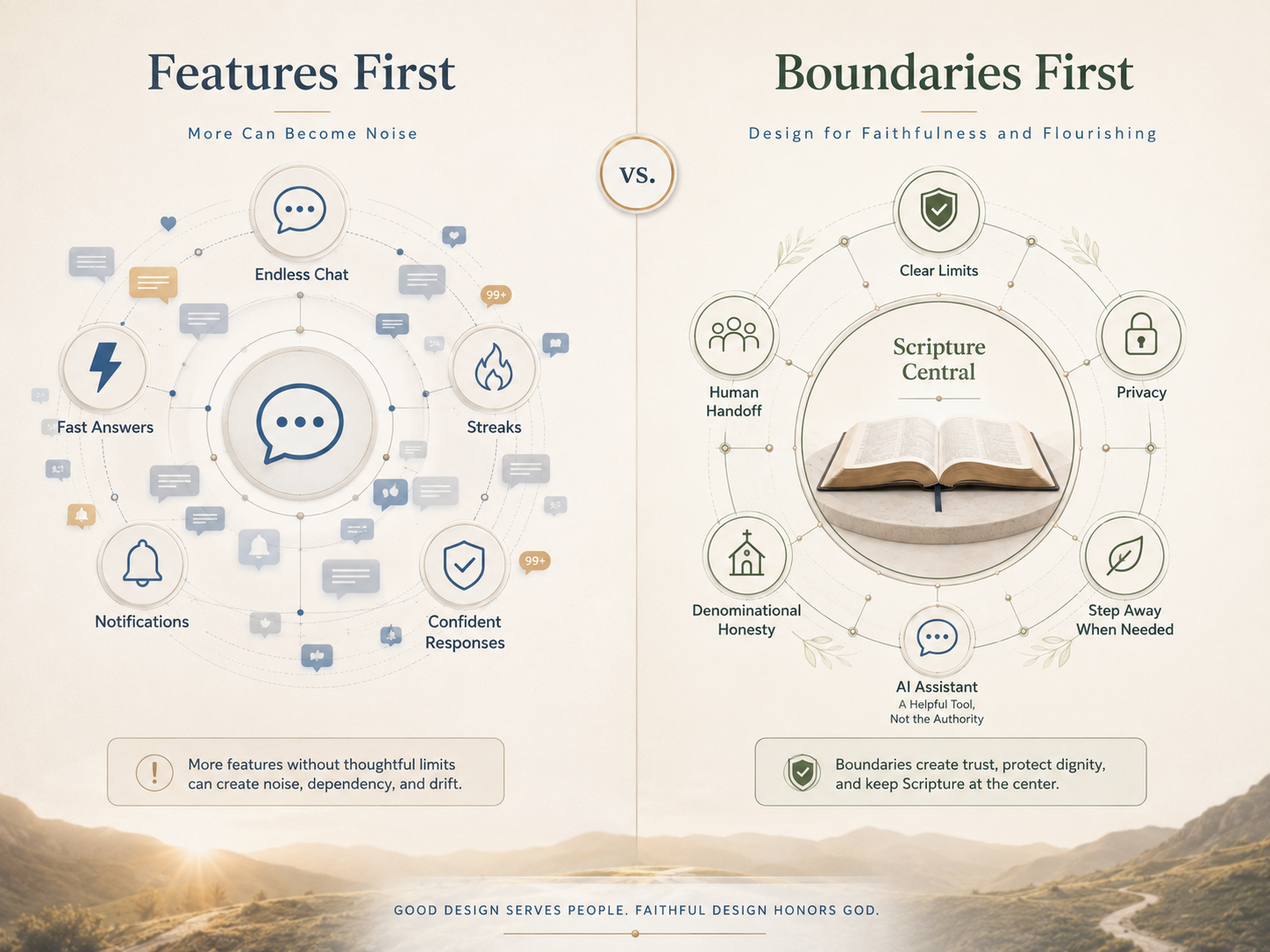
A features-first product asks how much the AI can do.
A boundaries-first product asks what role the AI should have.
The first approach may prioritize:
- Unlimited conversation
- Fast and confident answers
- Frequent notifications
- Streaks and engagement rewards
- Personalized responses that encourage continued use
A boundaries-first approach may prioritize:
- Scripture remaining central
- Clear limits on spiritual authority
- Honest representation of Christian disagreement
- Human handoff when the situation requires it
- Privacy and user dignity
- Encouragement to step away from the screen
These are not simply two different collections of features.
They represent two different definitions of success.
Boundaries make useful features safer
Boundaries are sometimes described as restrictions that prevent innovation.
I see them differently.
Good boundaries make it possible to build useful features without asking those features to carry authority they should not have.
Brenda can help explain context because she is not presented as the final interpreter. She can help users reflect because reflection is not confused with pastoral counseling. She can discuss denominational perspectives because the system is expected to acknowledge differences rather than erase them.
The boundaries clarify the role of the tool.
Once that role is clear, features can be designed to support it.
Building boundaries is ongoing work
Designing around boundaries does not mean every risk has been permanently solved.
AI systems change. Users ask unexpected questions. Language that seems clear in testing may be misunderstood in practice. Guardrails need review, adjustment, and continued humility.
Responsible design is not a one-time checklist.
It requires watching how people actually use the product, examining failures, listening to concerns, and being willing to change the system when a boundary does not work as intended.
Transparency matters here too.
Mat44 should not claim to be perfectly safe, perfectly neutral, or incapable of error. It should explain what it is trying to do, where its limits are, and why those limits exist.
The product should help users remain human
The most important boundary is not between good technology and bad technology.
It is between a tool that supports human responsibility and a tool that quietly replaces it.
Christians should remain active readers of Scripture. They should continue asking their own questions, seeking wisdom, participating in community, exercising judgment, and accepting responsibility for their decisions.
AI can support those practices.
It should not make them feel unnecessary.
I built Mat44 around boundaries first because the purpose of Christian technology should not be to make the technology indispensable.
It should help people engage Scripture faithfully while remaining connected to God, responsibility, and real human community.
Why this matters for Mat44
Mat44 is a Scripture companion, not a replacement pastor, church, counselor, or spiritual authority.
Brenda is one component within a larger system designed to support daily Scripture engagement.
Scripture remains central. Denominational differences should be represented honestly. Uncertainty should be visible. Crisis situations should lead toward real-world help. Privacy and dignity should be protected. Healthy use should matter more than endless engagement.
These boundaries do not sit outside the product.
They define what the product is.
Curious how this works in practice?
Try Mat44 and see how Brenda keeps the focus on Scripture, reflection, and careful boundaries.