Why Scripture Apps Should Not Chase Screen Time
A Scripture app should help people return to the Bible, not train them to spend more time staring at a screen.
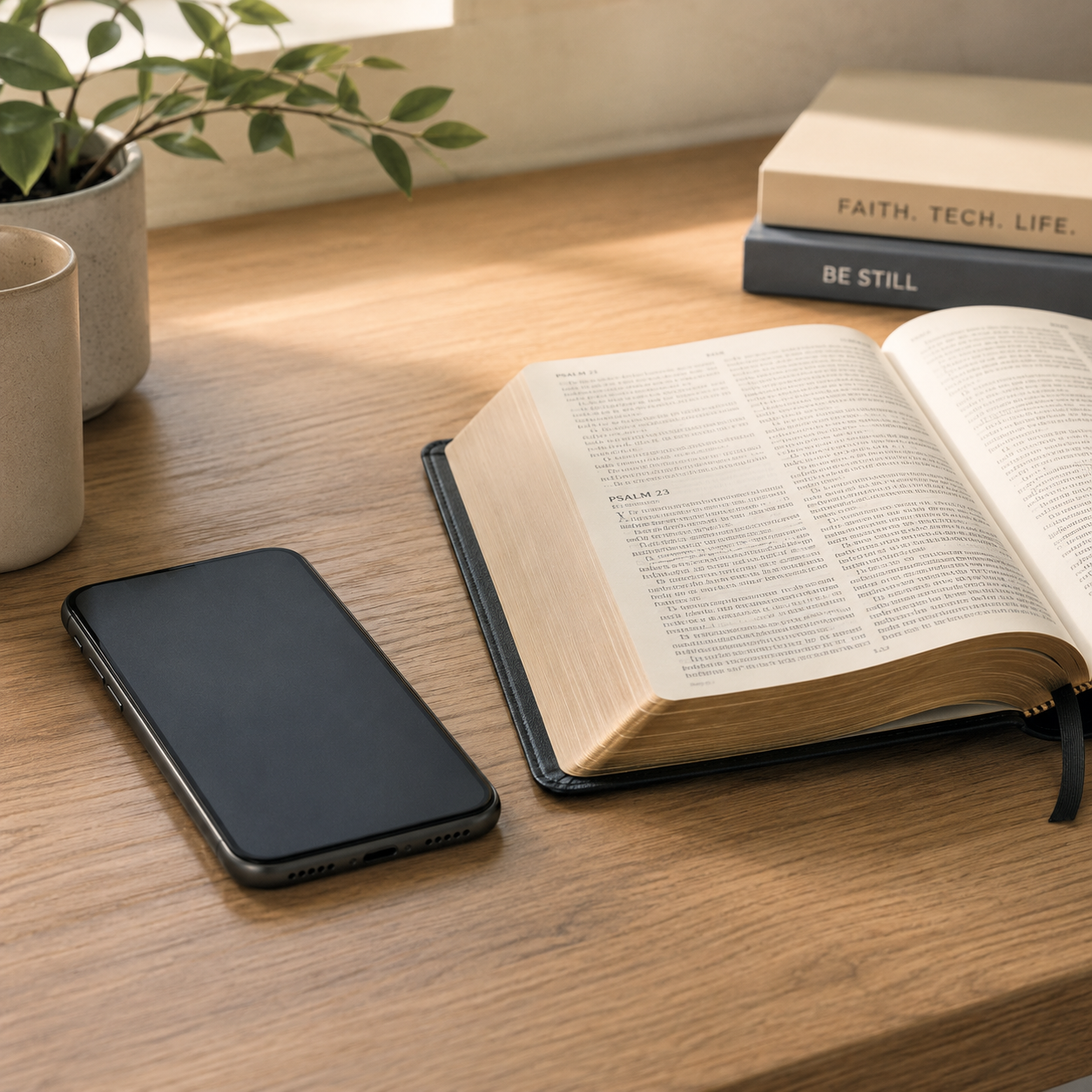
Most apps want more of your attention.
More opens. More taps. More notifications. More time spent inside the product.
That may make sense for entertainment, social media, shopping, or games. But it becomes a harder question when the app is built around Scripture.
A Bible or devotional app should not have the same goal as a feed.
The purpose of a Scripture app should be to help someone return to the Word of God with attention, humility, and consistency. If the app quietly helps a person read, reflect, pray, and then put the phone down, that may be a success even if the session was short.
In Christian technology, more screen time is not automatically a win.
Engagement is not the same as formation
Technology companies often measure success by engagement. That usually means how often people come back, how long they stay, and how many actions they take.
Those numbers can be useful. They tell builders whether something is being used. They can reveal confusion, friction, or interest.
But Christians should be careful about treating engagement as the highest good.
A person can spend twenty minutes inside an app and leave more distracted than when they began. Another person can spend three minutes reading one verse carefully and carry it with them for the rest of the day.
Only one of those looks impressive on an analytics dashboard.
The better question is not simply, "Did the user stay?"
The better question is, "Did this help them pay attention to Scripture?"
The problem with spiritualized attention traps
Not every notification is manipulative. Not every streak is bad. Not every reminder is unhealthy.
A gentle reminder to read Scripture can be helpful, especially for someone trying to rebuild a daily habit. A simple record of consistency can encourage people who feel scattered or discouraged.
The problem begins when the design shifts from encouragement to pressure.
A Scripture app can become unhealthy when it uses guilt, anxiety, comparison, or artificial urgency to keep people coming back. The language may sound spiritual, but the mechanism can still be the same one used by attention-driven platforms.
Did you miss your streak? Are you falling behind? Do you need to catch up? Are you less faithful because you forgot yesterday?
That kind of design can quietly turn a tool for Scripture into another place where people feel watched, measured, and inadequate.
Faith is not a game to be won.
Consistency matters, but pressure is not the point
Daily Scripture reading is a good habit.
Christians have long used rhythms, prayers, calendars, devotionals, reading plans, and repeated practices to shape attention over time. A habit can be a gift. It can carry us when motivation is low. It can create room for God's Word in ordinary life.
But Christian habit formation should not depend on panic.
The goal is not to make someone afraid to miss a day. The goal is to help Scripture become a normal, steady part of life.
There is a difference between a habit and a scoreboard.
A habit says, "Come back. Begin again. This is worth returning to."
A scoreboard says, "Keep proving yourself."
That distinction matters.
A short session can be a faithful session
Many apps treat longer sessions as better sessions.
For a Scripture app, that assumption is not always right.
Someone may open the app, read a short passage, answer one reflection question, and leave. From a business analytics perspective, that could look like low engagement. From a spiritual formation perspective, it might be exactly right.
The person did not get pulled into a feed. They did not scroll through arguments. They did not keep tapping for rewards. They read Scripture and moved back into their day.
That is not failure.
Sometimes the most faithful design is the one that knows when to get out of the way.
Scripture should stay central
Christian apps can easily drift.
A tool may begin with Scripture, then slowly become centered on commentary, content, personalization, AI responses, streak systems, community feeds, or emotional engagement.
Some of those features can be helpful in the right place. But they should not displace the Bible itself.
If a Scripture app makes the surrounding system more compelling than the actual passage, something has gone wrong.
The app should serve the text.
The design should make Scripture easier to approach, not easier to avoid. The companion features should point back to the passage, not become the main event.
What better metrics might look like
This does not mean Christian technology should ignore metrics.
Builders still need to know whether people are confused, whether pages are broken, whether reminders are useful, and whether people are returning over time.
But the metrics should be interpreted carefully.
For a Scripture app, healthier questions might include:
- Did the person read the passage?
- Did they pause long enough to reflect?
- Did they return without being pressured?
- Did the app help them build a sustainable rhythm?
- Did the design reduce distraction rather than increase it?
- Did the experience point them back to Scripture instead of deeper into the product?
Those are harder to measure than screen time.
But they are closer to the real purpose.

Why Mat44 avoids pressure-based streaks
Mat44 was built around a simple conviction: the goal is more Scripture, not more screen time.
That affects product decisions.
Mat44 can support a daily habit. It can help someone receive a passage, reflect on it, save notes, and return again tomorrow. Brenda, the Scripture companion inside Mat44, can offer gentle reflection and structure.
But Brenda is not the point.
The app is not the point.
Scripture is the point.
That is why Mat44 avoids pressure-based streaks and social comparison. It is also why the AI companion is designed with boundaries. The tool should help people come back to Scripture, not train them to depend on the tool itself.
Quiet technology can still be effective
There is a temptation to assume that a quieter product is a weaker product.
But quiet technology can be deeply useful.
A good alarm clock does not need to entertain you. A good calendar does not need to make you feel guilty for having a full life. A good Scripture app does not need to keep pulling you back after you have already read and reflected.
Sometimes good design is not louder.
Sometimes it is more restrained.
For Christian technology, restraint is not a lack of ambition. It can be a sign of respect.
Respect for the user. Respect for attention. Respect for Scripture. Respect for the difference between a spiritual habit and a product metric.
The goal is to return, not remain
A Scripture app should invite people to return.
Return to the passage. Return to prayer. Return to a daily rhythm. Return after missing a day. Return without shame.
But that is different from trying to make people remain inside the app as long as possible.
Christian technology should be willing to measure success differently. Sometimes the best outcome is a person reading a verse, reflecting honestly, closing the app, and carrying Scripture into the rest of the day.
That may not maximize screen time.
But it may serve the better goal.
Curious how this works in practice?
Try Mat44 and see how Brenda keeps the focus on Scripture, reflection, and careful boundaries.