Confidence Is Not the Same Thing as Truth
A fluent AI answer can feel authoritative before it has earned our trust. Confidence is presentation; truth requires evidence, context, and verification.

A confident answer is easy to recognize.
It is clear, organized, and direct. It does not stumble through its explanation or visibly struggle to choose between possibilities.
Those qualities are useful. They also create one of the most persistent problems in our relationship with artificial intelligence.
We are accustomed to treating confident language as a sign that the speaker knows what they are talking about.
With an AI system, that connection is unreliable.
The answer can sound certain because it is written well, not because the underlying claim has been verified.
Confidence is a feature of the writing
Language models generate responses by predicting and arranging language in ways that fit the conversation.
They can produce cautious language, assertive language, academic language, pastoral language, or a friendly conversational tone.
None of those styles is a built-in truth meter.
A sentence does not become more accurate because it begins with "clearly" or ends without qualification. It does not become less accurate merely because the system says that several interpretations are possible.
Tone changes how an answer feels. Evidence changes how well the answer is supported.
Why fluent answers receive unearned trust
People naturally use presentation as one clue when deciding whom to trust.
A confused explanation may signal that someone does not understand the subject. A precise explanation may signal experience and preparation.
That shortcut is imperfect even with human speakers, but at least a human person's confidence may be connected to memory, expertise, or direct experience.
An AI answer can reproduce the language of expertise without possessing expertise in the human sense.
This is why polished formatting, a calm voice, and a complete-sounding conclusion should never function as evidence by themselves.
An answer can combine true pieces incorrectly
Not every unreliable answer is invented from beginning to end.
Some of the hardest errors contain many accurate details.
The verse exists. The historical figure is real. The theological term is used correctly. The church tradition being described genuinely teaches something similar.
But the connection between those pieces may still be wrong.
A response can attach the right quotation to the wrong author, place a real event in the wrong century, or use a true verse to support a conclusion the passage does not address.
Familiar details create a feeling of recognition. That feeling can make the unsupported connection harder to notice.
Bible references can create borrowed authority
Scripture references carry weight for Christian readers, as they should.
But that weight belongs to Scripture, not automatically to every explanation that includes a chapter and verse.
An AI answer may borrow the appearance of biblical authority by listing several passages. The references can be accurate while the interpretation remains debatable, incomplete, or disconnected from context.
That is why the distinction between Scripture, paraphrase, commentary, and application matters.
A responsible tool should make those layers clearer rather than blending them into one authoritative voice.
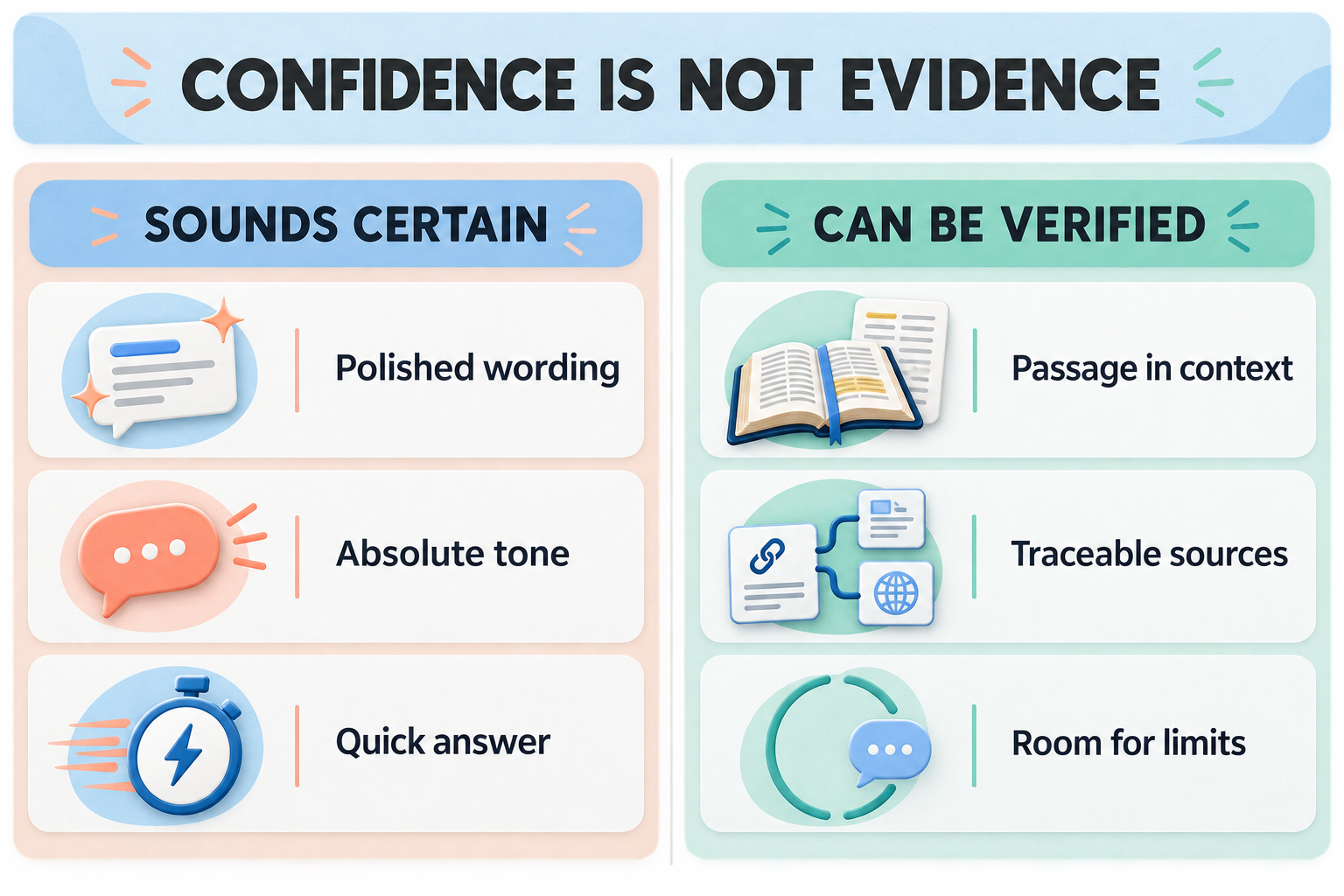
The same claim can be rewritten with a different tone
Imagine an AI gives a forceful answer about a disputed passage.
Ask the system to rewrite the same answer in cautious language, and it probably can. Ask it to make the answer sound more decisive, and it may be able to do that too.
The underlying evidence has not changed.
Only the presentation has changed.
This is a useful reminder that confidence is often something the system can add or remove stylistically. It is not a dependable report of how certain the claim should make us.
Uncertainty is not always a weakness
Users often prefer direct answers, and directness is not inherently irresponsible.
There are many questions with well-established answers. A tool does not need to bury every simple fact beneath endless disclaimers.
The problem appears when certainty is preserved after the evidence becomes uncertain.
OpenAI's published research on language-model hallucinations argues that common training and evaluation methods can reward guessing instead of acknowledging uncertainty. The details are technical, but the practical lesson is straightforward: a system may be pushed toward providing an answer even when restraint would be more accurate.
"I do not know," "the source is unclear," and "Christians interpret this differently" can be signs of a healthier answer.
Verification asks better questions than confidence does
Instead of asking whether an answer sounds convincing, ask questions that can be checked.
- What exact claim is being made?
- What passage or primary source supports it?
- Does that source say what the answer claims it says?
- What context was left out?
- Would another major Christian tradition frame the issue differently?
- What uncertainty would a careful human expert acknowledge?
Those questions move attention away from performance and toward support.
Responsible AI should help users see the foundation
The burden should not fall entirely on the person asking the question.
Developers make choices about whether sources are visible, whether uncertainty is allowed, whether denominational differences are acknowledged, and whether the product encourages users to consult real people.
A Christian AI tool should not merely produce the most persuasive answer it can.
It should help users understand where the answer came from, what kind of claim it is making, and where its limits begin.
That may feel less impressive than an instant, absolute answer. It is also more worthy of trust.
Truth does not need artificial confidence
Christians have good theological reasons to care about truth and good practical reasons to remain humble about our own understanding.
AI does not remove that responsibility. It gives us another setting in which to practice it.
We can appreciate a clear explanation without surrendering judgment to its tone.
We can use a fast tool without pretending that speed proves accuracy.
And we can welcome useful technology while remembering a simple rule: confidence is not evidence, and persuasion is not the same thing as truth.
Further reading
Curious how this works in practice?
Try Mat44 and see how Brenda keeps the focus on Scripture, reflection, and careful boundaries.