How to Choose an AI Bible App That Keeps Scripture First
An AI Bible app may sound biblical without handling Scripture responsibly. Before trusting one, look closely at its sources, boundaries, transparency, privacy, and the direction it encourages you to go.
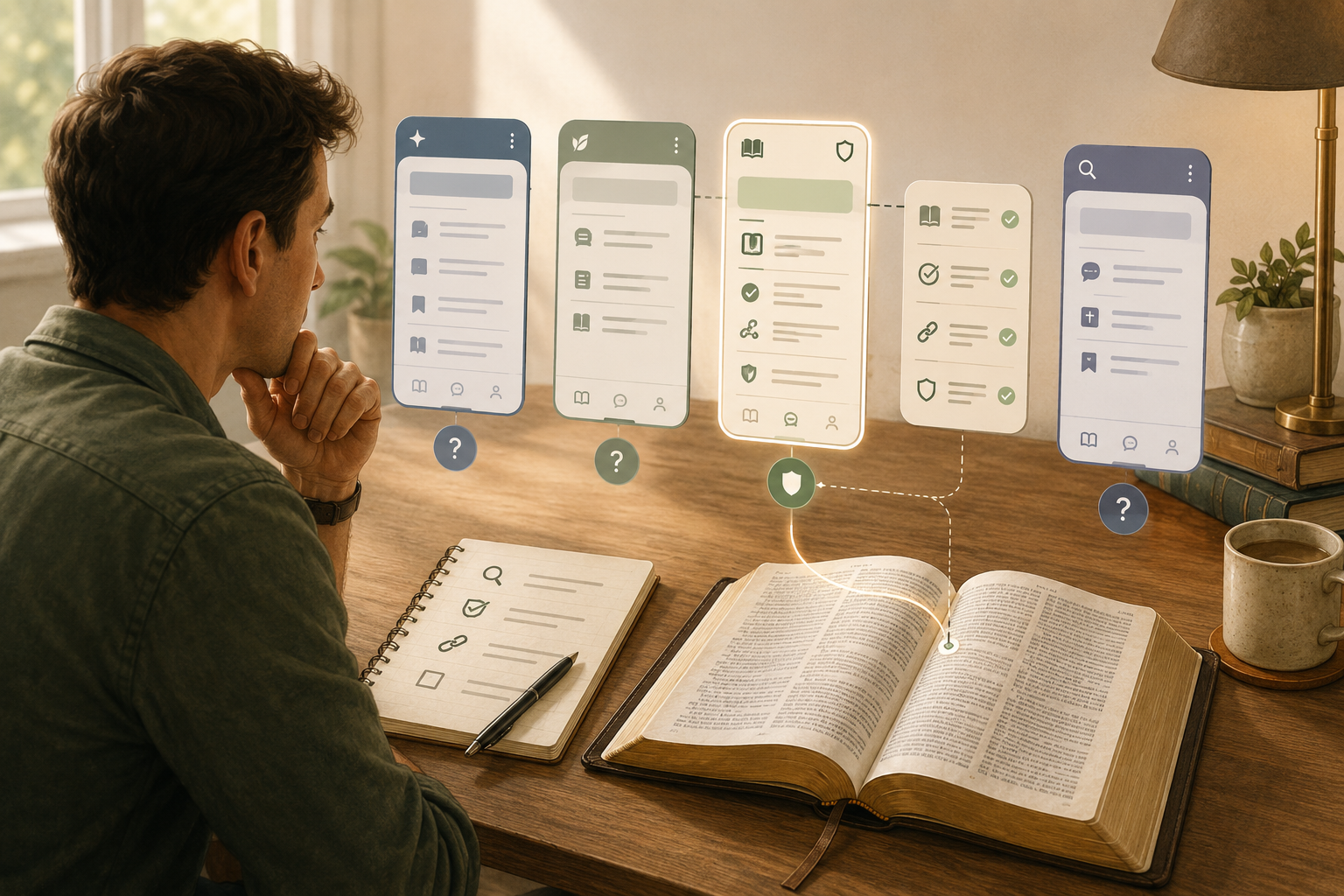
Searching for an AI Bible app can be confusing.
Many products use similar language. They may promise biblical answers, personalized devotionals, deeper study, spiritual encouragement, or a new way to ask questions about faith.
The interface may be beautiful. The answers may sound warm and confident. The app may quote Scripture and describe itself as Christian.
None of those qualities, by themselves, tell you whether the tool has been designed responsibly.
Choosing an AI Bible app requires more than asking whether its answers sound helpful. You also need to ask where those answers come from, how they can be checked, what the app does when certainty is not possible, and whether the technology keeps pointing you back to Scripture and real Christian life.
Here are eight practical questions to consider.
1. Are the answers grounded in Scripture?
A Christian tone is not the same as biblical grounding.
AI can generate familiar phrases about faith, hope, purpose, and God's plan without carefully connecting those ideas to a passage. An answer can sound spiritually encouraging while relying mostly on patterns learned from broad internet content.
A responsible AI Bible app should make Scripture central to the experience. When it offers an explanation or reflection, the user should be able to see which passages are relevant and return to the biblical text itself.
Ask whether Scripture is the foundation of the response or simply decoration added to an AI conversation.
2. Can you open and verify the verses?
Verse references should not function as impressive-looking footnotes that the user is expected to trust.
Can you tap a reference and read the passage? Can you see the verses before and after it? Does the quoted wording match the translation named by the app?
Context matters. A single verse may be technically relevant while the larger passage qualifies or changes the apparent meaning. Verification should be a natural part of the product, not extra work reserved for suspicious users.
3. Does the app distinguish Scripture from commentary?
An AI-generated explanation is not Scripture. A paraphrase is not a direct quotation. A devotional application is not the same as the meaning of the biblical text.
Those categories can be helpful, but only when the user can tell them apart.
Look for visual and verbal distinctions. Biblical text should be clearly identified. Generated commentary should not be placed in quotation marks or formatted in a way that makes it look inspired. If the app moves from the passage to interpretation or application, that movement should be visible.
4. Does it handle Bible translation choices honestly?
Bible translations are not interchangeable labels placed on identical wording. They reflect different translation philosophies, source-text decisions, reading levels, and denominational contexts.
An app should tell you which translation you are reading and avoid quietly combining wording from several versions. If a response depends on a particular English phrase, it should not imply that every translation or the original language makes the same point in exactly the same way.
Honest handling of translation does not require turning every answer into a seminary lecture. It requires enough transparency for the user to understand what text is being discussed.
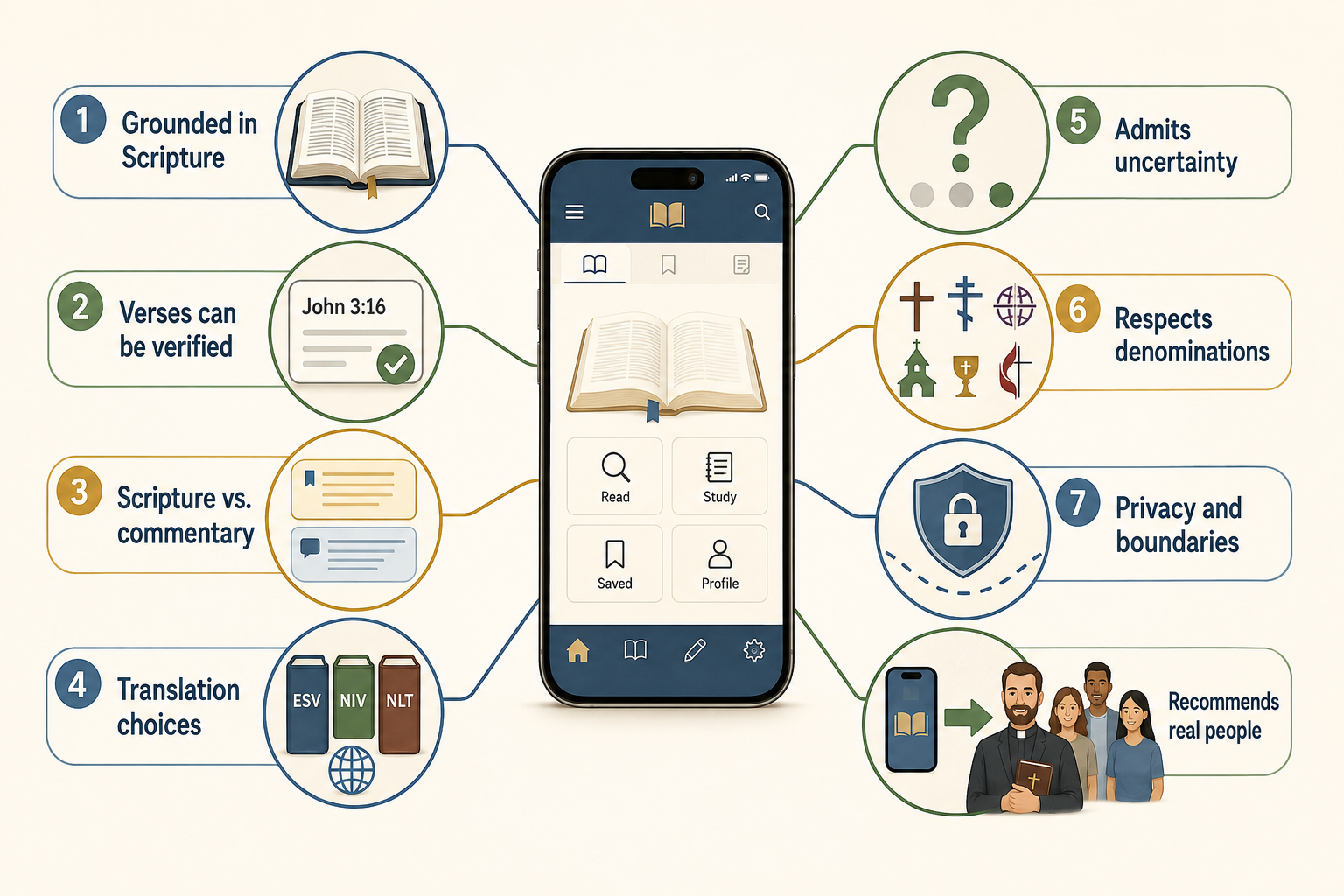
5. Can the app admit uncertainty?
AI systems are very good at producing complete sentences. That ability can make a disputed interpretation or incomplete answer sound settled.
Watch for claims that every response is perfectly biblical, completely accurate, or free from theological bias. Those promises are not realistic.
A trustworthy tool should be able to say that Christians disagree, that more context is needed, or that the user should verify an important conclusion. Honest uncertainty is evidence of responsible design, not a product defect.
6. Are denominational differences respected?
Christians share central convictions, but they do not interpret every passage, sacrament, church practice, or theological question in the same way.
No AI system approaches theology from nowhere. An app that claims complete objectivity may simply be presenting one tradition's assumptions without naming them.
Look for a tool that can acknowledge multiple historic Christian positions, describe them fairly, and avoid presenting denominational disagreement as a simple contest between true believers and everyone else.
Respecting differences does not mean treating every idea as equally sound. It means being honest about where interpretation is involved.
7. Are privacy and safety boundaries visible?
Faith questions can quickly become personal. Users may share information about relationships, mental health, grief, medical decisions, abuse, or spiritual fear.
Before sharing sensitive information, check what the app says about privacy, data collection, and account deletion. Also notice how the app responds when a question moves beyond Bible study and into crisis care, diagnosis, or personal pastoral direction.
A responsible app should not claim to be a pastor, therapist, doctor, or emergency service. Its boundaries should appear in actual behavior, not only in a legal document few users will read.
8. Does it recommend pastors and real people when appropriate?
Immediate availability is one of AI's genuine advantages. A user can begin a question at any time without scheduling a meeting or worrying that the question is too basic.
But an available response is not the same as a relationship.
Real people can understand history, notice changes over time, accept responsibility, provide practical help, and remain present after the conversation ends. An AI Bible app should recognize when those qualities matter more than another generated answer.
Healthy Christian technology should make it easier to move toward Scripture, prayer, pastors, family, trusted friends, and church community.
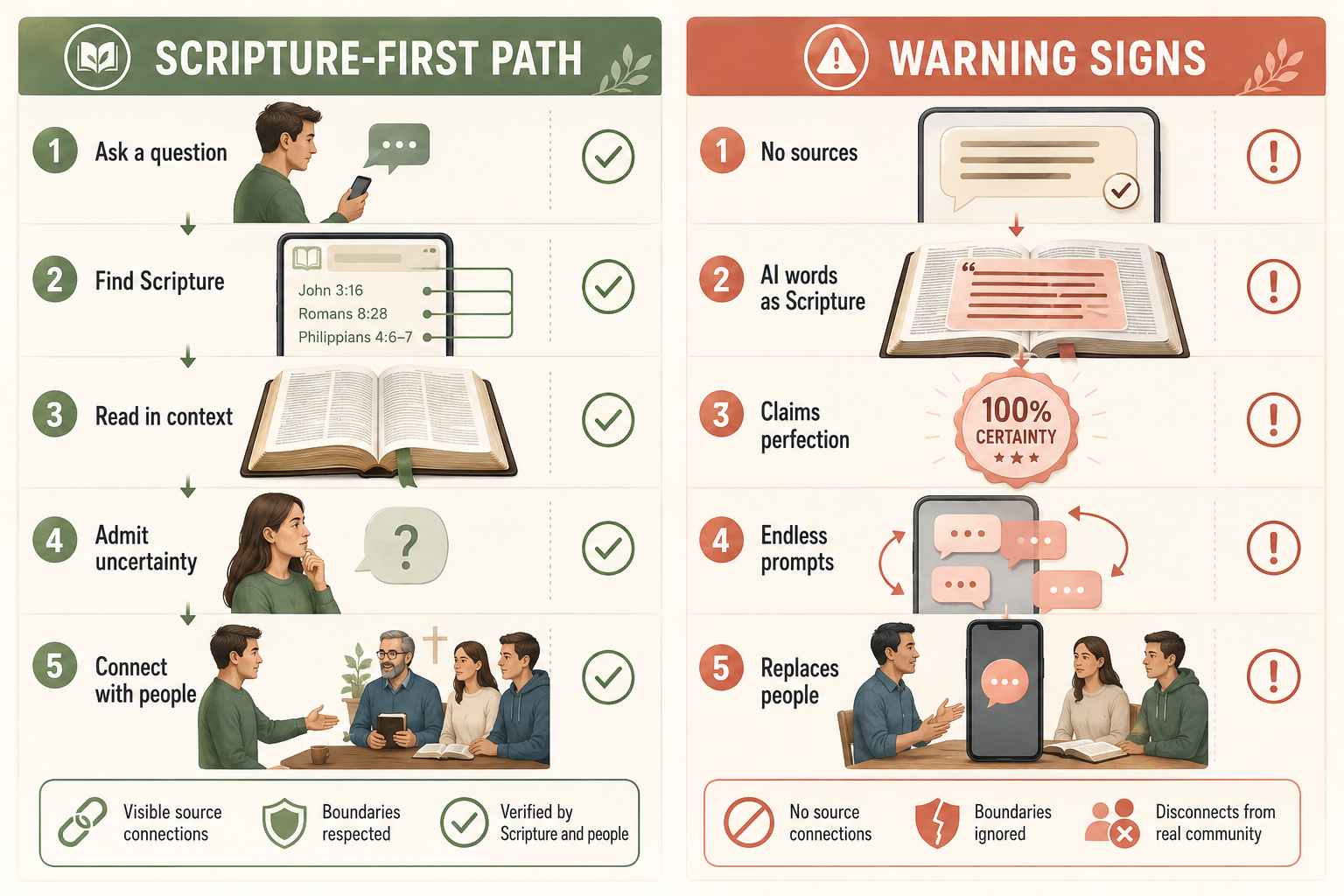
Look at the destination, not only the answer
The best way to evaluate an AI Bible app may be to ask what kind of habit it is building.
After using it, are you reading more Scripture or mainly reading AI summaries? Are you learning to verify references or becoming more dependent on polished answers? Does the app help you form better questions for real conversations, or does it encourage you to keep every spiritual concern inside the chat?
No app will answer every question perfectly. Responsible design does not require perfection.
It requires honesty about sources, uncertainty, differences, privacy, boundaries, and the proper role of the technology.
A trustworthy AI Bible app should not merely sound biblical. It should make Scripture easier to read, verify, and keep at the center.
Try a Scripture-first companion
Mat44 is designed to support a daily Scripture habit with clear boundaries, denominational context, and healthy stopping points that lead beyond the app.