How to Tell When an AI Answer Needs a Second Look
You do not need to investigate every sentence an AI produces, but some answers carry clear signs that it is time to slow down and verify the claim.

Artificial intelligence can be useful precisely because it makes difficult information easier to approach.
It can explain an unfamiliar term, summarize a complicated argument, suggest questions for Bible study, or help someone find a place to begin.
That usefulness creates a practical challenge: the easier an answer is to read, the easier it can be to accept without examining it.
Christians do not need to respond by treating every AI answer as suspicious. We also should not assume that a polished answer has earned our trust.
The wiser question is narrower: What should make us pause and take a second look?
Not every answer needs the same level of investigation
Verification takes time. It would be unrealistic to research every definition, formatting suggestion, or brainstorming idea as though it were a doctrinal claim.
The amount of checking should match the importance of the answer.
A suggestion for organizing study notes carries less risk than an explanation of salvation, marriage, church teaching, mental health, or a major personal decision.
The goal is not constant suspicion. It is learning to recognize the moments when convenience should give way to care.
The verse does not quite match the claim
A Bible reference can make an AI answer feel grounded even when the verse is being stretched beyond what it says.
Sometimes the reference is simply wrong. Sometimes the wording comes from a different verse. Sometimes the quotation is a loose paraphrase presented as though it were Scripture.
More often, the verse is real but the claim attached to it depends on information that is not actually in the passage.
When a verse is doing important work in an answer, open the Bible and read it. Then read what comes before and after it.
That small habit catches a surprising number of problems.
The source is missing or cannot be found
AI systems can produce names, books, quotations, historical details, and links that look credible.
A citation is helpful only if the source exists and supports the statement being made.
The National Institute of Standards and Technology includes confidently stated false content - often called hallucination or confabulation - among the risks that users and developers must manage in generative AI.
If an answer depends on a scholar, church document, historical event, or research finding, look for the original source. If it cannot be located, the citation should not increase your confidence.
One interpretation is presented as the Christian answer
Christians agree on many central convictions, but they do not interpret every passage, doctrine, sacrament, or church practice in the same way.
An answer deserves a second look when it quietly turns one tradition's interpretation into the only faithful Christian position.
Responsible AI should identify meaningful differences rather than erase them.
This is especially important for questions involving baptism, communion, church authority, gifts of the Spirit, election, sanctification, or the end times.
The problem is not that the answer takes a position. The problem is that it hides the fact that faithful Christians take other positions.
The surrounding context is missing
A sentence from Scripture can be accurate and still be used carelessly.
Who is speaking? Who is being addressed? What problem is the author responding to? Is the passage poetry, history, prophecy, wisdom, a parable, or a letter to a particular church?
When an AI answer moves directly from one isolated line to a broad rule for every person and situation, pause.
Context does not automatically settle every disagreement, but removing context makes misunderstanding much more likely.
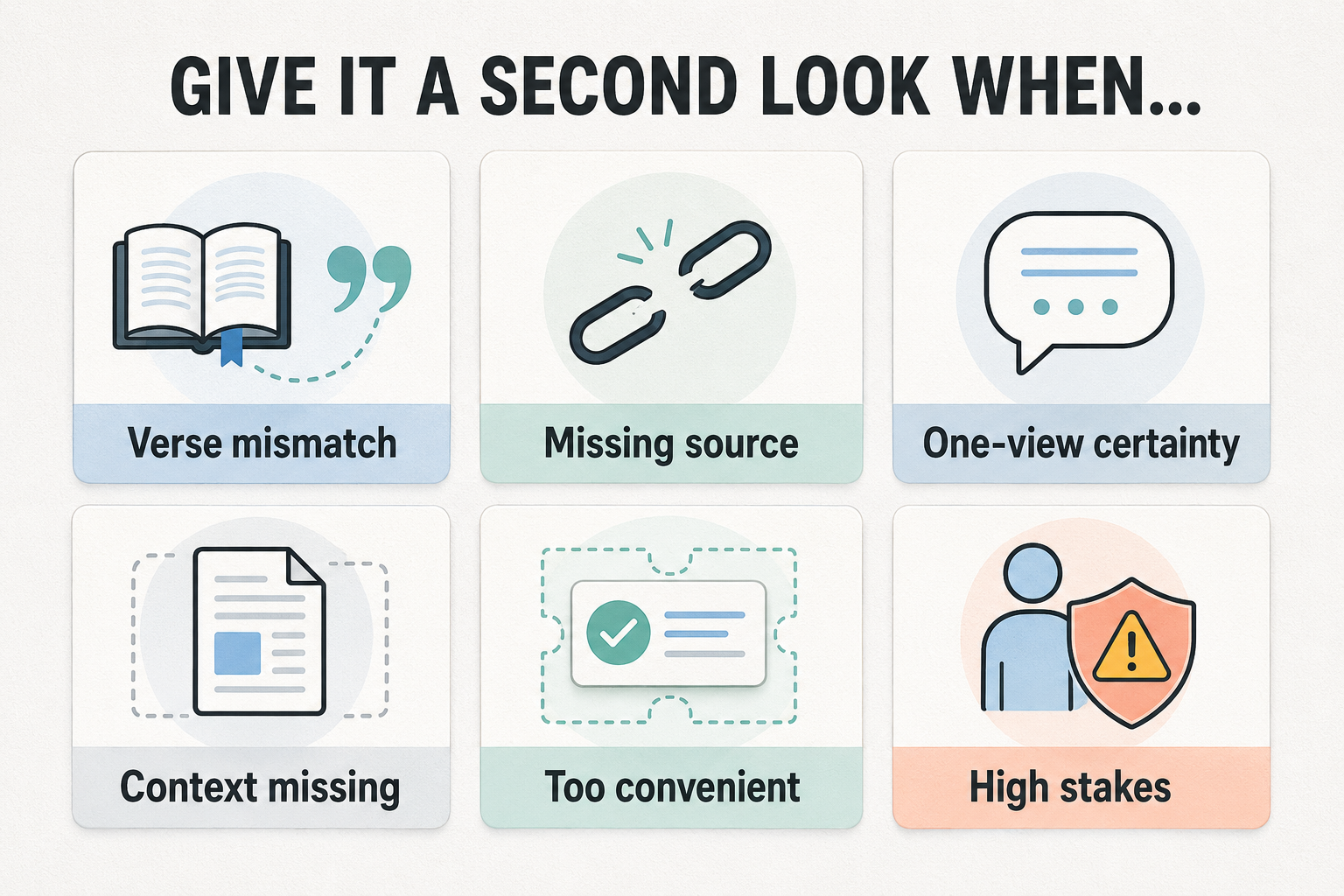
The answer is exactly what you hoped to hear
A satisfying answer is not necessarily a false answer.
But people are naturally less critical of information that confirms what they already believe or gives them permission to do what they already want to do.
AI can intensify that tendency because a conversation can be shaped by the assumptions inside the user's question.
If the answer resolves a complicated issue too neatly, removes every uncomfortable responsibility, or consistently casts you as entirely right, it deserves examination.
Sometimes the most responsible second question is: "What assumptions in my question may have shaped this answer?"
The stakes are personal, spiritual, or difficult to reverse
Some questions should trigger a second look even when the answer contains no obvious warning sign.
Decisions involving safety, health, abuse, marriage, finances, legal problems, church discipline, or a crisis of faith should not rest on one AI conversation.
The greater the possible harm, the more important it is to involve qualified and trustworthy people.
AI may help someone organize questions before a conversation. It should not become the only voice in a situation where wisdom, responsibility, and human knowledge matter.
A practical sixty-second second look
A useful verification habit does not always require an afternoon of research.
- Open every Bible passage the answer relies on.
- Read enough surrounding verses to understand the immediate context.
- Search for the original source behind an important quotation or factual claim.
- Ask whether the answer is reporting the text or interpreting it.
- Notice whether other Christian traditions would describe the issue differently.
- Move high-stakes questions toward a pastor, qualified professional, or trusted person.
If the answer survives those checks, your confidence has a better foundation than tone alone.
A second look is not a rejection of AI
Checking an answer does not mean the tool has failed.
We verify information from books, sermons, social media, conversations, and our own first impressions. AI belongs inside that same practice of discernment.
A good tool should make verification easier. It should distinguish quotation from paraphrase, show useful sources, acknowledge uncertainty, and avoid pretending that every faith question has one simple answer.
The healthiest relationship with AI is neither blind trust nor constant fear.
It is confident enough to use a helpful tool and responsible enough to look again when the answer matters.
Further reading
Curious how this works in practice?
Try Mat44 and see how Brenda keeps the focus on Scripture, reflection, and careful boundaries.