How to Use AI Without Letting It Think for You
AI can help organize ideas, surface questions, and explain unfamiliar concepts. It should not quietly take over the work of reading, reasoning, discerning, and deciding.

A useful AI tool can make difficult information feel easier to approach. It can summarize a complicated idea, suggest questions, compare perspectives, or help someone find a place to begin.
That convenience is real. So is the temptation to let the tool do more of our thinking than we realize.
Instead of reading a passage carefully, we may ask for its meaning immediately. Instead of sitting with a difficult question, we may request a polished answer. Instead of deciding what we believe, we may accept the explanation that sounds most confident.
The problem is not that Christians use AI. The problem begins when assistance becomes substitution.
AI can produce an answer before you have formed a question
Generative AI is designed to respond quickly. It can often produce a structured, persuasive answer before the person using it has fully decided what they are trying to understand.
Speed can be helpful, but it can also interrupt reflection.
Some questions deserve time. A difficult Bible passage may need to be read more than once. A theological claim may need to be compared with the surrounding text. A personal decision may require prayer, mature counsel, and an honest examination of our motives.
An immediate answer can create the feeling that this work has already been completed.
It has not.
UNESCO has emphasized that responsible AI use should preserve human agency, critical thinking, and the ability to make informed choices. The National Institute of Standards and Technology similarly treats human oversight as an important part of trustworthy AI design.
Those principles matter in Christian technology because faith questions are not merely information-retrieval problems. They involve interpretation, conscience, community, tradition, and lived obedience.
Receiving information is not the same as exercising discernment
AI can suggest a possible interpretation. It cannot perform Christian discernment on your behalf.
Discernment includes asking whether an answer is faithful to the biblical text, whether important context has been omitted, whether the tool is presenting one tradition as universal, and whether the response is appropriate for the person and situation involved.
Acts 17 describes the people of Berea receiving Paul and Silas's message eagerly while still examining the Scriptures daily to see whether the teaching was true.
Their willingness to listen did not eliminate their responsibility to examine.
That is a helpful model for using AI. We can remain open to useful input without treating every polished response as settled truth.
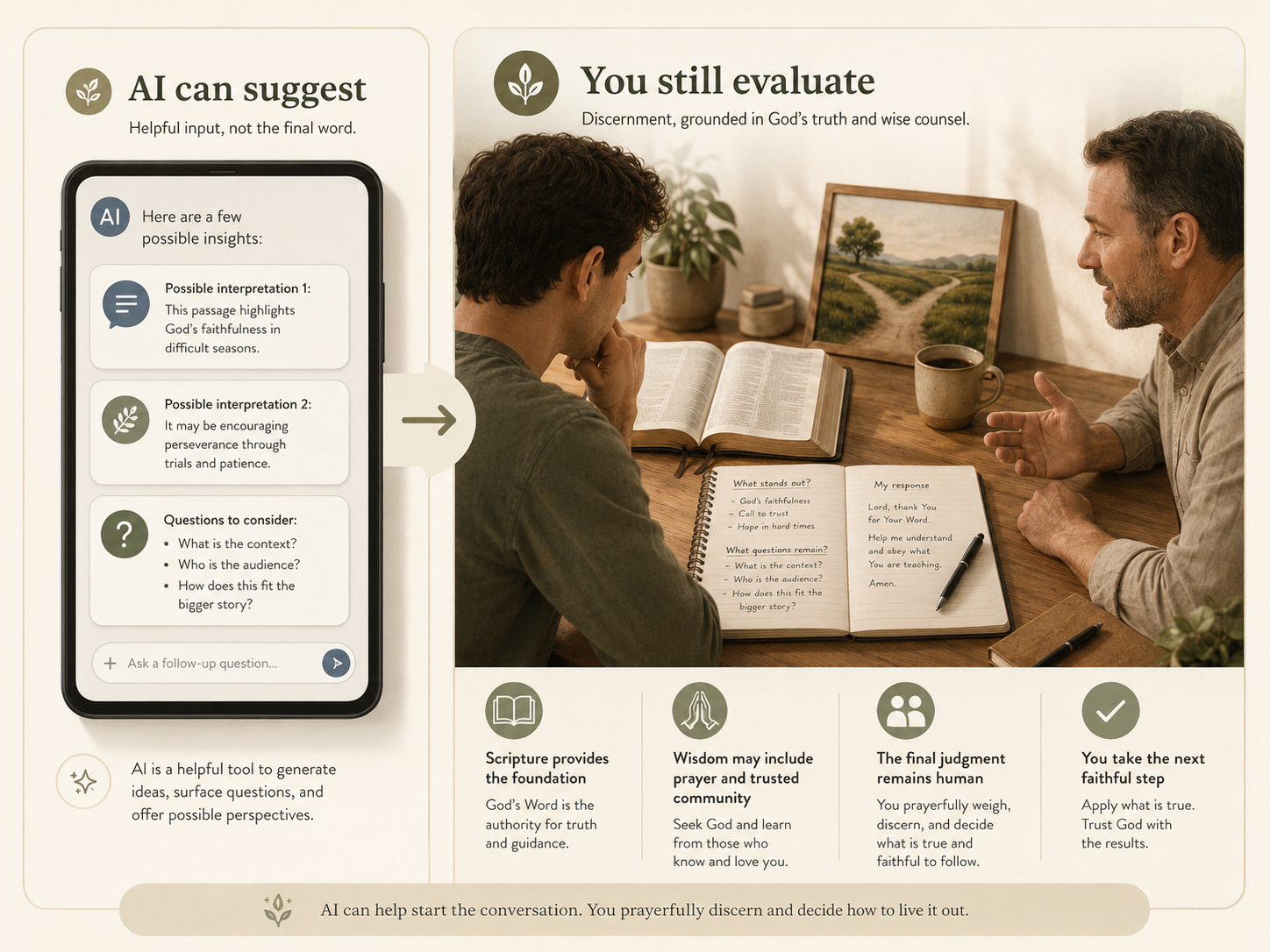
Use AI to support thinking, not bypass it
The healthiest uses of AI often keep the user actively involved.
Instead of asking, "What does this passage mean?" and accepting the first answer, try asking questions that preserve your participation:
- What questions should I consider while reading this passage?
- What historical or literary context should I research?
- Which words or themes are repeated in this chapter?
- What are several Christian interpretations of this passage?
- Where do those interpretations agree and disagree?
- What claims in this explanation should I verify?
These prompts do not ask the AI to become the final interpreter. They ask it to help organize the work that the reader still needs to do.
The distinction matters.
A tool can help you notice. It should not decide what you believe.
Read the original Scripture before reading the explanation
When an AI conversation begins with commentary rather than Scripture, the commentary can frame everything that follows.
You may begin noticing only the themes the tool selected. You may overlook details that do not fit its summary. You may even remember the explanation more clearly than the passage itself.
A better practice is simple:
- Read the biblical passage first.
- Notice what stands out to you.
- Write down your own questions.
- Examine the surrounding chapter.
- Then use supporting tools.
This does not guarantee that your first interpretation will be correct. It does keep you engaged with the actual text instead of outsourcing the first stage of reading.
Scripture should remain the source. AI-generated explanation should remain secondary.
Do not confuse confidence with accuracy
AI systems can present uncertain, incomplete, or mistaken information in smooth and confident language.
That is especially important when the subject is theology. A response may combine ideas from different traditions without explaining the differences. It may simplify a disputed doctrine. It may produce a verse reference that sounds appropriate but does not support the claim being made.
Confidence is part of the presentation. It is not evidence.
Important claims should still be checked against the biblical text, trustworthy reference material, and knowledgeable people.
A useful AI assistant should also be willing to state uncertainty. It should identify when Christians disagree and avoid pretending that one answer represents every church.
Keep writing your own words
One quiet form of overreliance happens when people stop articulating their own thoughts.
AI can produce prayers, journal entries, devotional reflections, discussion answers, and personal statements in seconds. Those outputs may sound thoughtful, but sounding thoughtful is not the same as having reflected.
There is value in struggling to find the words.
Writing your own response helps reveal what you understand, what remains unclear, and what you may be avoiding. The unfinished sentence and awkward question can sometimes be more spiritually honest than the polished paragraph generated for you.
AI may help you edit what you have already written. It may help you organize scattered notes. But it should not routinely replace the act of forming and expressing your own response.
Know when another person belongs in the conversation
Independent thinking does not mean isolated thinking.
Christians have always learned within communities. Pastors, teachers, family members, friends, and mature believers bring experience, accountability, denominational context, and personal knowledge that a chatbot does not possess.
A trusted person can notice when your question is not really about information. They may recognize grief beneath a theological question, anxiety beneath repeated reassurance-seeking, or a relationship problem beneath a request for a Bible verse.
AI sees the words entered into the conversation. A real person may understand the life surrounding them.
A practical checklist for active AI use
Responsible AI use does not require suspicion of every answer. It requires continued participation.
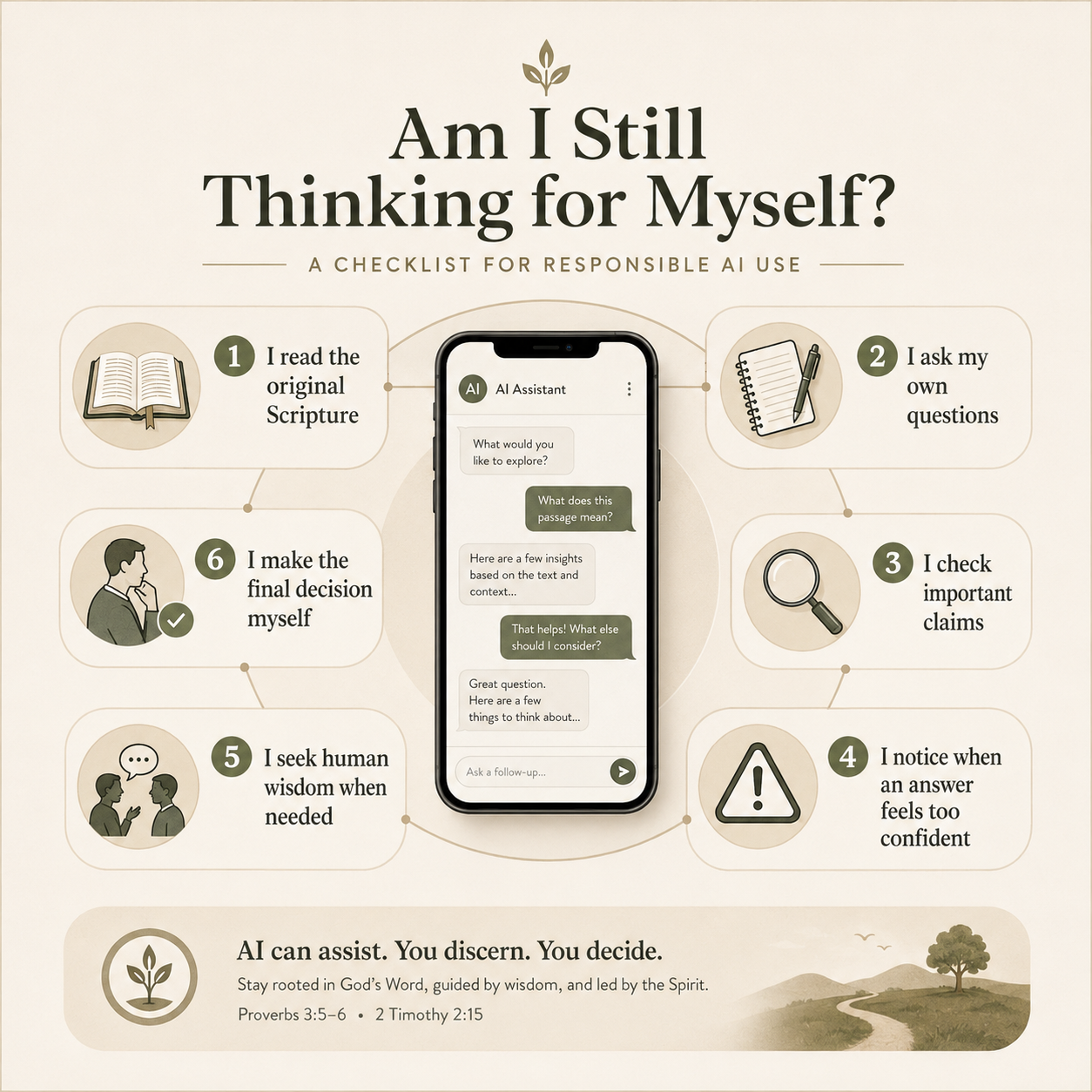
Before relying on an AI response to a faith question, ask:
- Did I read the original Scripture?
- Did I form any of my own questions first?
- Have I checked the most important claims?
- Does this answer sound more certain than the subject allows?
- Would a pastor, teacher, friend, or other trusted person add something important?
- Am I still making the final judgment myself?
These questions keep the user from becoming passive.
They also create a healthier relationship with the technology. AI remains available and useful, but it does not become the place where every question ends.
The goal is not to avoid help
None of this means Christians should refuse tools that make learning more accessible.
Study Bibles, commentaries, dictionaries, search engines, sermons, classes, and conversations have always influenced how people understand Scripture. AI joins that larger collection of resources.
But every resource should be used according to what it is.
An AI assistant can organize information. It can suggest questions. It can provide background and help a user compare ideas. It cannot pray, possess spiritual wisdom, participate in a church, accept responsibility, or live faithfully in response to what has been learned.
The goal is not to think without help. The goal is to remain an active, responsible participant in your own learning and discernment.
How Mat44 approaches this boundary
Mat44 was designed to support Scripture engagement without presenting its AI assistant as a pastor or spiritual authority.
Brenda can help users slow down, ask questions, examine a passage, and reflect. The system is also designed around limits: Scripture remains central, denominational differences should be acknowledged, uncertainty should be stated honestly, and situations requiring real-world support should be handed back to people.
That does not remove the user's responsibility.
It protects it.
The best Christian technology should not make people feel less capable of reading, thinking, praying, and seeking wisdom. It should help them practice those things more intentionally.
Further reading
- UNESCO: AI Operators or Creators? Two Visions of Agency and Learning
- National Institute of Standards and Technology: AI Risk Management Framework
- American Psychological Association: AI De-skilling and Cognitive Offloading
- Acts 17:11
Curious how this works in practice?
Try Mat44 and see how Brenda keeps the focus on Scripture, reflection, and careful boundaries.