What AI Misses When It Reads Scripture Like Data
AI can find patterns in biblical text with impressive speed, but word frequency, themes, and correlations are not the same thing as context, lived faith, prayer, or meaning.
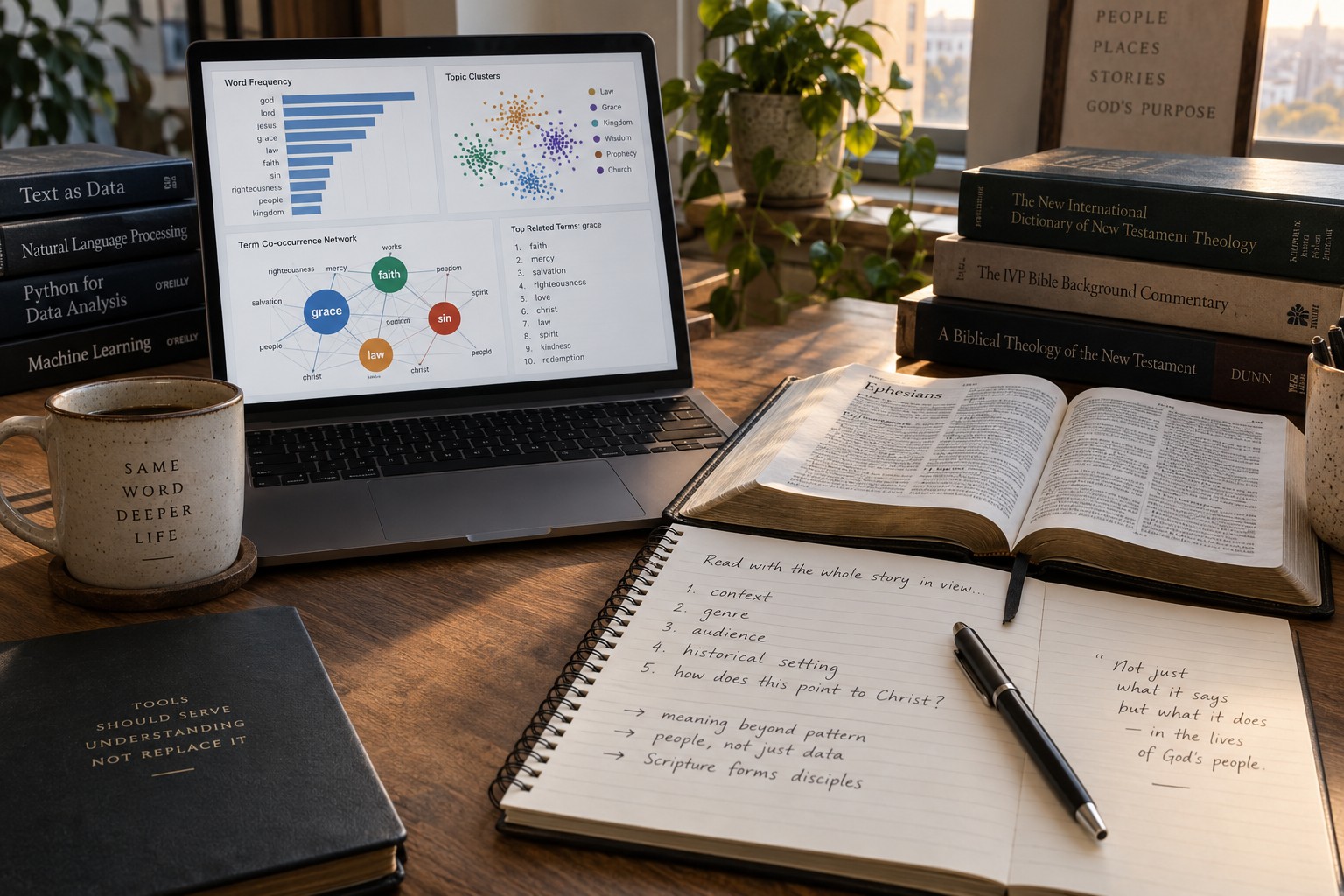
AI is unusually good at turning text into patterns.
It can count words, group themes, find repeated phrases, compare translations, summarize sections, trace names, and surface connections across large amounts of material faster than a person could do by hand.
Those abilities can be genuinely useful for Bible study.
They can also create a category mistake.
Scripture contains data, but Christians do not believe Scripture is merely data.
What a machine can notice
At the level of text analysis, AI can help us notice things we might otherwise miss.
It can identify repeated words in a letter. It can compare how different translations render a phrase. It can organize references to a place or person. It can suggest that two passages share vocabulary or themes.
That kind of analysis does not have to compete with faith. Concordances, indexes, Bible software, search tools, and databases have helped Christians study Scripture for a long time.
AI extends that tradition by making complex searches easier to ask for in ordinary language.
Patterns are not the same thing as meaning
The problem begins when a pattern is treated as though it explains itself.
A word may appear frequently because it is central to the author's argument, but frequency alone cannot tell us what the author means by it. Two passages may share vocabulary while using it differently. A theme can be statistically prominent without being the only or even the primary point of a passage.
Data can direct our attention. Interpretation still requires judgment.

Scripture is written by people to people
Biblical texts have authors, audiences, situations, emotions, arguments, memories, hopes, warnings, and relationships.
A letter is not only a collection of word frequencies. A lament is not only a sentiment score. A parable is not only a cluster of themes. A command is not fully understood by extracting the verb and attaching a modern application.
Human communication works through more than the statistical properties of sentences.
We ask why this person said this, to these people, in this moment, using this kind of language.
That is why context matters more than a single Bible verse, and why a data-first reading can become thin even when every counted word is correct.
A story is more than its inventory
Imagine describing the Good Samaritan by listing characters, locations, actions, and the frequency of words related to travel, injury, money, and mercy.
Those observations might be accurate. They might even help a reader notice details.
But the parable is not reducible to the inventory.
The force of the story comes from how Jesus tells it, the question surrounding it, the expectations it unsettles, and the way the listener is drawn into a moral and spiritual response.
A dataset can represent features of a story. It does not automatically represent what it is like to be addressed by the story.
AI does not have a lived place in the church
An AI system can describe grief without grieving. It can summarize a theology of baptism without belonging to a worshiping community. It can explain confession without needing to confess, describe forgiveness without having wronged or been wronged, and discuss hope without waiting through suffering.
That does not make its information useless.
It does mean the system's relationship to the subject is fundamentally different from ours.
Christian Scripture is read in homes, churches, hospitals, funerals, classrooms, prisons, kitchens, and quiet rooms where the words are connected to actual lives.
A tool can assist those readers. It cannot become one of them.
Application cannot be generated from text alone
AI is often asked, "How should I apply this verse to my life?"
Sometimes it can offer sensible reflection questions. But application depends on more than the words in front of the model.
The same passage may confront one person, comfort another, correct a misunderstanding, call a community to action, or require pastoral wisdom because of abuse, illness, grief, or conflict.
That is one reason Christian AI should be cautious about sounding like a pastor. The system does not know a person's life simply because it has received a prompt about it.
More information can still produce less understanding
AI can surround a passage with information very quickly.
Word studies. Timelines. Cross-references. Background notes. Doctrinal summaries. Interpretive options. Application ideas.
All of that can be helpful, and all of it can become noise.
A person can finish an AI-assisted study with twenty screens of material and very little memory of the passage itself.
This is the same design concern behind The Goal Is More Scripture, Not More Screen Time. The amount of generated content is not a spiritual metric.
Christian disagreement cannot be solved by averaging
AI systems are often good at summarizing multiple viewpoints, which can be extremely useful.
But theological disagreement is not a dataset where the safest answer is always the statistical middle.
Christians disagree because they weigh texts, traditions, historical arguments, church authority, philosophical assumptions, and theological systems differently.
A responsible tool should represent those differences fairly rather than flattening them into a generic answer that no tradition actually teaches.
Prayer is not another analytical layer
Christians may study grammar, history, literary structure, and theology, then pray over the same passage.
Prayer is not simply one more data source added to the analysis.
For a Christian reader, prayer involves a relationship with God. AI can suggest a reflection prompt or remind someone to pause. It should not pretend that its own processing is prayer, discernment, worship, or spiritual experience.
That boundary matters precisely because the language generated by AI can sound personal and spiritually fluent.
So what is AI actually good for?
A bounded role can still be a valuable one.
- Use AI to surface patterns worth checking.
- Use it to organize background questions.
- Use it to compare translations without pretending that comparison settles interpretation.
- Use it to find passages or themes you can then read yourself.
- Use it to summarize viewpoints, then consult real sources from those traditions.
- Use it to help prepare for study, not to replace the study.
In other words, let the machine be good at machine-like work.
The human work is not a flaw in the system
There is a temptation in technology design to treat every remaining human step as friction waiting to be removed.
But in Scripture reading, some of the human work is the point.
Paying attention is not inefficiency. Wrestling with a difficult passage is not a bug. Talking with another Christian is not a failed automation. Sitting quietly with a text instead of requesting another explanation is not wasted time.
AI can help us see the words more clearly. It can help us organize what we have found. It can even help us ask better questions.
But it does not turn Scripture into something Christians are meant to consume as processed information.
The Bible can be analyzed as data. Christian reading begins by remembering that it is more than data.
Curious how this works in practice?
Try Mat44 and see how Brenda keeps the focus on Scripture, reflection, and careful boundaries.