When Not to Use AI for Faith Questions
AI can help organize ideas and explain background information, but some questions belong with Scripture, pastors, trusted community, professionals, or emergency support.

A chatbot can feel like the easiest place to take a difficult question.
It is available immediately. It does not seem rushed. It can respond without embarrassment, awkwardness, or visible judgment. For someone who is unsure where to begin, that accessibility can be genuinely helpful.
But accessibility does not make AI the right destination for every question.
Some situations require more than information. They require responsibility, personal knowledge, spiritual authority, professional training, physical presence, or immediate action.
A trustworthy Christian AI tool should not merely answer questions well. It should also recognize when it is not the right place to continue.
Not every faith question is only a faith question
A person may ask, "What does the Bible say about fear?" when the deeper issue is a panic attack.
Someone may ask, "Should Christians forgive?" while living with ongoing abuse.
Another person may ask whether God still loves them while also expressing thoughts of self-harm.
The words may sound theological, but the situation may involve safety, health, trauma, family conflict, church discipline, or serious emotional distress.
AI sees the prompt. It does not automatically understand the full life surrounding it.
That limitation matters.
Use Scripture when the question is about the biblical text
If the question is, "What does this passage actually say?" the first destination should be the passage itself.
Read the surrounding verses. Notice who is speaking, who is listening, what happens before and after, and whether the text is narrative, poetry, prophecy, wisdom, a letter, or another kind of writing.
AI can help identify themes, define unfamiliar words, or suggest contextual questions. It should not replace direct engagement with Scripture.
Commentary about the Bible is not the same as the Bible.
A generated explanation may be useful, but it remains secondary.
Use a pastor or church leader for church-specific guidance
Some questions depend heavily on the beliefs, practices, and authority structures of a particular church.
Questions about baptism, communion, confession, church membership, discipline, ordination, temple participation, sacraments, spiritual gifts, or denominational teaching may receive very different answers across Christian traditions.
An AI assistant may summarize several perspectives. It cannot serve as your pastor, bishop, priest, elder, ministry leader, or church governing body.
It also cannot know the local circumstances, relationships, commitments, or pastoral responsibilities involved.
When the question concerns what your church teaches or what you should do within your church community, a real leader from that community belongs in the conversation.
Use trusted Christian community for lived wisdom
Information is not the only kind of help people need.
A trusted Christian friend may remember what you have already survived. A family member may recognize a pattern you cannot see. A mature believer may ask a question that changes how you understand the situation.
Real people can offer presence, accountability, practical support, and relationship over time.
They can also notice when you are asking the same question repeatedly because you are seeking reassurance rather than information.
A chatbot may continue answering indefinitely. A wise friend may gently say, "I think this is making you more anxious, not less."
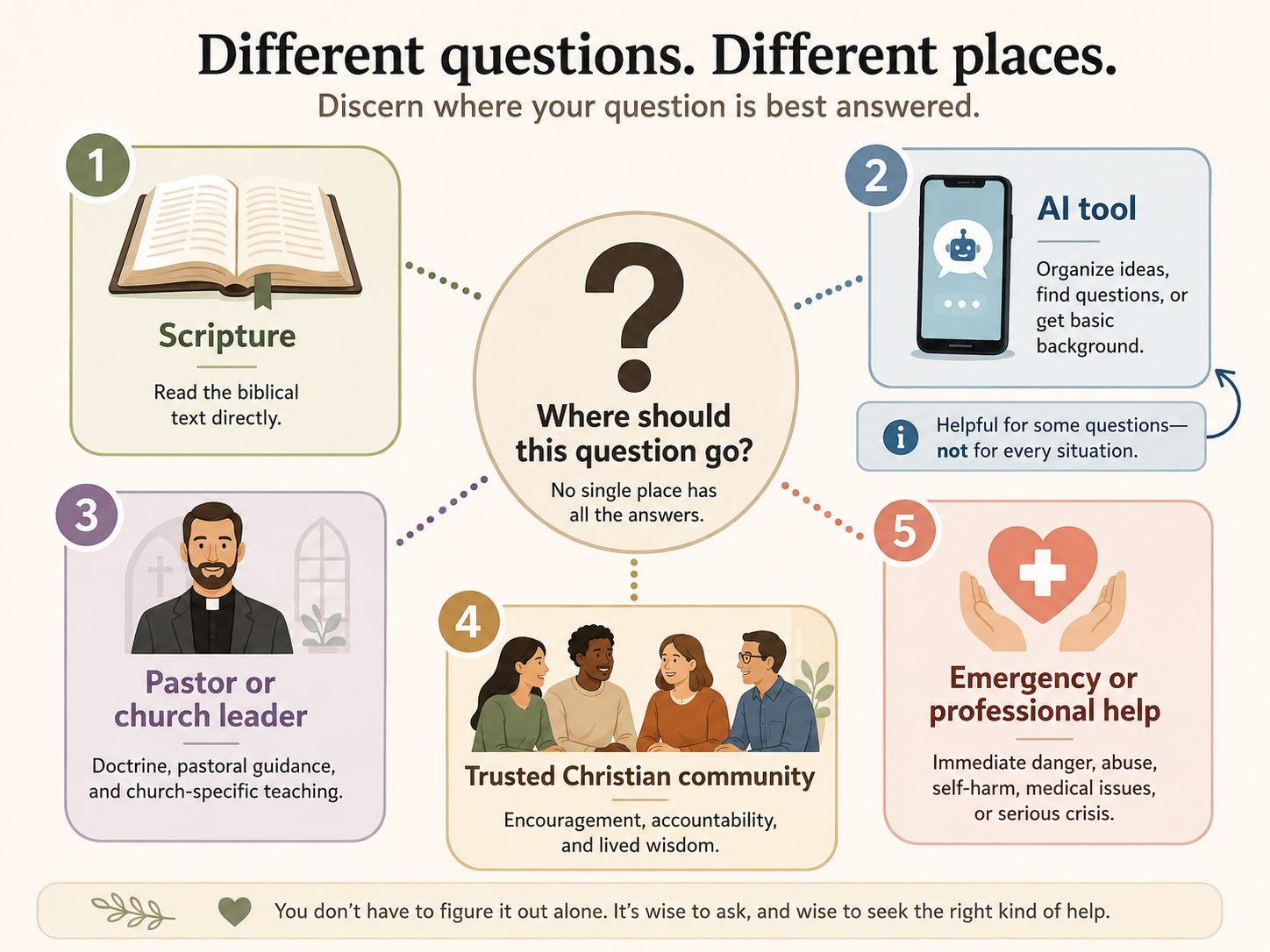
Use professional help for medical and mental health concerns
Faith and professional care are not enemies.
A person can pray and call a doctor. Someone can trust God and speak with a counselor. A church can provide spiritual support while trained professionals address medical, psychiatric, or psychological needs.
AI can provide general educational information. It should not diagnose a condition, determine whether medication is needed, replace therapy, or guide someone through a serious mental health crisis as though it were a licensed professional.
When symptoms are severe, persistent, frightening, or interfering with daily life, a qualified professional is the appropriate source of care.
Use immediate human help when safety is involved
Questions involving immediate danger should not remain inside a chatbot conversation.
This includes situations involving:
- Immediate physical danger
- Abuse or threats of abuse
- Self-harm or suicide
- A medical emergency
- A child or vulnerable adult who may be unsafe
- Violence, coercion, or serious threats
In those situations, the next step should involve a real person who can act: emergency services, local authorities, a doctor, a crisis professional, a trusted adult, a pastor, a family member, or another appropriate source of immediate support.
The purpose of a safe AI handoff is not to frighten the user. It is to stop the technology from pretending that conversation alone is enough.
Do not use AI to make major decisions for you
AI can help list options and questions. It should not make major personal, family, church, financial, medical, or legal decisions on your behalf.
A chatbot does not live with the consequences.
It does not know every person involved. It cannot accept responsibility if important facts were missing or if its reasoning was wrong.
Major decisions may benefit from Scripture, prayer, careful research, pastoral counsel, professional advice, and conversation with people who know the situation well.
The tool may support that process. It should not become the process.
Be cautious when you keep asking until you get the answer you want
AI conversations can make it easy to rephrase a question repeatedly.
Sometimes that is useful. Clarification can improve an answer.
But repeated questioning can also become a way of searching for permission, certainty, or reassurance.
A person may continue asking until the chatbot produces the preferred answer. They may request the same reassurance every day. They may feel temporarily calmer and then return as soon as the anxiety rises again.
At that point, the chatbot may be reinforcing the cycle instead of helping resolve it.
A real person can help identify what is happening beneath the repeated question.
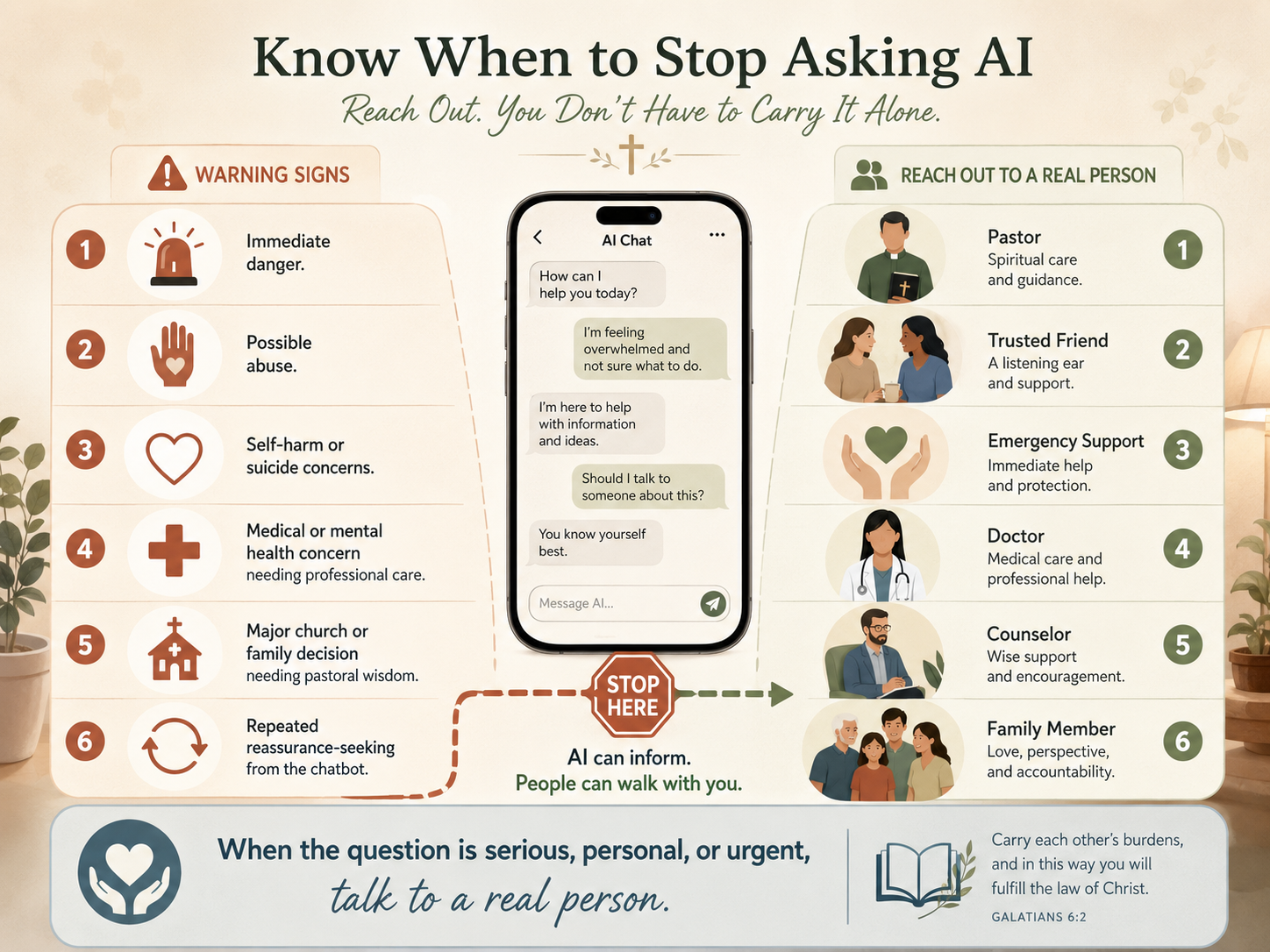
Warning signs that it is time to stop
It may be time to close the AI conversation and speak with someone when:
- The situation involves immediate danger.
- Someone may be experiencing abuse.
- The question involves self-harm or suicide.
- A medical or mental health concern needs professional care.
- A major church or family decision requires pastoral wisdom and personal knowledge.
- You are repeatedly asking the chatbot for the same reassurance.
A good tool should make human handoff easier
Christian AI safety should include more than a disclaimer hidden in the terms of service.
The product itself should be designed to recognize limits.
When a user describes danger, abuse, self-harm, or another serious crisis, the system should not continue behaving like an ordinary theological conversation.
It should respond clearly, compassionately, and without pretending to provide care it cannot deliver.
It should encourage the user to involve a real person and provide appropriate pathways toward help.
That is not a failure of the AI.
It is responsible design.
AI can still be useful without being appropriate for everything
Drawing boundaries around AI does not make the technology useless.
An AI assistant may still help someone:
- Organize study notes
- Generate questions for a Bible passage
- Compare broad denominational perspectives
- Understand historical background
- Prepare questions for a pastor or teacher
- Find words to begin a difficult conversation
These are meaningful uses.
The key is recognizing that a helpful starting point is not always the right ending point.
How Mat44 approaches these limits
Mat44 was built around the principle that AI should support Scripture engagement without presenting itself as clergy, a crisis counselor, or a replacement for Christian community.
Brenda can help users reflect, ask questions, and explore biblical context. But the system is also designed to recognize categories of questions that require human involvement.
Denominational questions should acknowledge real differences. Pastoral questions should point back toward pastors and church leaders. Serious safety, medical, and mental health situations should be handed toward real-world help.
A trustworthy Christian AI tool should know not only how to answer, but when it should stop answering.
Good boundaries do not push people away.
They help people reach the kind of support the situation actually requires.
Curious how this works in practice?
Try Mat44 and see how Brenda keeps the focus on Scripture, reflection, and careful boundaries.