Why Mat44 Is a Scripture Companion, Not a Chatbot
Mat44 uses conversational AI, but its purpose is not to become an endless source of religious answers. It is designed to help people engage with Scripture and then point beyond itself.

Mat44 includes an AI assistant named Brenda.
You can ask her questions. She can respond conversationally. From a technical perspective, it would be understandable to call her a chatbot.
But that word does not adequately describe the role Mat44 was built to play.
A general chatbot is designed to continue a conversation across almost any subject. It waits for the next question, produces another answer, and can keep the exchange going for as long as the user remains interested.
Mat44 has a narrower purpose.
It is a Scripture companion: a tool designed to help someone begin reading, reflect carefully, understand broad context, and recognize when the next step belongs outside the app.
That distinction affects what Brenda does, what she should not do, and how Mat44 defines success.
A general chatbot begins with the user's question
Most chatbots begin with an empty box and a broad invitation: ask anything.
This flexibility can be useful. People use general AI systems to brainstorm, summarize information, explain unfamiliar topics, draft writing, and explore questions from many different angles.
Faith questions can also be discussed that way.
Someone may ask an AI system to explain a doctrine, interpret a difficult passage, settle a denominational disagreement, or offer advice about a deeply personal situation.
The system will usually produce an answer because producing answers is what it was designed to do.
But an answer appearing on a screen does not mean the system possesses spiritual authority, knows the user's complete situation, or has interpreted Scripture correctly.
Language models generate responses based on patterns in information. They can sound certain when the subject is complicated, disputed, or beyond what the system can responsibly determine.
A Scripture companion therefore needs a different starting point.
Mat44 begins with Scripture
Mat44 is built around the conviction expressed in Matthew 4:4: people do not live by bread alone, but by every word that comes from God.
That means the biblical passage is not supporting material for the AI conversation. The passage is the center of the experience.
Brenda's role is secondary.
She can offer a reflection question, explain general historical context, help someone notice a theme, or encourage the user to look carefully at the words in front of them.
She should not behave as though her response is more important than the text.
She should also be willing to say that a question needs more than an AI-generated answer.
Sometimes the appropriate next step is to compare passages. Sometimes it is to consult a trusted study resource. Sometimes it is to pray. Sometimes it is to speak with a pastor, counselor, family member, or another real person who understands the circumstances.
A Scripture companion does not need to occupy every role.
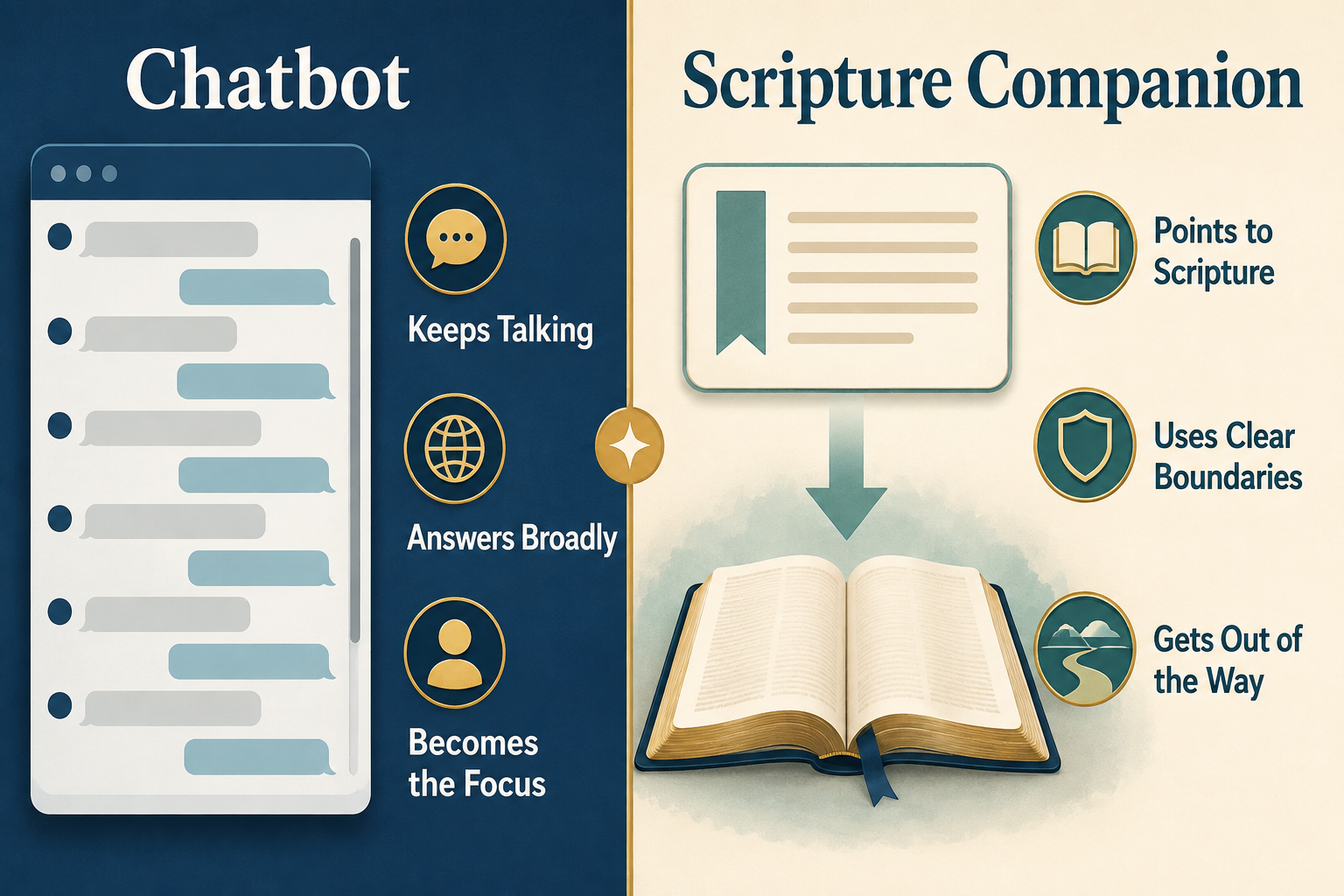
The difference is visible in the design
Calling Mat44 a Scripture companion is not simply a branding preference.
The distinction should appear in the way the product behaves.
A general chatbot may:
- Invite questions about nearly any subject.
- Answer broadly even when important context is missing.
- Encourage the conversation to continue.
- Become the primary voice in the interaction.
- Leave the user to decide how much authority the answer deserves.
A responsible Scripture companion should:
- Keep the biblical passage easy to see and return to.
- Distinguish Scripture from explanation and generated commentary.
- Acknowledge uncertainty and denominational differences.
- Use clear limits around pastoral, medical, legal, and crisis-related questions.
- Recommend real people and appropriate professional support when needed.
- Allow the interaction to reach a natural stopping point.
Some of these choices reduce the amount of time a person spends talking to the AI.
That is not necessarily a product failure.
If the tool helped someone return to Scripture or seek wise human support, it fulfilled its role.
Brenda is not a pastor
Pastoral care involves far more than producing religious language.
A pastor may know a person's history, family, church community, beliefs, patterns, responsibilities, and current circumstances. Pastoral guidance also carries human accountability and a relationship that continues beyond one exchange.
Brenda does not possess those things.
She can be available when a pastor is not. She can help someone organize a question before bringing it to a church leader. She can offer general background that makes a later conversation more productive.
Availability is useful, but availability is not pastoral authority.
Mat44 should support pastors and churches rather than compete with them.
That is why the app is designed to point people toward real community instead of presenting AI as a complete spiritual relationship.
Brenda is not the Holy Spirit
Christian language about guidance requires particular care.
An AI system can identify patterns in a passage and generate questions that may help someone reflect. It cannot declare what God is personally saying to a user. It cannot verify a calling, deliver revelation, or claim divine authority for its advice.
The difference can become blurry when generated language sounds warm, confident, and personal.
Responsible Christian AI should make the boundary clearer, not exploit that emotional effect.
Brenda may invite reflection, but she should not impersonate God. She may help a user think through Scripture, but she does not replace prayer, discernment, or the work of the Holy Spirit.
The humility of the tool matters as much as its fluency.
Brenda is not a substitute for Bible study
AI can make difficult material feel more approachable.
It can define a word, summarize historical background, or describe several common interpretations. Those functions may help someone get started.
But summaries necessarily leave things out. Generated explanations may contain errors. A smooth answer can hide disputed assumptions or combine ideas that different Christian traditions would treat separately.
This is why users should remain active readers.
Read the passage around the quoted verse. Compare translations when wording matters. Look at related passages. Consult reliable study resources. Ask where a claim came from and whether the biblical text supports it.
The AI response can participate in that process, but it should not become the final authority over it.
A companion knows when to step back
The word companion suggests presence and support without claiming control.
A good companion can walk beside someone for part of a journey without pretending to be the destination.
That is the role Mat44 is intended to serve.
The app may remind someone to read. Brenda may help the person slow down, notice a question, or consider how a passage connects with daily life.
Then the tool should be willing to step back.
The person may continue in prayer. They may write in a notebook, discuss the passage with a friend, bring a question to church, or simply carry one sentence into the rest of the day.
None of those actions need to happen inside Mat44 to count as success.
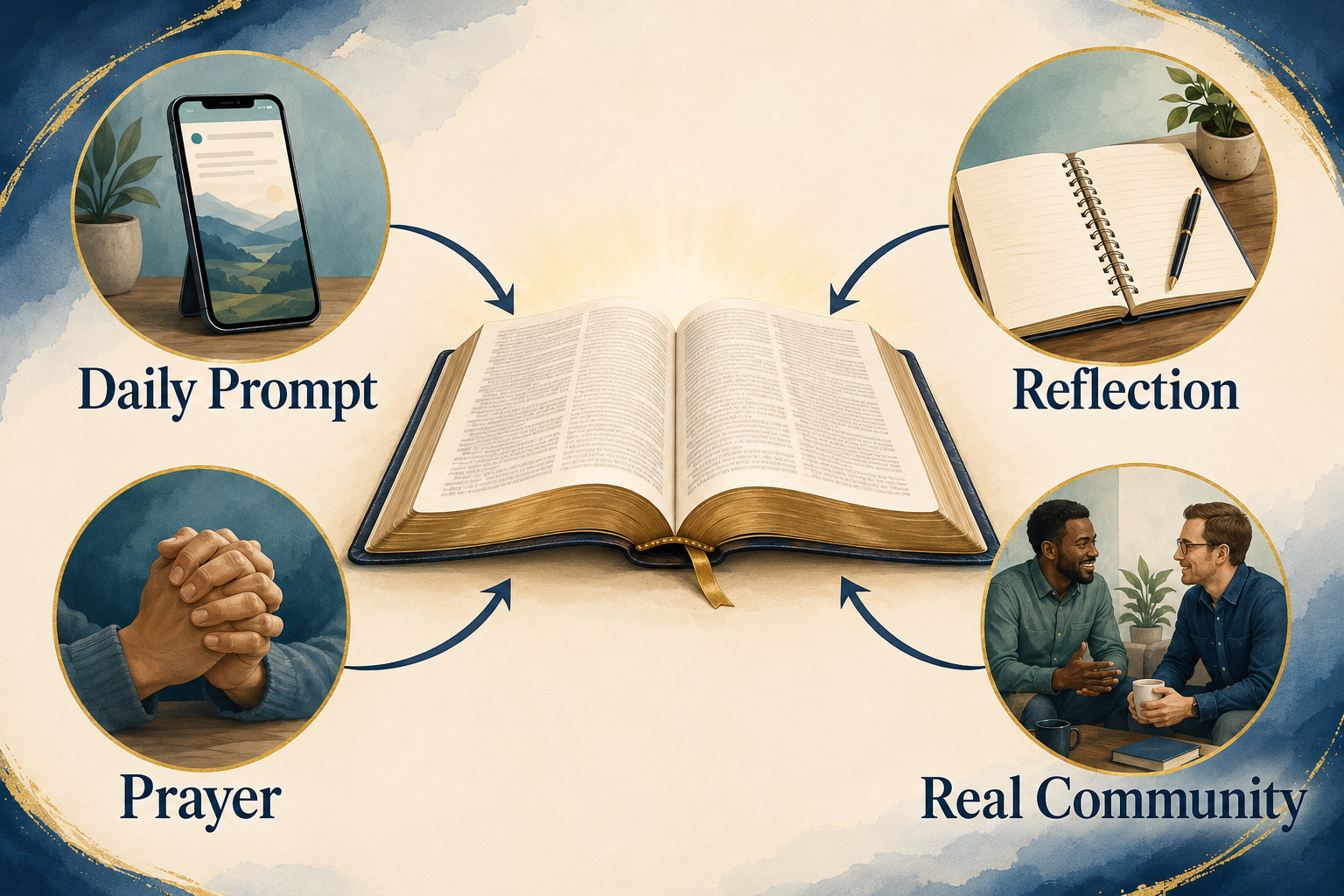
The role of each part should remain clear
Healthy Christian technology does not flatten every part of spiritual life into one digital experience.
Each element has a different role:
- Scripture provides the biblical text at the center of the practice.
- A daily prompt helps someone remember and begin.
- Reflection creates space to think honestly about what was read.
- Prayer belongs to the person's relationship with God.
- Real community provides relationship, wisdom, correction, care, and accountability.
Mat44 can support movement among these practices, but it should not absorb them all into the AI.
The distinctions protect the user and give the technology a healthier, more honest place.
Questions to ask about any Christian AI tool
The label on an app matters less than its actual behavior.
Before trusting a Christian AI tool, consider asking:
- Does it make Scripture central, or does generated commentary dominate?
- Can I clearly tell which words come from the Bible and which come from AI?
- Does it acknowledge uncertainty and theological differences?
- Does it claim spiritual authority it cannot possess?
- Does it recommend pastors, churches, trusted people, or professionals when appropriate?
- Does it encourage healthy stopping points?
- Can I use it without feeling pressured to keep the conversation going?
These questions do not guarantee that every answer will be correct.
They do reveal whether the product was designed with an honest understanding of what AI can and cannot provide.
Why the name matters
Describing Mat44 as a Scripture companion sets an expectation.
It says that the app is here to support a practice larger than itself. It says Brenda has boundaries. It says the technology should remain useful without becoming the center of a person's spiritual life.
Mat44 is conversational, but conversation is not its ultimate purpose.
The goal is not to create an AI that people consult instead of Scripture. The goal is to build a responsible tool that helps people return to Scripture.
That is why Mat44 is a Scripture companion, not merely another chatbot.
See what a Scripture companion looks like in practice
Try Mat44 and see how Brenda keeps the focus on Scripture, reflection, and careful boundaries.