Christian AI App vs. General Chatbot: What’s the Difference?
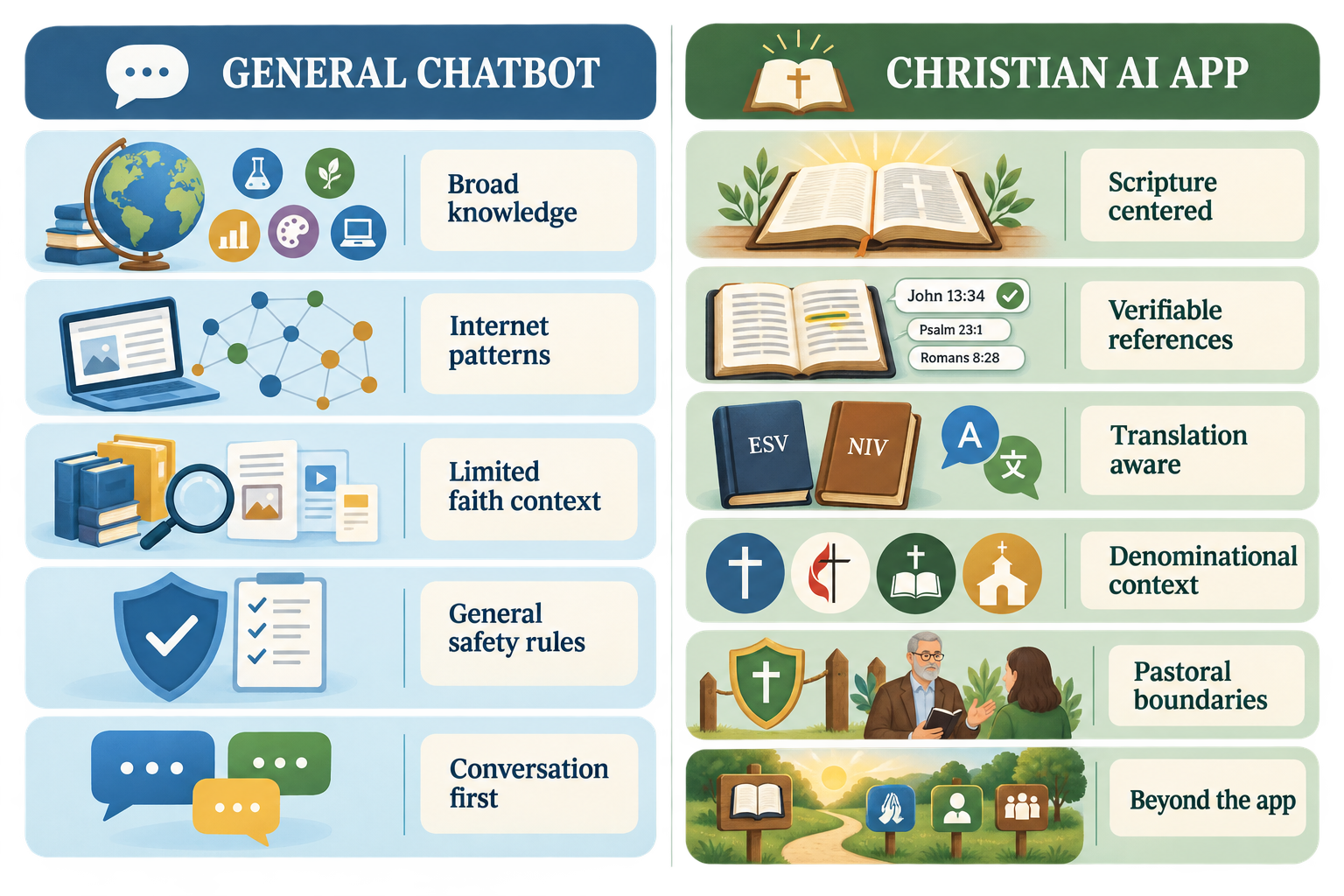
A Christian AI app and a general chatbot may use related technology, but the important differences are found in their purpose, sources, context, safeguards, and the destination toward which they guide the user.

General chatbots can be remarkably useful.
They can explain unfamiliar concepts, help organize a project, suggest a recipe, plan a trip, draft an email, troubleshoot code, or provide a starting point for research.
They can also answer questions about the Bible and Christianity.
That raises a reasonable question: if a general chatbot can discuss Scripture, why would anyone need a Christian AI app?
The answer is not that every general chatbot is bad or that placing a Bible icon on an interface automatically makes another tool trustworthy.
The difference should be found deeper in the product.
A responsibly designed Christian AI app has a narrower purpose and a different level of responsibility. Its sources, theological context, translation handling, safety boundaries, and stopping points should reflect the fact that users may approach its answers as spiritual guidance rather than ordinary information.
A general chatbot is designed for breadth
A general chatbot is built to respond across a broad range of subjects. The same interface may discuss business strategy, history, health, entertainment, software development, relationships, and religion.
Breadth is one of its strengths.
But broad usefulness also means the product is not necessarily organized around the specific responsibilities of faith-related conversation. Its training may include Scripture, theology, sermons, academic sources, social media, popular Christian writing, criticism of Christianity, and countless other kinds of content.
The chatbot may produce a useful answer, but the user may not know which sources or assumptions shaped it.
A Christian AI app should have a defined purpose
A Christian AI app should not simply be a general chatbot with religious colors, a cross, and instructions to sound biblical.
Its purpose should influence the entire design.
Is the app intended to help people read Scripture, find relevant passages, reflect on a daily reading, compare interpretations, or build a consistent habit? What questions are outside its role? When should it stop answering and recommend a person?
A narrower purpose can be valuable because it allows the product to be designed around the risks and responsibilities of that particular use.
The sources should be easier to see
When a general chatbot answers a Bible question, it may provide verse references, but the generated explanation is still a synthesis produced by the model.
A responsible Christian AI app should make verification easier. Scripture references should open to the passage. Biblical text should remain visibly different from generated commentary. The user should be encouraged to read verses in context rather than treat citations as proof that the entire answer is correct.
The goal is not to claim that the app can never be wrong.
The goal is to help the user recognize what can be checked.
Bible translation awareness matters
A broad chatbot may quote whichever Bible wording appears most likely in the conversation. It may combine familiar phrases from different translations or discuss a wording choice without clearly identifying the version.
A Christian AI app should handle translation more deliberately.
Users should know which translation they are reading. The app should avoid implying that an English wording is identical across every version. When a difference affects interpretation, the tool should acknowledge it without overwhelming the user.
Denominational context should not be invisible
Christians agree on many central beliefs and disagree on others. Questions about baptism, communion, church leadership, spiritual gifts, salvation, predestination, sacraments, and biblical interpretation may receive different answers across Christian traditions.
A general chatbot may offer the position most common in its training data or combine several traditions into one smooth response.
A Christian AI app should be able to identify when denominational context matters. It should describe differences fairly, avoid claiming false neutrality, and resist presenting one tradition's assumptions as though all Christians agree.
This does not require the app to avoid conclusions. It requires honesty about interpretation.
Faith questions need specific boundaries
General chatbots use broad safety systems intended for many kinds of conversation. Those protections are important, but Christian applications also face faith-specific risks.
An AI should not claim to speak for God, declare a personal revelation, or present itself as a spiritual authority. It should not replace a pastor, counselor, doctor, or emergency service. It should recognize when a question involves crisis, abuse, mental health, medical care, or a major life decision that requires informed human support.
Those boundaries should be designed into the experience rather than added as a vague disclaimer beneath the conversation.
The destination should be different
General chatbots are built around conversation. The natural next step after an answer is often another prompt.
A Christian AI app should be willing to lead somewhere beyond the chat.
The next step may be opening the biblical passage, pausing to pray, writing down a question, speaking with a pastor, contacting a trusted friend, or participating in church community.
If the app measures success only by time spent, messages sent, or daily engagement, it may begin serving the same incentives as any other digital product.
A Scripture-centered tool should be able to succeed by helping the user leave the tool.

Specialized does not automatically mean trustworthy
None of this means that every product labeled Christian has been designed responsibly.
A Christian AI app can still overclaim, hide its sources, flatten denominational differences, mishandle private information, or encourage dependence. Religious branding is not evidence of careful engineering or theological wisdom.
Users should evaluate the actual product. Can references be verified? Is generated commentary clearly identified? Does the app admit uncertainty? Are privacy and boundaries visible? Does it point toward real people when the question exceeds its role?
Choose the tool according to the responsibility
A general chatbot can be useful for brainstorming, summarizing, drafting, and exploring many kinds of questions. A Christian AI app should be designed for a narrower task with more deliberate handling of Scripture and spiritual trust.
The most important difference is not the presence of Christian vocabulary. It is whether the product's purpose, sources, context, boundaries, and destination match the responsibility it has accepted.
Similar technology can serve different purposes. The design should make that difference visible.
Meet a Christian AI Scripture companion
Mat44 is designed around daily Scripture reading, denominational context, clear boundaries, and a simple goal: help people spend more time with the Bible, not more time with a chatbot.