What I Learned Building Christian AI for 15 Months
Building Mat44 taught me that responsible Christian AI requires more than accurate-sounding answers. It requires clear boundaries, careful design, theological humility, and a willingness to point people beyond the tool.

When I began building Mat44, I knew what I wanted the app to help people do: spend more time reading Scripture.
The basic idea sounded simple. Offer a daily passage, make it easier to establish a consistent habit, and use conversational AI to help people reflect on what they read.
The difficult part was not making an AI system produce Christian language.
The difficult part was deciding what a responsible Christian AI should do with the trust people might place in that language.
Over 15 months of building, testing, revising, and reconsidering Mat44, the questions became more complicated.
What should happen when the AI sounds confident but may be wrong? How should it respond when Christians interpret a passage differently? When should it recommend a pastor, counselor, doctor, or trusted person? How do you build a useful tool without encouraging people to depend on it?
Those questions shaped Mat44 far more than any individual feature.
Here are five of the most important lessons I learned.
1. Boundaries matter as much as capabilities
Product development usually begins with capabilities.
What can the technology do? What features can be added? How many kinds of questions can it answer? How natural can the conversation feel?
Christian AI also needs to begin with another question:
What should the technology refuse to become?
A system may be technically capable of producing pastoral-sounding advice, declaring what God wants someone to do, or answering a deeply personal question with apparent certainty.
That does not make those responses responsible.
Brenda, the AI assistant inside Mat44, is not a pastor, counselor, doctor, or spiritual authority. She does not know a user's complete history. She cannot observe relationships over time, accept responsibility for advice, or provide the accountability of a real human community.
Clear boundaries are not missing features. They are part of the product.
They help define Brenda's proper role: support Scripture reading, offer reflection, provide broad context, acknowledge uncertainty, and point toward appropriate human support.
I learned that a trustworthy Christian tool should not try to answer every question simply because it can generate a response.
2. Confidence is not accuracy
AI can make uncertainty sound remarkably polished.
A generated answer may be organized, detailed, warm, and persuasive. It may use familiar theological language and quote a relevant passage. None of those qualities guarantees that the answer is correct.
Language models are designed to produce likely sequences of words. They do not possess perfect knowledge, spiritual discernment, or an internal commitment to truth.
That distinction becomes especially important when an answer concerns Scripture.
A small factual error can distort the context of a passage. A summary can leave out an important qualification. A response may present one denominational interpretation as though all Christians agree.
The smoothness of the answer can make these problems difficult to notice.
Building Mat44 taught me to treat confidence as a design concern.
Responsible Christian AI should use careful language when certainty is not justified. It should acknowledge that traditions disagree. It should distinguish biblical text from generated explanation and encourage users to verify important claims.
The goal is not to make every answer sound less helpful.
The goal is to make the confidence of the answer more honest.
3. Real people still matter
AI offers something real people cannot always provide: immediate availability.
A user can open an app early in the morning, late at night, during a commute, or in the middle of a busy day. There is no appointment to schedule and no concern about whether a simple question is worth someone else's time.
That availability can make Scripture study easier to begin.
But availability is not relationship.
Real people can recognize changes in behavior, remember previous conversations, ask difficult follow-up questions, and remain accountable for how they respond. They can offer practical care and understand circumstances that never appear in a prompt.
Pastors, family members, trusted friends, teachers, counselors, and professionals each bring forms of knowledge and responsibility that an AI system does not possess.
I learned that Christian AI should strengthen the user's connection to real people rather than quietly weaken it.
Sometimes Brenda can help a person organize a question before discussing it with a pastor. Sometimes she can identify that a question is beyond the app's role. Sometimes the most responsible response is a clear recommendation to seek human support.
A tool should not present that recommendation as a failure.
Pointing people toward appropriate relationships is one of the ways the tool succeeds.
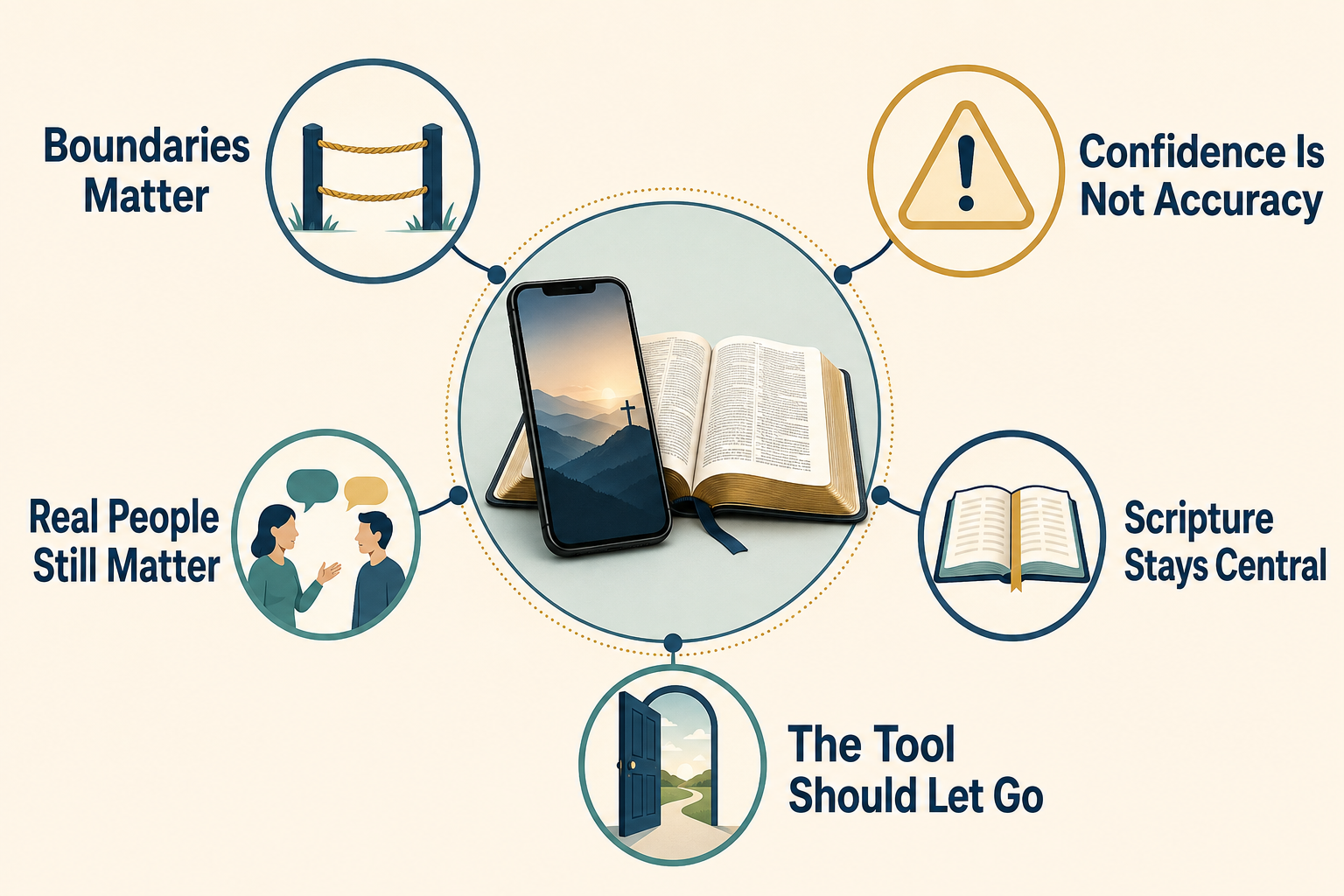
4. Scripture must remain central
This lesson sounds obvious for a Scripture app, but it has practical consequences.
Conversational AI naturally attracts attention. It responds directly to the user, adapts its language, and produces a new answer every time it receives a question.
Scripture does not rearrange itself around the reader in the same way.
If the product is not designed carefully, generated commentary can become the most prominent part of the experience. The user may begin with a biblical passage but spend most of the session reading what the AI says about it.
That reverses the proper relationship.
Brenda should help someone look more carefully at Scripture, not train the person to rely on Brenda's summary instead.
This means keeping the biblical text easy to find, clearly distinguishing Scripture from commentary, and designing reflection prompts that send attention back to the passage.
It also means accepting that the AI does not need to offer the longest or most comprehensive response.
A short question that helps someone notice an important word may be more useful than several paragraphs of explanation.
A suggestion to reread the surrounding verses may be better than an immediate interpretation.
Christian AI should not make Scripture feel like a starting prompt for a more interesting conversation with the machine.
The generated conversation should remain secondary to the text.
5. The tool should know when to let go
Many digital products are rewarded for keeping people engaged.
More sessions, longer conversations, constant notifications, and unbroken streaks can all look like evidence of success.
A Scripture companion needs a healthier definition.
If someone opens Mat44, reads a passage, reflects for a few minutes, and then closes the app to continue with the day, that can be an excellent result.
The tool does not need to manufacture another reason to stay.
This became one of the clearest lessons of the development process: good Christian technology should be willing to become less important.
It should support prayer without trying to replace prayer. It should support churches without competing with pastors. It should help people think without asking them to surrender their judgment.
It should also allow a conversation to end peacefully.
Sometimes the next faithful action happens away from the screen: writing in a journal, apologizing to someone, serving a neighbor, talking with a friend, attending church, resting, or quietly carrying a passage into the day.
Mat44 does not need to witness or measure every outcome to have helped.
Responsible design is an ongoing process
These lessons did not appear all at once.
They emerged through repeated decisions: testing an answer, revising a prompt, strengthening a boundary, reconsidering an interface, and asking what role the technology was encouraging the user to give it.
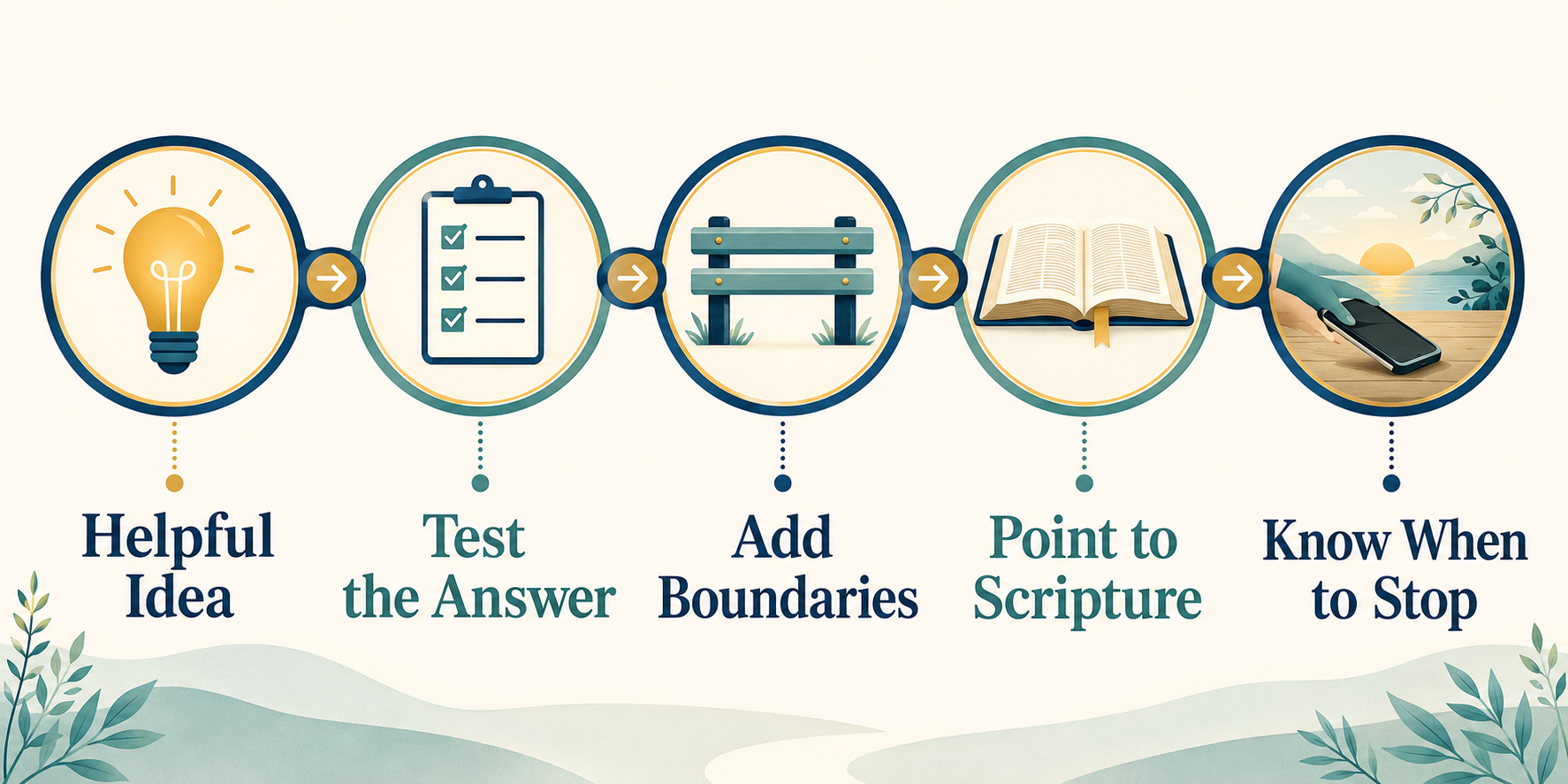
The process often follows a simple path:
- Begin with an idea that might genuinely help.
- Test the answer rather than assuming fluent language is reliable.
- Add boundaries where the system might overreach.
- Point attention back to Scripture.
- Recognize when the tool should stop.
None of these stages is permanently finished.
AI systems change. New use cases reveal new risks. Real users ask questions a developer did not anticipate. A responsible design therefore requires continued testing, listening, and revision.
Safety cannot be added at the end
It is tempting to think of safety as a final layer added after the main product works.
Build the exciting features first, then add a warning, a disclaimer, or a few prohibited topics before launch.
Fifteen months of development taught me that this approach is too shallow.
Boundaries affect the purpose of the product, the structure of prompts, the wording of responses, the interface, the stopping points, and the way success is measured.
They influence which features should exist at all.
A disclaimer cannot repair a product that continually encourages users to treat AI as a spiritual authority. A warning cannot undo an interface that makes generated answers look indistinguishable from Scripture.
Responsible design has to begin before the first answer is generated.
Denominational honesty builds trust
Christian AI also has to acknowledge that Christians do not interpret every passage in the same way.
Some differences are minor. Others reflect centuries of theological disagreement among sincere believers and established traditions.
An AI system can easily flatten those differences into one confident answer.
That may make the response sound clean and decisive, but it does not make it honest.
Mat44 is intended for Christians from different denominational backgrounds. Brenda should not quietly impose one tradition while presenting it as the universal Christian position.
When an issue is disputed, the response should say so. When useful, it can describe several broad perspectives and encourage the user to consult the teachings and leaders of their own church.
Humility does not make a Christian tool weak.
It helps the user understand what kind of answer they are actually receiving.
Building for trust changes the questions
Early product questions often focus on convenience:
- Can users get an answer quickly?
- Does the conversation feel natural?
- Can the system handle many kinds of questions?
- Will people return to the app?
Building for trust adds another set of questions:
- Does the answer deserve the confidence it expresses?
- Can users distinguish Scripture from generated commentary?
- Are theological disagreements represented honestly?
- Does the tool recognize when human support is needed?
- Does the design encourage healthy use rather than dependence?
- Can the tool point beyond itself and allow the interaction to end?
Those questions do not eliminate the need for a useful, approachable product.
They clarify what usefulness should mean.
What I believe now
After 15 months, I remain convinced that AI can support Scripture habits.
It can help someone begin when they are unsure where to start. It can offer a thoughtful question, explain broad context, and make a daily reading practice feel more approachable.
But the value of Christian AI will not be determined only by how intelligent or conversational it becomes.
It will also be determined by whether its builders understand the limits of the technology and respect the parts of spiritual life that should never be handed over to a machine.
Responsible Christian AI should be helpful without pretending to be authoritative, available without replacing relationship, and conversational without drawing attention away from Scripture.
That is the standard I continue working toward with Mat44.
The work is not finished, and responsible design is not a box that can be checked once.
But the central lesson is clear: the best Christian AI will not be the tool that claims the largest role.
It will be the tool that understands its role and serves it well.
See these lessons reflected in Mat44
Try Mat44 and see how Brenda supports Scripture reading with careful boundaries, theological humility, and healthy stopping points.