Why Context Matters More Than a Single Bible Verse
A verse can be memorable and meaningful, but the surrounding passage, genre, audience, and larger biblical story help us understand what it is actually saying.

A single Bible verse can be powerful.
It can be memorable enough to carry through a difficult week, simple enough to teach a child, or familiar enough to come back to us years after we first learned it.
But a verse is not a self-contained unit of meaning just because modern Bibles place a number beside it.
Most of the biblical authors did not write in isolated sentences designed to be lifted from their surroundings. They wrote letters, stories, poems, laws, wisdom, prophecy, testimony, and teaching that develop meaning across paragraphs, chapters, and entire books.
That is why context matters more than the convenience of a single quotation.
Verse numbers are useful, but they are not the argument
Chapter and verse numbers help us find a passage quickly. They are enormously useful for study, teaching, and conversation.
They can also create an accidental illusion: that every numbered sentence can be understood independently.
Sometimes it can. Often it cannot.
If Paul is answering a problem in a church, the sentence before a familiar verse may tell us what problem he is addressing. If a prophet is speaking judgment and hope to a particular people, the historical setting matters. If a psalm is poetry, images work differently than they do in a historical narrative.
The number helps us locate the text. The surrounding text helps us understand it.
Start with what comes before and after
The simplest context check is also one of the most effective: read more.
Read the paragraph before the verse. Read the paragraph after it. If the thought continues across a chapter boundary, keep going.
This often changes the question from "What does this sentence mean to me?" to "What is the author doing here?"
That shift matters because application should grow out of meaning, not replace it.
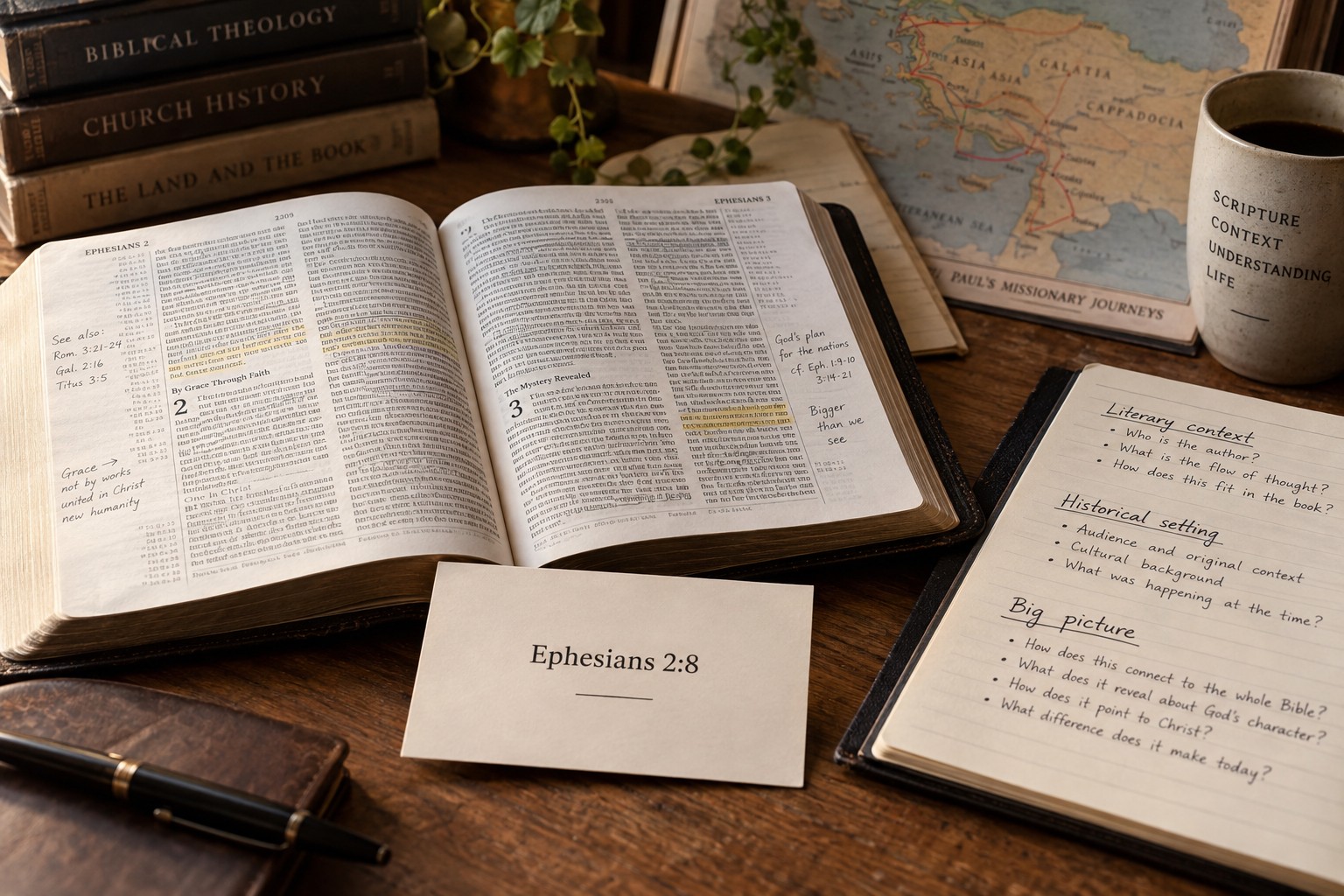
Literary context tells us what kind of thing we are reading
Genre is part of context.
Poetry uses image, compression, parallelism, and emotion. Proverbs often describe patterns of wisdom rather than unconditional promises. Narratives tell us what happened, but not every action in a narrative is an instruction to imitate. Letters respond to real communities with particular questions and tensions.
An interpretation that ignores genre can be technically attentive to words while still misunderstanding what those words are doing.
AI can help identify genre or point out a literary structure, but the reader still needs to ask whether the proposed explanation actually fits the passage.
Historical context can explain why a sentence matters
Who wrote the text? To whom? What was happening around them? What problem, event, practice, or expectation might the author be addressing?
Those questions are not an attempt to make Scripture less relevant. They are an attempt to hear it more carefully.
A first-century letter was written to first-century people before it was placed in a modern Bible app. Understanding their world can help us avoid turning our assumptions into the author's assumptions.
Historical background also needs humility. Some details are well established. Others are debated or reconstructed from limited evidence. A responsible study tool should distinguish between the two.
Context does not mean only history
Sometimes "read it in context" is reduced to a history lesson.
History matters, but biblical context is larger than that.
There is the immediate sentence and paragraph. There is the argument or story of the book. There are repeated themes within Scripture. There is the way later biblical writers quote or develop earlier passages. There are also theological questions Christians have wrestled with across traditions.
Context is not one fact that unlocks the verse. It is a set of relationships that keeps us from treating the verse as though it appeared alone.
Why isolated verses are especially tempting online
Digital media rewards small pieces of content.
A single sentence fits on an image. It fits in a caption. It can be shared without explanation and recognized instantly.
There is nothing wrong with sharing a verse. The problem begins when the format trains us to assume that the quotation is the whole message.
AI can intensify the same tendency. Ask for "a Bible verse about success," "a verse about anxiety," or "a verse that proves this point," and a system can quickly return a neat list of references.
But retrieval is not interpretation.
AI should resist proof-texting on demand
A Christian AI tool should be careful when a user asks for a verse to support a conclusion they have already chosen.
The helpful response may be to offer passages worth reading while also encouraging the user to examine their context.
That is especially important when the topic involves doctrine, moral decisions, relationships, politics, money, suffering, or pastoral care. A verse can be true and still be misused if it is made to answer a question the passage is not addressing.
This is one reason fact-checking AI about the Bible includes more than confirming that a quotation exists. We also need to ask whether the passage supports the claim attached to it.
Context can complicate a favorite interpretation
Sometimes careful reading confirms what we already believed. Sometimes it does not.
A verse may be broader than the way we learned it. It may be narrower. It may be addressing a community rather than an individual. It may carry a promise, warning, or hope that depends on the larger argument.
That can feel uncomfortable because familiar interpretations often become emotionally important to us.
But careful reading is not disrespectful to Scripture. It is a form of respect.
We are saying that the author's actual words, in their actual setting, matter more than the version we happen to remember.
Context does not eliminate application
Christians do not read Scripture only to reconstruct the ancient world.
We ask what it means for faith, character, worship, relationships, justice, hope, obedience, and life with God now.
Context does not block those questions. It gives them a stronger foundation.
The better we understand what a passage is doing, the better prepared we are to ask how its truth should shape us today.
A simple context checklist
- Before and after: What thought surrounds this verse?
- Book: How does this fit the argument or story of the whole book?
- Genre: What kind of writing is this?
- Audience: Who first received it?
- Setting: What historical or cultural details matter?
- Connections: How does the passage relate to other Scripture?
- Interpretation: Where do careful Christians agree or disagree?
- Application: What follows from the text rather than being imposed on it?
The verse is part of a larger word
Short quotations are useful. Memory verses are useful. Search tools are useful. AI can be useful too.
But usefulness should not train us to read Scripture as fragments.
The Bible gives us sentences inside paragraphs, paragraphs inside books, and books inside a much larger story.
A verse can speak powerfully on its own, but we understand it more faithfully when we remember that it was never meant to be alone.
Curious how this works in practice?
Try Mat44 and see how Brenda keeps the focus on Scripture, reflection, and careful boundaries.