Why Christian AI Should Show Its Limits Clearly
A trustworthy Christian AI tool should not merely have boundaries behind the scenes. It should help users see when those boundaries matter.
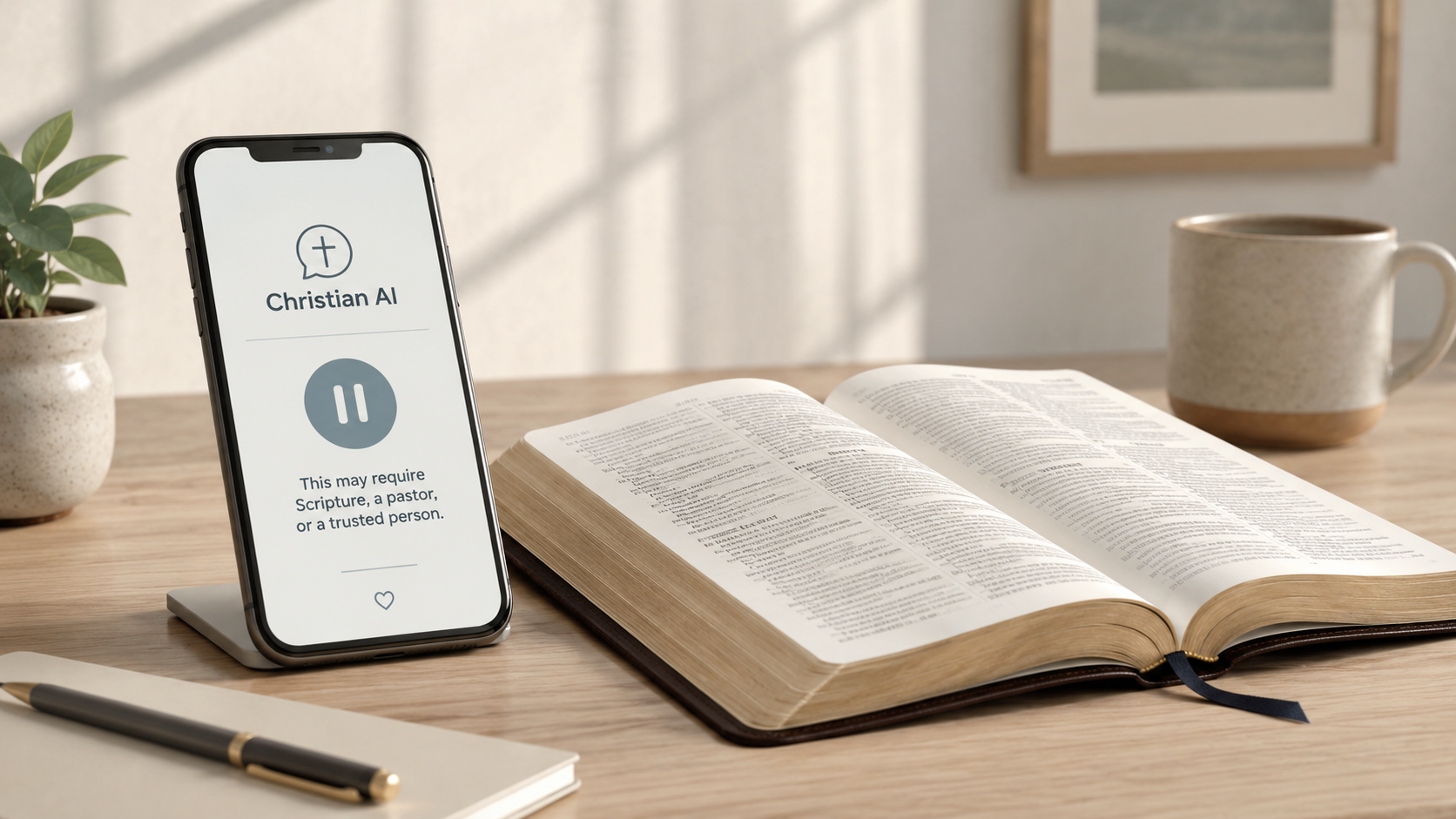
Artificial intelligence is often designed to keep the conversation moving.
Ask a question, receive an answer, ask another question, receive another answer.
From a product-design perspective, that can feel smooth and helpful.
But in a Christian context, uninterrupted confidence can become a problem.
There are questions an AI can help explore. There are questions it should answer cautiously. And there are situations where the healthiest response is to say, clearly, that the tool is not the right authority for what the user is asking.
A Christian AI system should not hide that distinction.
Limits are not a product failure
Technology companies often treat limitations as something to minimize.
A good product is expected to feel capable. It should answer quickly, remove friction, and avoid leaving the user at a dead end.
That expectation makes sense in many settings.
But Christian AI operates in areas where confidence can carry more weight than the system deserves.
A user may ask about doctrine, prayer, guilt, family conflict, church leadership, mental distress, or a major life decision. The language may sound ordinary, but the question may actually require pastoral care, trusted community, professional help, or careful study of Scripture.
In those cases, the system saying "I should not take the lead here" is not weakness.
It is responsible design.
Hidden guardrails are not enough
Many AI products have internal safety rules that users never see.
Those rules may shape which responses the system gives, which topics trigger caution, and what kinds of advice the model avoids.
Internal guardrails matter.
But for Christian AI, they should not be the whole story.
Users should be able to recognize when a tool is deliberately stepping back.
A clear response might say that a question depends on a particular church tradition. It might suggest reading the relevant Scripture directly. It might encourage someone to speak with a pastor, priest, trusted Christian leader, family member, counselor, or other real person.
The important part is that the boundary is visible.
Otherwise, users may assume the system is simply another source of complete answers.
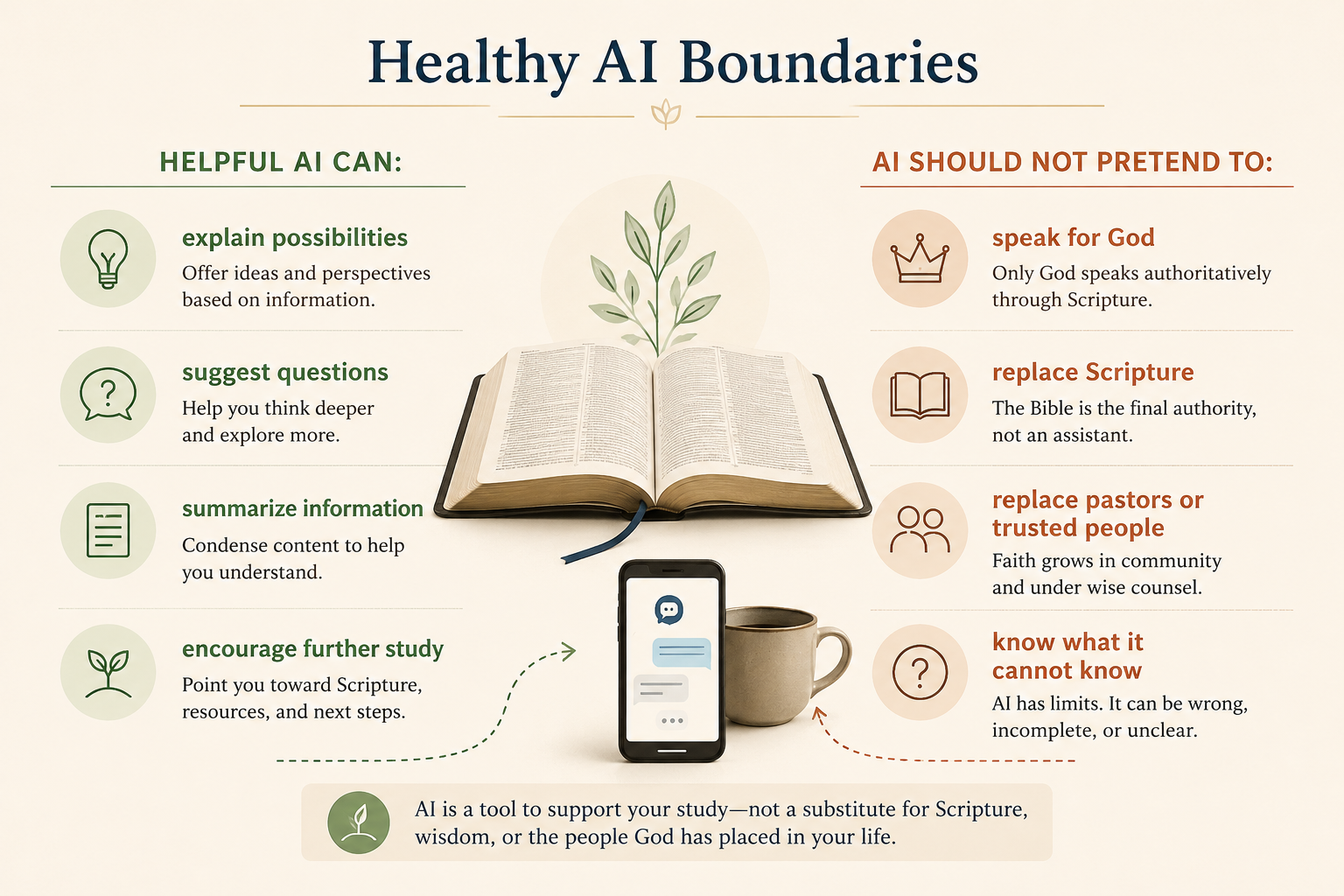
Christian AI should not borrow spiritual authority
This is especially important because AI language can sound unusually certain.
A polished response can feel researched, thoughtful, and authoritative even when the underlying model is making a mistake.
That concern is explored more fully in How AI Can Sound Right and Still Be Wrong .
In Christian settings, there is an additional risk.
If an AI tool speaks in spiritual language, quotes Scripture, or responds to emotional questions, users may begin to assign it a kind of authority it was never meant to have.
That is why boundaries need to be more than technical safety measures.
They are also part of how the tool communicates what it is.
A Christian AI tool should be able to say, in effect, "I can help you think through this, but I am not your pastor. I am not Scripture. I am not God. And I should not pretend otherwise."
Not every question has one Christian answer
Another important limit appears when Christians disagree.
Many theological questions have been debated faithfully for centuries.
Baptism, communion, spiritual gifts, church government, predestination, sanctification, the end times, and many other topics are understood differently across Christian traditions.
An AI system can summarize those differences.
It should be much more cautious about pretending that one interpretation is simply "the Christian answer."
That is one reason Mat44 was designed around denominational awareness rather than a single generic Christian voice.
The broader issue is discussed in Can Christian AI Respect Different Denominations? .
A visible limitation can be as simple as acknowledging that faithful Christians disagree and encouraging the user to examine Scripture and the teaching of their own church tradition.
Good boundaries should point somewhere useful
A boundary should not merely stop the conversation.
It should help the user know what to do next.
Depending on the question, that may mean:
- Read the relevant Scripture passage directly.
- Compare several Christian interpretations.
- Talk with a pastor or trusted church leader.
- Ask a family member or trusted friend for support.
- Use a qualified professional when the issue involves health, safety, abuse, law, or another specialized concern.
- Accept that the question may not have a simple answer.
In other words, a healthy limitation should create a handoff.
It should move the user toward a better source of help rather than simply saying no.
Clear limits can actually increase trust
There is a temptation to assume that admitting limitations makes a technology product seem less capable.
The opposite can also be true.
When a system is willing to say what it does not know, users gain information about when its answers deserve confidence and when they deserve caution.
That is why Why Christian AI Should Admit When It Does Not Know is not simply an argument for modest language.
It is an argument for better trust calibration.
A tool that sounds certain about everything teaches users the wrong lesson.
A tool that distinguishes between strong information, uncertain interpretation, and areas outside its role teaches users to think more carefully about what they are receiving.
Some questions should move away from the screen
The healthiest AI interaction may sometimes end with the user closing the app.
That might sound strange in an industry built around engagement.
But Christian technology should not measure success only by how long someone remains inside the product.
If a person needs Scripture, prayer, worship, pastoral care, family conversation, professional support, or simple time away from a screen, the technology should be comfortable pointing them there.
This is part of the same principle behind The Goal Is More Scripture, Not More Screen Time .
The tool is not the destination.
What visible boundaries can look like
Christian AI does not need to become covered in warning labels.
Clear limits can be calm, natural, and useful.
- "Christians interpret this passage differently. Here are several common views."
- "I can help you explore this, but this sounds like something worth discussing with a pastor or trusted person."
- "I am not confident enough in this information to present it as settled."
- "Let's return to the Scripture passage and look at the surrounding context."
- "This question involves an area where a qualified professional would be a better source of guidance."
None of these responses makes the AI useless.
They make its role clearer.
Christian AI should not earn trust by pretending to have no limits. It should earn trust by making those limits understandable.
Curious how this works in practice?
Try Mat44 and see how Brenda keeps the focus on Scripture, reflection, and careful boundaries.